
As an Amazon Associate, I earn from qualifying purchases. This means I may earn a commission if you purchase through links on this page — at no extra cost to you.
Grey flooring has become the default choice for modern living rooms, and for good reason: it is forgiving, it pairs with almost any furniture, and it hides dust better than dark wood or pale tile. But grey floors also have traps that only show up after installation — a cold room, a blue cast nobody planned, furniture that clashes with the floor’s undertone, or a grey-on-grey room that feels like a waiting area. Most of those traps are decided before the first plank goes down, by undertone and material rather than by shade name.
Find your grey’s undertone first
No grey is neutral. Every grey leans blue, warm (toward beige, often called greige), or as close to true grey as a product gets. The undertone decides everything that follows: wall colors, wood tones, fabric choices. A blue-grey floor with warm beige furniture will always feel slightly off, and a warm grey floor with cool chrome and icy whites can look muddy.
Test it properly. Hold a sheet of plain white paper against the sample — the paper exposes the cast. Compare the sample against your actual sofa fabric and wood pieces, not against other samples. And look at a large sample, not a chip: undertones that are invisible on a small chip become obvious across a whole floor. Check it in daylight and again under your evening lamps, since artificial light shifts grey noticeably.
Material matters more than shade
The same grey in different materials lives very differently. Luxury vinyl plank handles water and daily wear well, feels softer underfoot than tile, and suits homes with pets — but cheaper planks can look flat and hollow underfoot. Laminate is budget-friendly and scratch-resistant, yet it feels harder and sounds hollower than vinyl or wood. Tile suits wet-adjacent areas and lasts, but it is cold underfoot and grout needs care. Carpet over a grey base adds warmth and sound softening, but it stains and wears in traffic paths. Engineered wood with a grey finish gives real wood character, with limits on how many times it can be refinished.
Choose by the room’s life, not by the sample’s looks. A living room that opens to a garden or hosts pets and children needs water and scratch tolerance more than it needs a perfect shade. A quiet, adult living room can prioritize feel and appearance. And check the finish: a matte or low-sheen finish hides dust and scratches far better than a glossy one, which shows every mark.
🛒 Shop This Look:
Light and room size
Dark grey floors ground a room and make furniture pop, but they also shrink it visually — a risk in small or dim living rooms. Light grey floors expand a room and bounce light around, but they show dirt more readily and can feel washed out without enough contrast elsewhere. Mid-greys split the difference and suit most rooms, which is why they dominate sales.
Light direction matters as much as shade. North-facing rooms cool grey further, so a blue-grey floor in a north room can feel icy; a warm grey compensates. South-facing rooms warm grey up, so a warm grey can drift beige in strong sun. Sample boards laid on the actual floor, left for a day, tell you more than any showroom display.
Furniture that works with grey floors
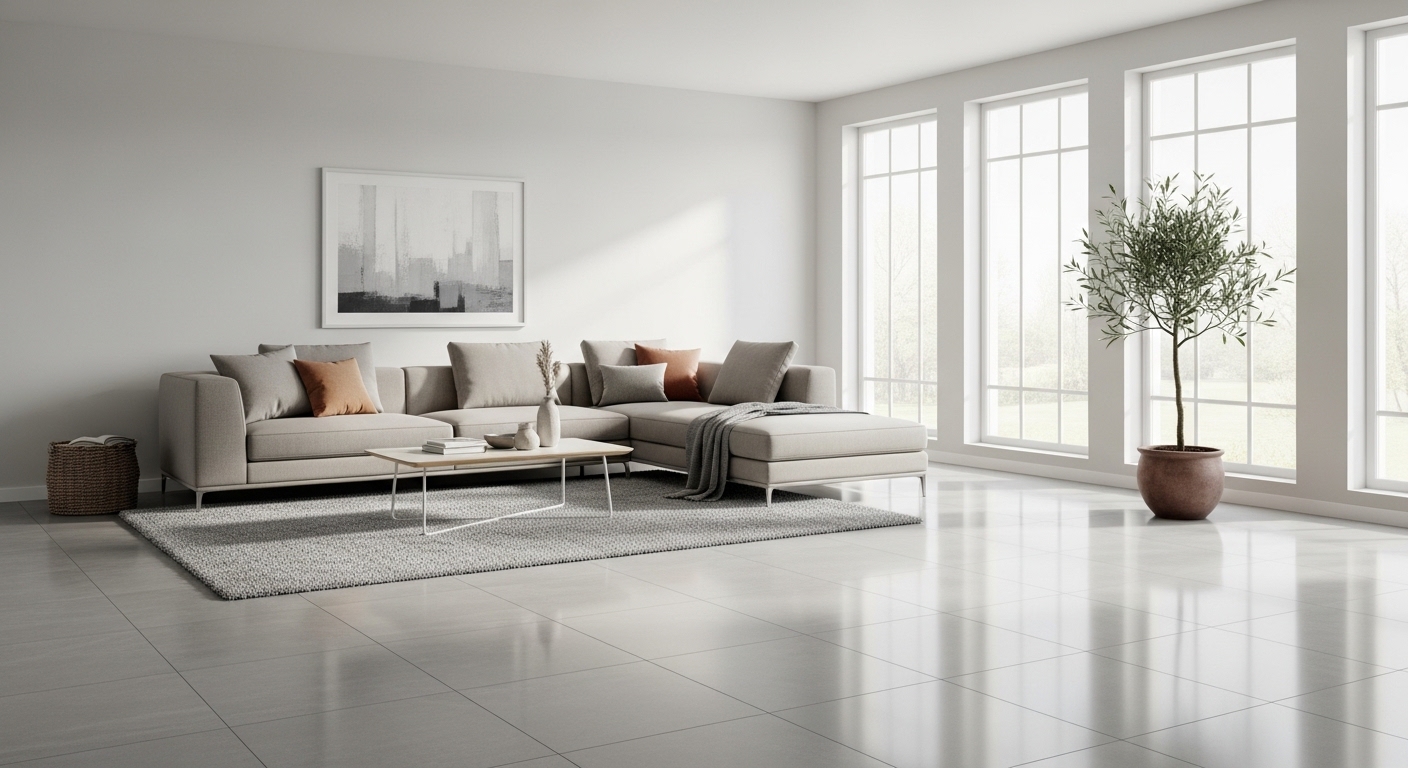
The contrast rule is simple: furniture should not match the floor’s tone exactly. A grey sofa on a grey floor in the same tone melts into one mass; the rug, the wood, or the sofa itself needs to step away in tone. Warm woods — oak, walnut — add warmth against cool grey floors and are the easiest way to stop a grey room feeling cold. Black metal sharpens the look; chrome can tip a cool grey room into sterility, so use it in details rather than as the dominant metal.
A grey sofa is the most common partner for grey floors, and the pairing needs deliberate contrast — a lighter or darker grey than the floor, plus warm layers in between. Grey couch living room ideas cover that pairing, including how to keep a grey sofa from disappearing into a grey floor.
Walls that work with grey floors
Warm whites are the safest wall choice with grey floors: they lighten the room without fighting the floor’s undertone. Sage green, navy on one accent wall, and warm beige all pair well, provided their undertones agree with the floor’s. The combination to avoid is grey walls in the same tone as grey floors — the room loses all depth and reads as one grey box. If you love grey walls, make them clearly lighter or darker than the floor, and break the expanse with wood, art, or a contrasting trim.
Wall decor does real work in a grey-floored room: it is where warmth and personality enter. Wood frames, woven pieces, and art with warm tones all counterbalance a cool floor. Calm cozy living room wall decor ideas focus on exactly that — wall treatments that keep a grey-based room feeling inviting rather than flat.
Rugs on grey floors
A rug on a grey floor is where warmth returns. Size it like any living room rug: front legs of the seating on the rug, rug extending past the sofa ends. A warm-toned or patterned rug — beige, terracotta, natural jute — breaks the grey field and gives the seating group a boundary. A grey rug on a grey floor needs a clear tone difference or a strong pattern, or it vanishes into the floor.
Layering works well here: a large natural-fiber base rug with a smaller patterned rug on top adds texture and lets you change the look without replacing the base. In a hard-use living room, washability matters — a rug that cannot be cleaned will either restrict the room or look tired quickly.
🛒 Shop This Look:
Transitions and adjoining rooms
Grey flooring rarely stops at the living room door. Running the same floor through an open-plan space unifies it; changing materials at a threshold needs a deliberate transition strip and a reason — tile in a wet zone, carpet in a bedroom. Abrupt changes between two similar greys look like mistakes, so either match exactly or contrast clearly.
Watch the kitchen and hallway junctions. A grey living room floor meeting a warm wood hallway floor can work when a rug or a threshold marks the change; meeting a different grey without a transition reads as an error. Plan the transitions before ordering, not after the installer asks.
Living with it: maintenance by material
Maintenance differs by material more than by color. Vinyl and laminate want grit swept up promptly — sand and grit scratch surfaces underfoot — and damp mopping rather than soaking. Tile wants grout attention: sealed grout resists staining, unsealed grout absorbs it. Carpet wants regular vacuuming and prompt stain treatment, and it wears visibly in traffic paths. Engineered wood wants the same care as any wood floor: felt pads under furniture, prompt wipe-ups, and protection from standing water.
Sun matters too. Strong sun through large windows fades some grey finishes unevenly, leaving lighter patches where rugs sat. Rotating rugs occasionally and using window coverings in the brightest hours keeps the floor’s tone even over time.
Testing samples the right way
Small chips lie. A grey that looks perfect on a two-inch chip can read entirely differently across a whole floor, because the eye averages tone over area — a slightly blue chip becomes a noticeably blue floor. Always test with large sample boards, at least a plank or tile wide, laid on the actual floor in the actual room.
Lay several candidates side by side and live with them for a day. Look at them in morning light, in evening lamplight, and from the doorway — the viewpoint you will actually use. Stand on them in socks: texture and temperature matter as much as color, and a sample you only looked at can surprise you underfoot. Check the sample against your sofa, your main wood pieces, and your rug, not against other samples. And photograph the candidates in your light; a phone photo sometimes reveals a cast your eye had adjusted to. Order the full batch from the same production run once you choose, since grey tones can shift slightly between runs.
Pets, children, and high traffic
A living room with pets and children punishes floors in specific ways, and grey hides some sins while revealing others. Pet nails scratch softer surfaces, so harder finishes and scratch-resistant coatings matter more than shade. Muddy paws and spills favor water-tolerant materials and finishes that wipe clean rather than absorb. Children add toy traffic, dropped objects, and art supplies — all arguments for a floor that tolerates impact and cleans easily.
Grey’s advantage here is real: mid-grey hides dust, pet hair, and light scuffs better than very dark or very pale floors. Its weakness is that it also hides the grit that causes scratches, so the sweeping habit matters more, not less. Put a good doormat at every entrance, keep a soft broom handy, and treat the entry zone as part of the floor’s maintenance plan. A washable rug in the main traffic path protects the floor where it wears fastest and can be replaced without replacing the floor.
Mistakes to avoid
The avoidable mistakes repeat across grey-floor projects. Choosing from a small chip instead of a large sample, and discovering the undertone only after installation. Matching grey walls to grey floors in the same tone. Picking a glossy finish that shows every scratch and speck of dust. Ignoring transitions to adjoining rooms. Putting carpet in a wet-adjacent zone because it felt warmer in the shop. And the all-grey room: grey floor, grey sofa, grey walls, grey rug — a room with no warm layer anywhere, which feels cold no matter how good each piece is. One warm element — wood, a warm rug, warm art — is usually all it takes to fix it.
Grey flooring works when its undertone is chosen deliberately, its material matches the room’s life, and at least one warm layer breaks the grey field. Get those three decisions right and the floor does what it promises: a calm, forgiving base that lets the rest of the room shine.
🛒 Shop This Look:
For more living room direction, explore more living room ideas for inspiration.