
As an Amazon Associate, I earn from qualifying purchases. This means I may earn a commission if you purchase through links on this page — at no extra cost to you.
Kitchen walls have two jobs, and they are often in conflict. They must hold things — pans, tools, dishes, food — and they must look good doing it. Most kitchen wall decor fails at one of the two: either the wall is beautiful but useless, or it is useful but so crowded that the room feels smaller and tenser than it is.
This guide treats both jobs together. It starts with reading the wall itself, then works through shelves, rails, art, and backsplashes, with the survival rules that matter in a room full of heat, steam, and grease. The goal is a wall that earns its keep and still lets the kitchen breathe.
Read the wall before you decorate it
Every kitchen wall is not the same wall. The stretch beside the stove lives in heat and grease. The wall by the sink lives in splashes. The wall near the dining end may be the calmest surface in the room. Decor that ignores these zones fails early: paper peels near steam, unsealed wood darkens near the stove, and anything hung where it gets bumped daily will not stay straight.
Measure before you buy anything. Note the width of each usable stretch, the height of outlets and switches, and where studs sit if you plan to hang anything heavy. A shelf that looks right in a photo can look wrong when it lands an inch above an outlet or blocks a cabinet door’s swing. A few minutes with a tape measure prevents the most common wall-decor regret.
Light matters as much as size. A wall that gets direct daylight will show every fingerprint and grease mark, so it suits wipe-clean surfaces and simple arrangements. A dim wall can carry deeper color and busier texture without overwhelming the room, because the eye reads it more softly.
Shelves that earn their place
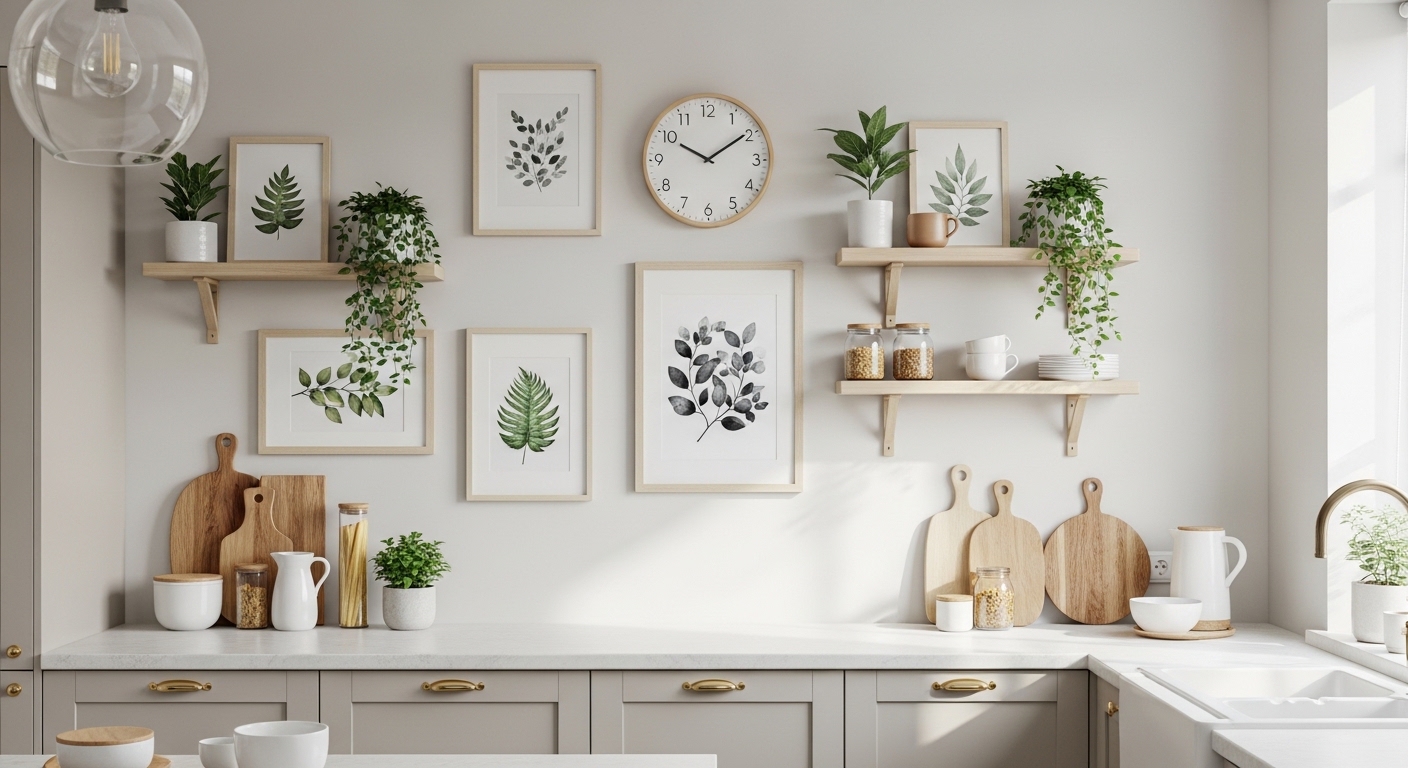
Open shelving works when it holds things you actually reach for, arranged with breathing room. The rule is simple: if a shelf is full edge to edge, it reads as storage, not decor, and the room feels cluttered. Leave gaps between groupings, keep the tallest items at the ends, and repeat one material — wood, ceramic, glass — so the shelf looks intentional rather than accumulated.
Shelf depth deserves thought. Standard wall shelves are deep enough for plates and bowls, but a shelf that sticks out too far over a walkway becomes a hazard for heads and shoulders. In narrow kitchens, a shallower shelf holding cups, jars, and small boards gives the look without the bump risk.
What goes on the shelf matters as much as the shelf itself. Everyday dishes, glasses, and wooden boards look honest and lived-in. Decorative objects that serve no kitchen purpose should be few: one or two per shelf, not a collection. A kitchen shelf that looks like a gift shop has stopped being a kitchen shelf.
🛒 Shop This Look:
Rails, hooks, and pegboards
Wall-mounted rails are the hardest-working decor a kitchen wall can carry. A simple rail with hooks holds pans, utensils, and measuring tools where they are visible and reachable, and it frees drawer and cabinet space for things that do not hang well. The key is editing: hang the tools you use weekly, and store the rest. A rail crammed with every utensil you own looks like a hardware store display.
Pegboards suit small kitchens especially well, because they turn an awkward wall — beside the refrigerator, at the end of a counter run — into flexible storage. Paint the board the wall color so it recedes, and use hooks sized to what actually hangs there. A pegboard painted a loud accent color draws the eye to the board itself rather than to the kitchen.
For a full walkthrough of wall-mounted storage, see this guide to maximizing kitchen storage with wall-mounted racks and rails, and for small-kitchen pegboard layouts, this guide to pegboard wall ideas for small kitchens.
Art in a working kitchen
Art belongs in kitchens, but it needs the right wall and the right protection. Choose the calmest wall — away from the stove’s heat and the sink’s splash zone — and favor prints under glass or sealed frames, which wipe clean when cooking film settles on them. Unframed paper and raw canvas absorb grease and moisture, and they show it within months.
Scale is the difference between art that anchors a wall and art that gets lost on it. A single larger piece over a sideboard or a dining nook reads more deliberately than a scatter of small frames across a big wall. If you prefer a gallery arrangement, keep the frames consistent and the spacing even; a gallery with mixed frame styles and random gaps reads as unfinished rather than collected.
Subject matters less than tone. Food prints, botanical prints, and abstract color all work in kitchens, as long as the colors sit comfortably with the cabinets and counters. For choosing pieces that reflect how you actually cook and live, see this guide to kitchen wall art that reflects you.
When the backsplash is the decor
In many kitchens, the backsplash already is the wall decor, and adding more above it only competes. If your backsplash has a strong pattern or color, let it carry the wall: keep shelves minimal, skip the gallery above it, and let the tile be the one decorative statement in that stretch.
Conversely, a plain backsplash leaves room for the wall above it to work harder. That is where a shelf, a rail, or a single piece of art earns its place — the plain tile below acts as a quiet base, and the decor above reads clearly against it. The mistake is giving both the backsplash and the wall above it a loud voice at once.
Small kitchens: one focal wall, not five
Small kitchens punish scattered decor more than large ones do. Every small object on every wall adds visual weight, and a small room has little weight to spare. Pick one wall to be the decorated one — usually the wall you face while cooking, or the wall beside the dining spot — and keep the others calm.
Vertical thinking helps here. Tall, narrow arrangements — a vertical rail, a stack of two small shelves, a single tall print — draw the eye upward and make the room feel taller. Wide arrangements spread the eye sideways and make a small room feel wider than it is, which is the opposite of what you want. For more on this, see these vertical wall decor ideas that suit small rooms.
🛒 Shop This Look:
Open shelves, glass cabinets, or closed doors
One decision shapes every kitchen wall more than any other: how much of what you own stays visible. Open shelves suit the things you reach for daily and that look good grouped — boards, bowls, glasses, jars. They also demand discipline, because everything on them is on display, including dust and chips. If you do not enjoy editing a shelf, open shelving across a whole wall will feel like a chore within months.
Glass-front cabinets are the middle path. They show the shapes and colors behind the glass while protecting contents from cooking film, and they forgive less-than-perfect arrangement because the glass softens the view. They suit kitchens where the wall faces the cooking zone, since the glass wipes clean in seconds.
Closed cabinets are the honest choice for the rest: small appliances, mismatched plastics, cleaning supplies, and the everyday clutter that no kitchen actually lacks. A wall with one open shelf for display and closed storage for the rest looks calmer than a wall of open shelves, and it stays calmer with far less effort. The mix matters more than the choice of any single option.
Whatever you choose, keep the top of wall cabinets in mind. The strip above wall cabinets either holds a few large, simple objects or stays empty. Small objects lined up there read as a forgotten shelf, not decor, and they collect the grease film that rises with cooking heat. Empty is a legitimate choice, and often the best one.
Renters: decor without damage
Rented kitchens can still have good walls. Removable rails that mount with strong adhesive, leaning shelves that need no fixing at all, and art hung from existing picture rails or adhesive hooks all work without drilling. Test any adhesive on a hidden spot first, and respect weight limits — a rail of cast iron pans needs studs, not adhesive, and no landlord will thank you for a wall torn out by a falling rail.
Removable wallpaper and backsplash panels are another renter-friendly option, but they demand honest prep: the wall must be clean, dry, and smooth, or the panel will peel at the edges within weeks. In a steamy kitchen, check that the product is rated for moisture, and avoid placing it directly behind the stove.
Cleaning and upkeep
Kitchen wall decor gets dirty in a way bedroom decor does not. Cooking film settles on every surface, and the wall behind the stove collects it fastest. Choose materials you can wipe: sealed wood, glass, glazed ceramic, metal. Avoid raw paper, unsealed fabric, and rough textures on the walls nearest the cooking zone, because they trap film and cannot be cleaned without damage.
Build a quick wipe into your routine. A monthly pass over shelves, frames, and rails with a damp cloth keeps film from building into a layer that needs scrubbing. Decor that cannot survive a damp cloth does not belong in a kitchen, however good it looks on installation day.
Mistakes that crowd a kitchen wall
The most common mistake is hanging too many small things. Ten small frames, hooks, and ornaments on one wall read as clutter; three considered pieces read as decor. When in doubt, remove one thing and live with the wall for a week before adding anything back.
Another mistake is hanging decor where work happens. Items hung directly over the stove collect grease and block the range hood’s airflow; items hung where you chop and prep get bumped and splashed. Decor belongs where hands and heat do not constantly reach it.
Finally, do not let wall decor block light. A tall shelf unit across a window wall, or a dark gallery on the wall opposite the window, can dim the whole room. The brightest wall in the kitchen should stay the lightest in decor, so daylight can do its work.
For the broader set of kitchen guides on this site, browse the kitchen ideas hub.
🛒 Shop This Look:



