
As an Amazon Associate, I earn from qualifying purchases. This means I may earn a commission if you purchase through links on this page — at no extra cost to you.
The grey couch is the hardest-working piece of furniture most living rooms own. It absorbs whatever is thrown at it — bold color in winter, pale linen in summer, daily life with children and pets all year round. That versatility is also its weakness: a grey sofa with nothing to play against looks flat, cold, and forgettable. Styling a grey couch is less about decorating around it and more about giving it contrast, texture, and warmth to react to.
Know your grey first
Grey sofas lean cool (blue undertone) or warm (greige, leaning beige), and the palette follows that lean. Cool grey pairs with navy, black, white, chrome, and cool greens. Warm grey pairs with brown, cream, wood tones, terracotta, and brass. Mixing the families — warm cream cushions on a cool blue-grey sofa — can work in small doses, but building the whole palette across the undertone line usually looks unsettled.
Test it before buying cushions or rugs. Hold a sheet of white paper, a cream pillow, and a wood sample against the sofa in daylight. The paper exposes the cast; the cream pillow shows whether warm cream fights or flatters it; the wood shows which wood tones belong. This one check prevents the most common grey-couch complaint: a room full of pieces that individually look fine and collectively feel wrong.
Build a palette around it
Two palette routes work reliably. The warm route wraps the grey sofa in brown and cream — warm woods, cream cushions, brown leather accents — and turns a cool piece into a warm room. Brown and cream living room ideas show how that warm layering works, and the same logic applies when the sofa is the grey anchor. The cool route leans into the grey: navy, sage, black, and white, with metal accents. Either route works; mixing both without a plan produces a room that cannot decide what temperature it is.
Whichever route you choose, keep to one accent color, repeated in three or four places — cushions, art, a throw, a vase. A grey sofa can carry a strong accent — mustard, teal, rust — precisely because grey stays quiet. But two or three competing accents turn the sofa’s calm into background noise, and the calm was the reason to buy grey.
🛒 Shop This Look:
Texture before color
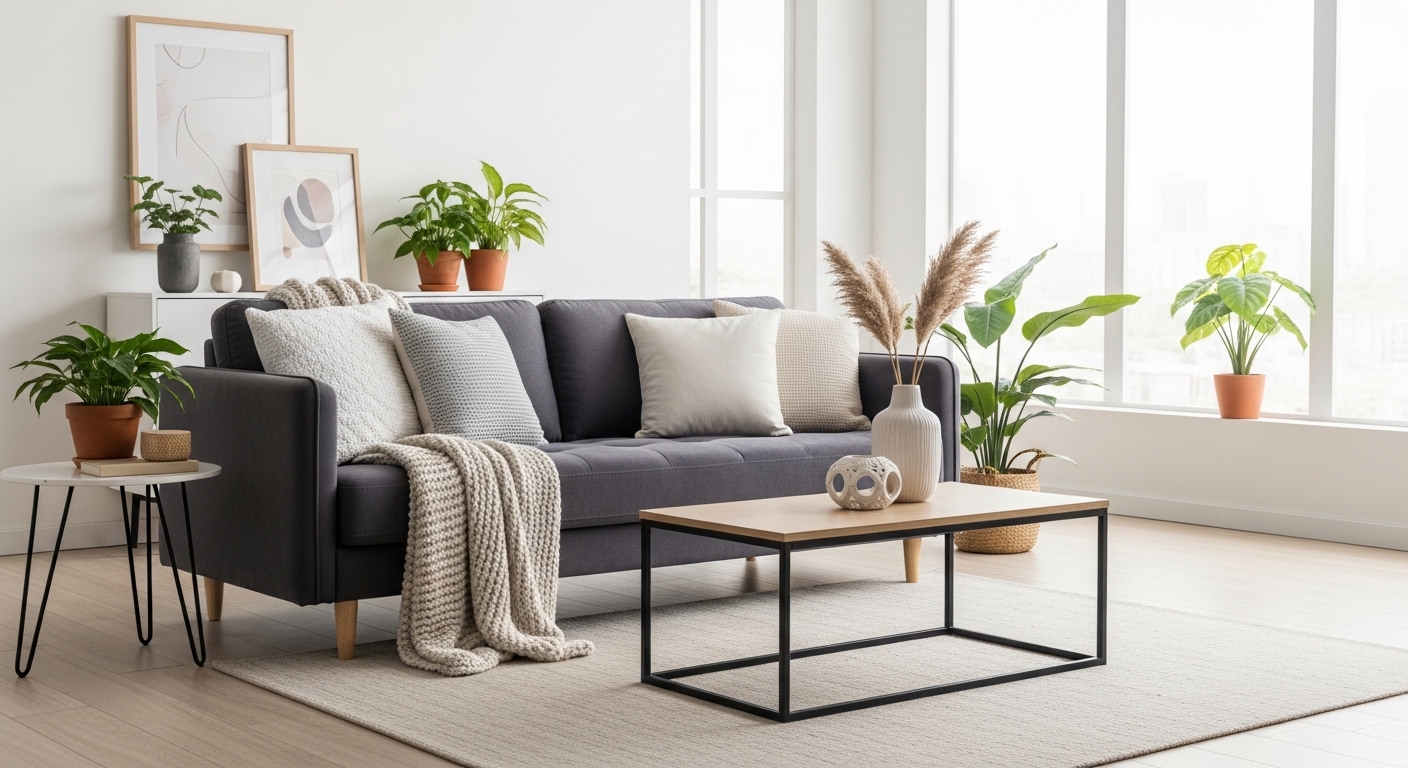
Texture saves a grey sofa before color does. A grey room with one texture — smooth fabric, smooth walls, smooth floors — looks flat even in a good palette. Mix at least three textures around the sofa: boucle or velvet cushions against a linen-look sofa, a knit throw, a leather tray on the coffee table, a woven basket beside it. The eye reads texture differences as richness, which is exactly what a single-color sofa needs.
Throws and cushions are the texture carriers, and they are also the cheapest way to change the room. A chunky knit in winter and a light linen in summer can make the same sofa feel like a different room, without touching the large pieces.
Rugs that anchor the sofa
The rug is the sofa’s ground, and its size decides whether the seating group looks settled or adrift. Front legs of the sofa on the rug, rug extending past the sofa ends — the same rule as any living room, and more important with grey because an undersized rug leaves the sofa floating in open floor. Color-wise, a warm neutral rug warms a cool grey sofa; a patterned rug with grey in it ties the sofa to the floor without matching it exactly. A grey rug on a grey floor needs a clear tone difference or it disappears.
Material follows the household: washable rugs for pets and children, natural fiber for quieter rooms, layered rugs — a large jute base with a smaller patterned top — when you want texture and flexibility. Living room rug ideas go deeper on size rules, placement by layout, and materials for different households.
Walls behind and around
Art above a grey sofa should relate to the sofa’s width — roughly two-thirds of it, as a single piece or a group measured together — and hang low enough to connect with the sofa rather than floating near the ceiling. Small art above a long sofa is the fastest way to make a good sofa look lost.
An accent wall behind the sofa can give a grey room its drama, and deep tones work well against grey: a dark wallpapered wall makes the sofa read lighter and the room more layered. Dark moody wallpaper ideas cover how to use deep hues without closing a room in. If wallpaper feels like a commitment, a large piece of art with a dark background does similar work without it.
Pillows and throws without the showroom look
The showroom look — matched pillow sets in the sofa’s exact color — is what makes grey sofas look dull. Break it with odd numbers, varied sizes, and a mix of solid, pattern, and texture: a large solid, a medium pattern, a small textured cushion, rather than four identical squares. Do not match the rug exactly; echo one of its colors instead. And leave some sofa visible — a sofa buried under cushions stops looking like a sofa and starts looking like a cushion display.
🛒 Shop This Look:
Tables that warm it up
The coffee table is the grey sofa’s nearest neighbor, and its material does heavy lifting. Warm wood warms a cool grey sofa more effectively than almost any other single change. Black metal sharpens it. Glass keeps a small room feeling open but adds no warmth, so pair it with warm accessories. Scale matters too: a table roughly half the sofa’s length, at about seat height, keeps the arrangement usable and proportioned. A table that is too small looks lost; one that is too large blocks the room’s path.
Seasonal swaps
A grey sofa is the ideal base for seasonal swaps, because it accepts both directions. Summer: light linen cushions, rattan or light wood accessories, pale throws. Winter: wool and velvet cushions, deeper accent tones, a heavier throw. Store the off-season textiles in one box and the swap takes an afternoon. This is also the cheapest way to keep a grey room from feeling static year after year — the sofa stays, the room changes around it.
Keeping it clean
Grey hides dust better than white and shows pet hair more than brown — a trade worth knowing. Removable, washable covers change the maintenance story entirely; if your sofa does not have them, a washable throw where people actually sit protects the most-worn areas. Vacuum textured fabrics regularly, since texture traps dust. Treat stains promptly rather than letting them set, and rotate seat cushions so wear evens out. Sun fading is real for grey fabrics near large windows: rotate cushions and consider window coverings in the brightest hours.
Lighting a grey sofa room
Grey rooms live or die by their lighting. A single overhead light flattens a grey sofa, washes out texture, and makes the whole room feel like an office after dark. Grey needs layered light: a floor lamp beside the sofa for reading, table lamps on side tables for warmth, and the overhead light on a dimmer for general use. Warm-white bulbs suit most grey rooms — they add the warmth the palette lacks — while cool-white bulbs can push a cool grey sofa into icy territory.
Check the sofa’s color under your evening lighting before finalizing cushions and rugs. A grey that looks soft in daylight can turn cold under cool bulbs, and warm bulbs can yellow a warm grey. If the room has a dimmer, use it: a grey sofa at half light with lamps on looks richer than the same sofa under full overhead glare. Picture lights or a lamp washing the wall art also give the eye somewhere warm to rest, which matters in a room built around a cool anchor.
Grey couch in open-plan spaces
In an open-plan room, the grey sofa often does a second job: marking where the living area ends and the dining or kitchen area begins. Its back becomes a boundary, so treat the back as a visible surface — a console table behind it, a throw draped over it, or a rug that ends cleanly at its line all signal that the boundary is deliberate rather than accidental.
Keep the palette continuous across the open space rather than restarting it in each zone. The dining chairs, the kitchen stools, and the sofa cushions should share an undertone family, even if their colors differ. A grey sofa beside a warm wood dining table works when the rug and the cushions carry warmth between them; a grey sofa beside a cool chrome kitchen works when black or navy details tie the zones together. The sofa’s neutrality is an advantage here — it connects zones without competing with either — but only when the zones share something with each other.
Mistakes to avoid
The recurring mistakes are all fixable. The grey-on-grey room: grey sofa, grey walls, grey rug, no warm layer anywhere — add wood, warm textiles, or warm art. Matching everything to the sofa instead of contrasting with it. A rug too small for the seating group. Art too small or too high above the sofa. A single overhead light as the only lighting — grey rooms need layers: a floor lamp beside the sofa, table lamps, and the overhead light on a dimmer if possible. And ignoring the sofa’s undertone when choosing cushions and rugs, which makes the whole room feel slightly off without an obvious cause.
A grey couch earns its reputation when it has contrast to react to: warm wood, varied texture, one accent color, art scaled to the sofa, and a rug that grounds the group. Give it those things and the hardest-working piece in the room stops looking like a compromise and starts looking like a choice.
🛒 Shop This Look:
For more living room direction, explore more living room ideas for inspiration.



