
As an Amazon Associate, I earn from qualifying purchases. This means I may earn a commission if you purchase through links on this page — at no extra cost to you.
Blackout curtains promise a dark room, but the word “blackout” on a label is not a guarantee. Curtains sold under that name range from near-total darkness to barely dimming a room, because no single standard defines what counts as blackout. What matters is how the curtain is made: the construction type, the density of the fabric, and how completely the panels cover the window once hung. This guide explains the main construction types, what to check before you buy, how to measure and hang curtains so light does not leak around the edges, and the alternatives worth considering when curtains alone are not the right answer. It also covers nurseries, travel, and care, so you can choose once and get the darkness you actually need.
How Blackout Construction Types Compare
Blackout curtains are made in a few different ways, and the construction decides how much light gets through and how long the curtain keeps working. The blocking layer is either woven into the fabric, coated onto the back, or added as a separate lining — and each approach has trade-offs in durability, drape, weight, and care.
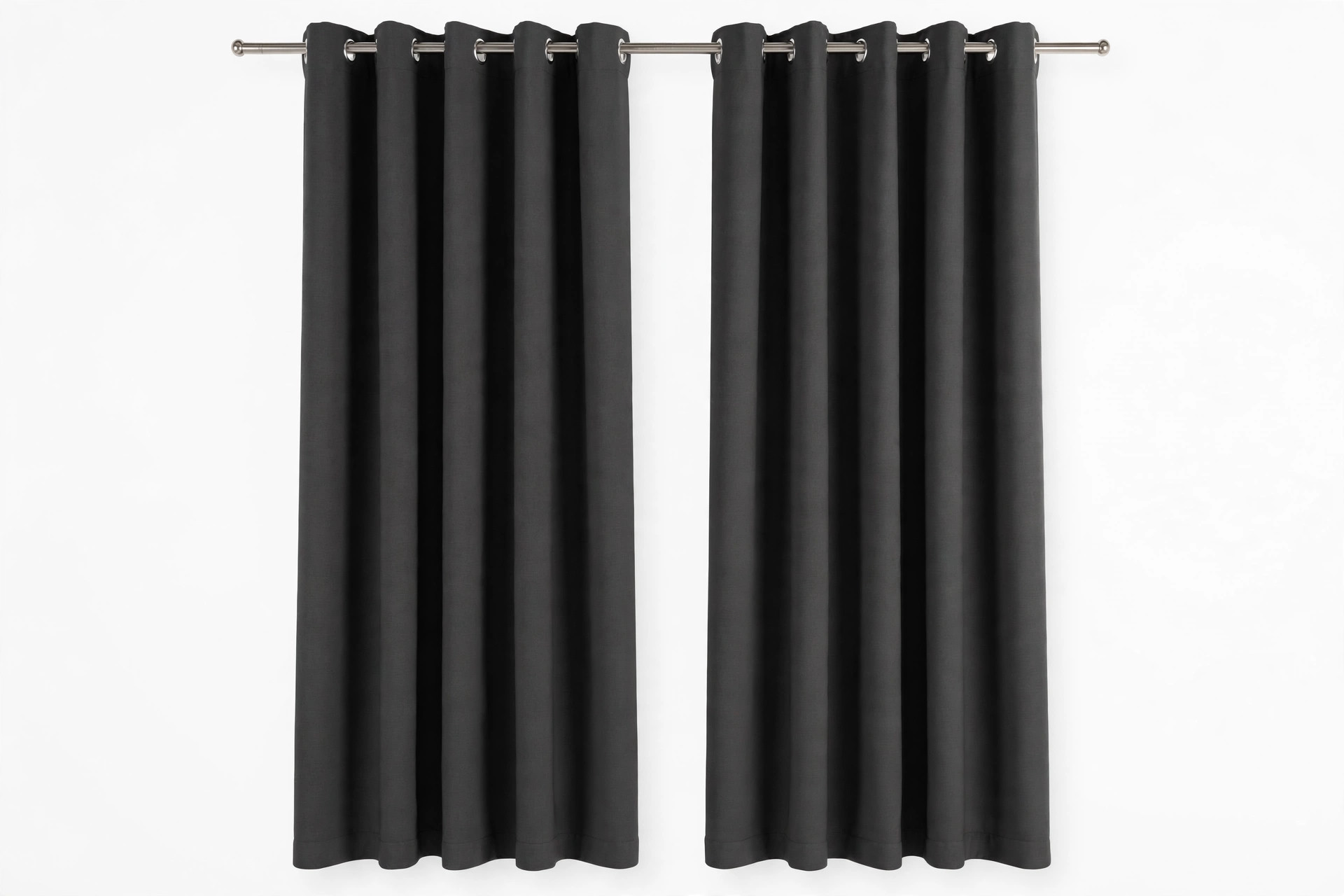
Triple-weave fabric is woven from three layers in a single cloth, with a dense, dark yarn core sandwiched between two face layers. Because the light-blocking layer is part of the weave rather than a coating, there is nothing to crack or peel, and the fabric usually survives machine washing. Triple-weave panels tend to drape softly and look the same from both sides, which suits rooms where the curtain is visible from outside as well. It is generally considered the most dependable construction for consistent darkness, and it is the type to look for first when the goal is a genuinely dark bedroom.
Coated curtains start as an ordinary face fabric with a foam or acrylic coating applied to the back — sometimes described as a “3-pass” coating, meaning three layers of coating. The coating blocks light well when new, but it is the part that ages: strong sun and repeated washing can make it stiff, crack, or peel, and once the coating breaks down, light comes through the damaged spots. Coated panels are often cheaper and lighter than triple-weave, which makes them a reasonable choice for rooms where total darkness matters less, such as a living room or a guest room used occasionally.
Bonded blackout lining attaches a separate blackout layer to the back of a decorative face fabric. You get the pattern or texture you want on the front with real light blocking behind it, at the cost of extra weight and a stiffer drape, and the bond can separate over years of strong sun. Thermal curtains add an interlining, usually a thick cotton or synthetic layer, primarily for insulation — they block light as a side effect of their bulk, and the added weight needs a sturdy rod. A separate blackout liner, hung on its own rod or rings behind decorative curtains you already own, gives flexibility: the liner does the blocking, the outer curtains provide the look, and the liner can be replaced on its own when it wears out.
Face color matters less than construction. A dark face fabric helps at the margins, but a white triple-weave panel blocks far more light than a thin black curtain with no real blocking layer. The practical check is simple: hold the fabric up to a bright window or lamp before buying when you can — if you can see the shape of the light source through it, the curtain will let light through on your window too. Solid, dense weaves block better than open or patterned weaves, and seams and joins are worth inspecting, since pinholes of light at stitching lines show up clearly in a dark room.
🛒 Shop This Look:
How to Choose Blackout Curtains: What Actually Matters
Shopping for blackout curtains is confusing because the label “blackout” isn’t regulated — products marketed with the word can range from near-total darkness to barely dimming a room. Here’s what to evaluate instead of trusting the label. Construction: Triple-weave fabrics (three layers woven together, with a dense black yarn core) block light without a separate coating and tend to outperform single-layer fabrics with a foam or acrylic backing — and they drape better and last longer. Coated “blackout linings” work, but the coating can crack or peel over time, especially in sunny windows.
Color and weight: Darker face fabrics block more light than light ones at the same construction, but a well-made triple-weave in white can still outperform a thin dark curtain. Heavier generally means better — hold the fabric up to a light in the store; if you can see the bulb’s shape through it, light will get through on your window too. Specified percentages: Some manufacturers publish actual light-blocking percentages. These aren’t independently verified, but a brand willing to state a number is usually more trustworthy than one hiding behind the word “blackout.”
“Blackout” vs. “room darkening”: These are different products. Room-darkening curtains reduce light significantly but aren’t designed for total darkness — fine for a TV room, not enough for a night-shift sleeper. If you need real darkness, look specifically for blackout construction and be skeptical of anything that won’t commit to the term. Finally, check the return policy before buying: light blocking is genuinely hard to judge until the curtain is on your window, and you want the option to send back anything that underperforms.
What to Check Before You Buy
Start with the construction description on the listing. It should name the type — triple-weave, coated, bonded lining, or liner — and describe the layers. Vague wording such as “light-blocking fabric” with no detail is a warning sign: a manufacturer confident in the construction usually says what it is. Check whether the price is per panel or per pair, since curtains are often sold singly and a window usually needs two.
Next, match the header to your rod. Grommet tops slide easily and stack neatly; rod pockets give a gathered look but can be harder to slide closed; pinch pleats and tab tops need the right rings or hooks. Confirm the curtain’s weight against what your rod and brackets can hold — heavier thermal and lined panels need stronger hardware. Finally, check the care label and the return policy before ordering. Light blocking is hard to judge until the curtain is hanging on your own window, so a free or cheap return matters, and a curtain you cannot wash the way the label requires will not stay looking good. Color is the last decision, not the first — if your walls are grey, this guide to curtain colors that work with grey walls narrows the options.
How to Measure for Blackout Curtains
Measure the window frame, not the glass. For the rod, allow 4 to 6 inches above the frame and 3 to 4 inches beyond each side so the closed curtain covers wall as well as glass — that overlap is what stops side leaks. Use a steel tape and measure the width in three places if the frame is old or uneven, then use the widest figure.
For panel width, add the panels’ combined width together: when closed, the fabric should span the full rod length with a little fullness left over, so order enough panels to cover the rod end to end rather than just the glass. For length, decide the finish first — sill length, below the sill, just touching the floor, or puddling slightly — then measure from the rod down to that point at both ends, since floors are rarely perfectly level. Choosing the right curtain length walks through each finish in detail. If you are unsure between two lengths, the longer one is the safer choice for darkness, because any gap at the bottom becomes a light leak at eye level in bed.
How to Hang Blackout Curtains for Maximum Darkness
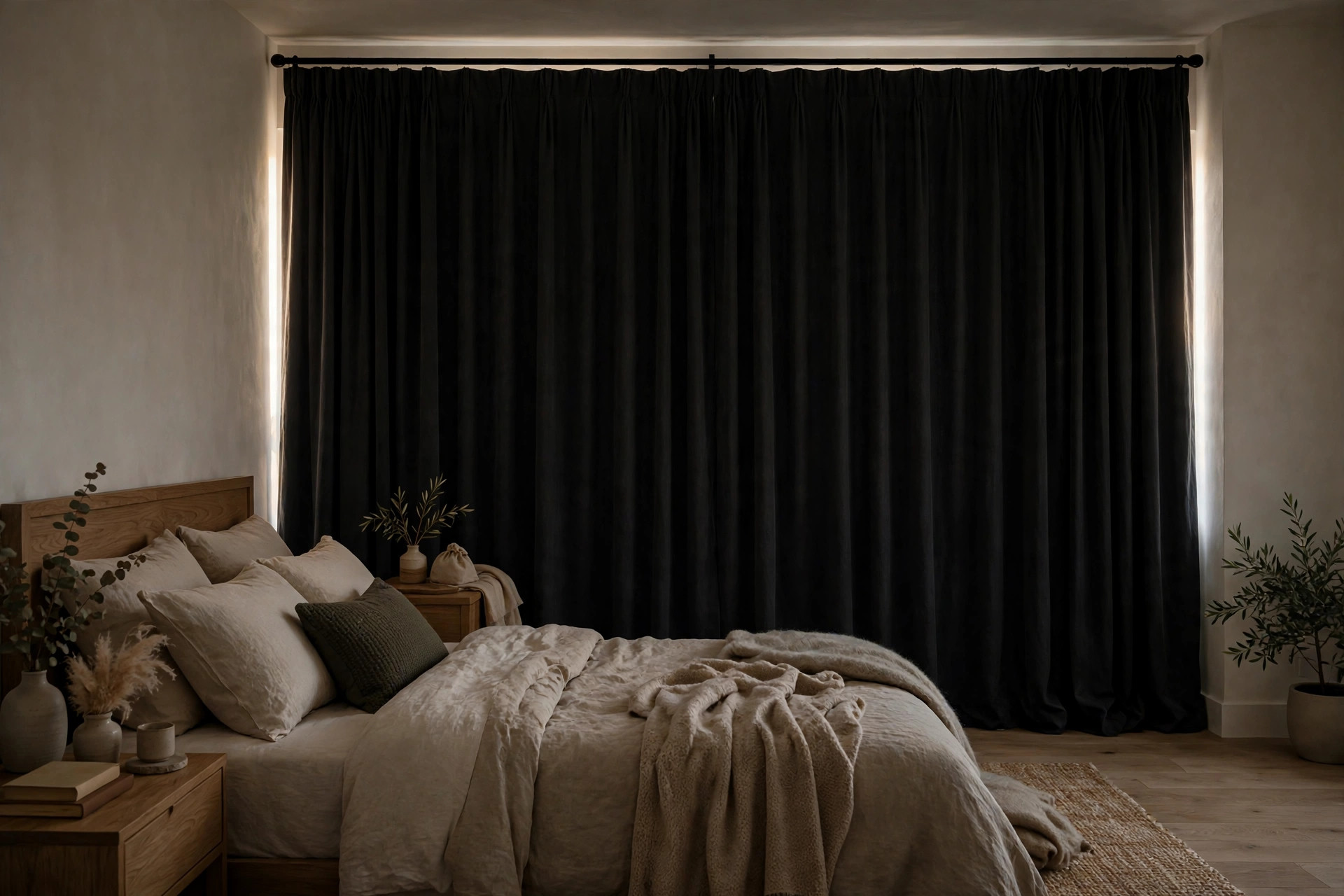
Even the best blackout curtain leaks light around its edges if hung poorly — and edge leaks can undo most of the fabric’s work. Mount the rod 4–6 inches above the window frame and extend it 3–4 inches beyond the frame on each side, so the closed curtain covers wall, not just glass. Choose a wraparound (French return) rod that curves back to the wall; this closes the side gaps where light sneaks in. For the top gap, mount the rod close to the ceiling or add a simple valance or cornice board.
Length matters: curtains should just kiss the floor or puddle slightly. Any gap at the bottom is a light leak — and in bedrooms, that bottom gap lands right at eye level when you’re lying down. Use one wide panel per side rather than multiple narrow ones to minimize center gaps, or overlap panels generously in the middle.
For truly light-sensitive sleepers, add a blackout roller shade or a wraparound blackout liner behind the curtains — the layered approach blocks the edge leaks that curtains alone can’t fully solve. And don’t forget the rest of the room: LED standby lights, hallway light under the door, and glowing chargers all undermine blackout curtains. A dark room is a system, not a single product. Darkness is only part of good sleep — bedroom decorating mistakes that ruin sleep quality covers the rest of the room.
🛒 Shop This Look:
Blackout Alternatives Worth Considering
Curtains aren’t the only path to darkness. Blackout roller shades mount inside the window frame and, when paired with side channels, block light extremely effectively — they’re the top choice for a clean, modern look and for windows where curtains aren’t practical. Cellular (honeycomb) blackout shades add insulation as a bonus, noticeably reducing heat transfer at the window. Portable blackout shades with suction cups are a renter-friendly and travel-friendly option — not pretty, but effective and completely removable.
For the budget-conscious, a blackout curtain liner hung behind your existing decorative curtains gives you the light blocking without replacing curtains you already like. And for daytime naps in a pinch, a quality sleep mask outperforms every window treatment for a fraction of the cost — it travels with you and blocks light regardless of the room. Many light-sensitive sleepers use both: blackout window treatments for the room, plus a mask for the last few percent.
Blackout Curtains for Nurseries and Kids’ Rooms
Nurseries are where blackout curtains earn their reputation — daytime naps live or die on darkness. For nurseries, prioritize safety alongside light blocking: choose cordless curtain construction or cord cleats mounted high, since curtain cords are a strangulation hazard for young children. Wands or cordless traverse rods are the safest operating options. Mount hardware securely into studs, not just drywall — toddlers pull on curtains with surprising dedication.
Kids’ rooms add a fun constraint: many children are afraid of the dark. The solution isn’t less blackout — it’s a dim, warm nightlight that provides reassurance without meaningful light.
A red or amber nightlight preserves sleep quality far better than white or blue light, because longer wavelengths interfere less with melatonin. And involve older kids in choosing the curtain fabric or pattern; a child who picked their own “sleep curtains” resists bedtime less than one who had darkness imposed on them. For shared kids’ rooms, blackout curtains on the windows plus a room divider curtain can give each child a darker, more private sleep zone. Wall color plays a part too — paint colors for better sleep explains which bedroom colors support rest.
Travel and Temporary Blackout Solutions
What about hotel rooms, rentals, or guest rooms where you can’t install curtain rods? Portable blackout curtains with suction cups stick directly to window glass — they look utilitarian but block light remarkably well, fold into a suitcase, and need no tools. They’re also the answer for renters whose landlords prohibit new hardware: no holes, no damage, full darkness.
Blackout EZ-style window covers use Velcro-attached fabric cut to your window size — a semi-permanent option that’s removable without a trace. For the truly minimal approach, aluminum foil taped to the window blocks light completely for essentially zero cost; it’s ugly from outside (check HOA or lease rules) but unbeatable for shift workers in a pinch. And don’t overlook the humble sleep mask as a travel essential — it works in every hotel, on every red-eye flight, and during every in-law visit, regardless of what the windows are doing. Frequent travelers often find that a great sleep mask plus portable suction-cup shades cover every scenario they’ll ever face.
🛒 Shop This Look:
Blackout Curtain Care and FAQs
Read the care label before the first wash — it varies by construction. Triple-weave panels are usually machine washable on a cold, gentle cycle and best hung to dry; high heat can damage the dense weave and shrink the fabric. Coated curtains need gentler handling: spot clean or hand wash, and never wring or iron the coated side, since heat and creasing damage the backing. Vacuum panels regularly with a brush attachment to keep dust out of the weave, and steam out wrinkles on a low setting held a few inches away rather than pressing with an iron. Sun is the slow enemy of coatings and linings, so expect a coated panel in a south-facing window to age faster than one in a shaded room, and replace panels when the coating cracks or the edges fray.
Do blackout curtains keep a room cooler? Thermal and lined types reduce heat gain through the window to a degree, especially when closed during the sunniest hours, but they are not a substitute for insulation or shading outside the glass. Do they block sound? They muffle outside noise slightly because of their weight and density, but they are not soundproofing. Can you layer them with blinds or shades? Yes — layering is one of the most effective approaches, since a shade inside the frame closes the gaps curtains leave at the edges. Do white blackout curtains work? Yes, when the construction is genuinely blackout. Color is secondary; a white triple-weave panel blocks light far better than a dark curtain with no blocking layer.



