
As an Amazon Associate, I earn from qualifying purchases. This means I may earn a commission if you purchase through links on this page — at no extra cost to you.
Affordable wall art is easy to buy and easy to get wrong. The same design can arrive as a sharp, richly colored print on heavy paper or as a washed-out poster that curls at the edges — and the listing page rarely makes the difference obvious. Price alone does not settle it either: some of the cheapest art on the market is genuinely good, and some of the priciest is a thin poster in a fancy frame.
This guide explains how to compare affordable wall art stores on the facts you can check before ordering: print resolution and materials, what the price actually includes, shipping and return policies, and the warning signs of AI-generated or stolen listings. Use it to judge any store on its listing, not on its marketing.
What to Check Before You Order
Before you spend anything, run through this checklist on the listing itself. Every answer should be visible on the product page — if it is not, that absence is itself information.
Resolution and size honesty: The listing should state the print resolution, the file’s pixel dimensions, or the maximum recommended print size. A print should be produced at roughly 150 dots per inch at the size you order, with 300 DPI as the ideal. If a shop sells a 24-by-36-inch print and gives no resolution information at all, assume the file may not hold up at that size. Small files stretched large are the most common cause of blurry, pixelated wall art.
Paper and ink specifics: Look for the paper type and weight, stated in grams per square meter (gsm). Art prints generally start around 200 gsm; anything much lighter behaves like a poster. Pigment-based inks hold their color far longer than dye-based inks, so check which the seller uses, especially for sunny rooms. Listings that only say “high-quality print” without naming paper, weight, or ink are asking you to trust them with nothing to check.
What the price includes: Confirm whether the price covers the print alone, the print plus a frame, or a mounted and ready-to-hang piece. A framed price that looks high can be reasonable once framing is factored in, and a bare-print price that looks cheap can double once you add a frame, a mat, and shipping. Compare the total delivered cost, not the headline number.
Shipping cost and timing: Large framed art ships in oversized boxes, and the shipping charge can rival the price of the art itself, particularly on international orders. Check whether shipping is free, flat-rate, or calculated at checkout, and how long delivery takes. A shop that ships from overseas may need weeks, which matters if you are decorating to a deadline.
Returns and damage policy: Unframed prints are usually returnable; custom-framed pieces often are not, and digital downloads are never returnable. Read the damage policy before ordering: a clear replacement process for prints that arrive bent or damaged is a good sign, while a “no returns on sale items” clause with no damage exception is a risk on a fragile product.
Review photos, not just star ratings: Star ratings for wall art skew positive, because most buyers never compare the print against anything. Customer-uploaded photos show the real sharpness, color, and packaging. Look for repeated comments about dull colors, bent corners, or thin paper — a pattern across several reviews tells you more than a hundred five-star ratings with no photos.
🛒 Shop This Look:
How to Judge Art Quality Before You Buy
You cannot inspect every print before buying, but you can read listings like someone who knows what to look for. Check the DPI and dimensions: Reputable sellers state the print resolution or the maximum recommended print size. A good rule: the file should support at least 150 DPI at the size you’re ordering (300 is ideal). If a seller offers a 24-by-36-inch print from a listing with no resolution info, that’s a red flag — small files blown up large are exactly how pixelated prints happen.
Read the review photos, not just the stars: Star ratings for wall art skew positive because most buyers never compare against anything. Customer-uploaded photos are the most useful evidence — look for sharpness in close-ups, color accuracy versus the listing images, and comments about packaging. A pattern of “colors are duller in person” or “arrived bent” tells you more than a hundred five-star reviews.
Understand what you’re actually buying: “Print” can mean anything from a giclée on archival paper to a thin poster. Look for specifics: paper type and weight (heavier is better — 200gsm+ for art prints), ink type (pigment inks last decades; dye inks fade), and whether the print is framed, mounted, or just the paper. Vague listings (“high-quality print!”) usually mean a low-quality product.
Where to Shop for Affordable Wall Art (and What to Expect)
The affordable art market has distinct tiers, and knowing what each offers saves disappointment. Print-on-demand marketplaces (Society6, Redbubble, TeePublic) print your chosen design when you order. Quality is generally consistent, returns are easy, and the range of art is enormous — but you’re paying a premium over DIY printing, and framing options vary. Good fit: hassle-free ordering with reliable results.
Digital download shops (Etsy printables) are the budget champion: you buy the file for a few dollars and print locally or online. The art itself can be excellent, and total cost stays low even with professional printing – but quality depends entirely on the seller’s file and your chosen printer. Good fit: maximum value when you’re willing to handle printing and framing.
Scandinavian poster shops (Desenio, Juniqe) offer curated, on-trend designs with matching frames. The aesthetic is cohesive and the quality is solid, but shipping from Europe can be slow and pricey outside the EU. Good fit: a coordinated gallery wall with minimal effort.
Big-box and fast-furniture stores (IKEA, Target) are surprisingly strong for large-format art – their scale and framing prices are hard to beat. The tradeoff is originality: thousands of homes have the same prints. Good fit: large statement pieces on a tight budget. For inspiration on how to arrange larger pieces, see these living room ideas and wall decor ideas.
General marketplaces (Amazon, Wayfair) are a mixed bag: genuine bargains exist alongside pixelated disappointments. The rule is simple – only buy listings with hundreds of reviews and plenty of customer photos, and favor sellers who specify print resolution and materials.
Key Takeaways
- Compare the total delivered cost — print, framing, and shipping — not just the headline price
- Check resolution, paper weight, and ink type on the listing before ordering
- Read customer-uploaded review photos, not just star ratings
- Standard frame sizes keep framing affordable; odd sizes push costs up
- On general marketplaces, favor listings with hundreds of reviews and customer photos
Sizing and Framing Guide for Affordable Prints
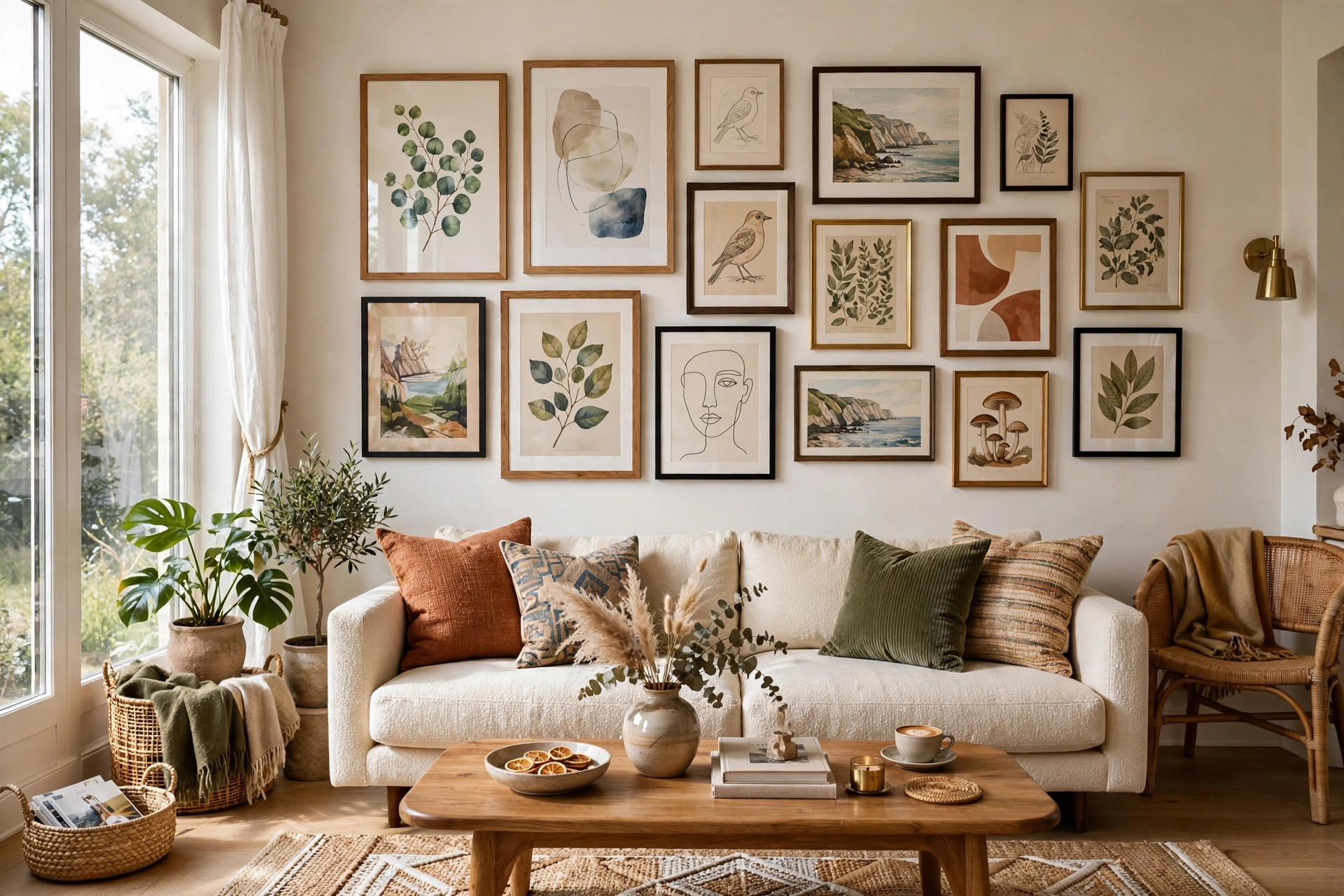
Affordable art fails most often on size, not quality — a beautiful print hung too small looks cheap no matter how good it is. Above a sofa, aim for art (or an arrangement) spanning about two-thirds the sofa’s width. As a standalone piece on an empty wall, go bigger than your instinct says; most people underestimate by one full size. When ordering, remember that listed dimensions are usually the print size — add 2–4 inches per side for matting and framing when planning your wall space. If you are building a gallery wall around a TV, the same sizing rules apply, with extra attention to keeping frames clear of glare.
For framing on a budget, standard sizes are your friend: 8×10, 11×14, 16×20, and 18×24 frames are mass-produced and cheap, while odd sizes require custom framing that can cost more than the art. If you fall in love with a non-standard print, check whether the seller offers it in a standard size before paying for custom framing. A mat (the border between art and frame) instantly makes affordable prints look more expensive — it adds visual breathing room and a gallery feel for very little money. And for the ultimate budget move, IKEA and big-box frames with included mats can make a budget printable look like a premium piece. Avoid the common pitfalls in this guide to gallery wall mistakes to avoid before you start hanging.
🛒 Shop This Look:
Returns, Shipping, and Fine Print
Before ordering affordable art, check three policies. Returns: Unframed prints are usually returnable; custom-framed pieces often aren’t.
Digital downloads are never returnable – but at a few dollars each, the risk is minimal. If you’re unsure about a store, order the smallest/cheapest option first as a quality check before committing to the large framed version. Shipping: Large framed art ships in oversized boxes and the shipping cost can rival the art’s price, especially internationally.
Factor total delivered cost into comparisons, not just the list price. Prints shipped in tubes need flattening time – unroll them and place them under heavy books for a day or two before framing.
Damage protocol: Inspect art immediately on arrival, even if you won’t hang it for weeks — return windows are short. Photograph any damage before contacting the seller; most reputable stores replace damaged pieces quickly with photo evidence. And keep the original packaging until the art is safely on your wall — if you do need to return it, proper packaging is usually your responsibility.
Framing on a Budget: Where to Get It Done
Affordable art becomes expensive art at the framing counter — a budget print in a custom frame is a budgeting failure. The hierarchy of framing value: standard-size ready-made frames (IKEA, Target, big-box stores) are the unbeatable baseline — a clean 16×20 frame with a mat often costs less than a takeout dinner. Buy the art to fit standard frames, not the other way around. Online custom framers (like Framebridge and similar services) cost more than ready-made but far less than local frame shops, and they’re the answer for odd sizes or when you want a specific mat and frame combination without the boutique markup.
Local frame shops are the premium option – worth it for valuable or irreplaceable pieces where archival materials and expert fitting matter, overkill for a budget printable. Thrift stores are the wildcard: quality wood frames for a few dollars, often with glass and backing included.
Pop out the sad motel art, clean the glass, and you have a solid frame – just check that the size is standard enough for your print or be ready to cut a mat to fit. And remember the mat trick: a wide mat in a larger standard frame makes a small print look intentional and gallery-worthy. An 8×10 print in an 11×14 frame with a mat looks like a premium piece; the same print crammed into an 8×10 frame looks like a dorm poster. For a monochrome scheme, these black and white gallery walls show how framing choices carry the whole look.
🛒 Shop This Look:
How to Spot AI-Generated and Stolen Art Listings
The affordable art market has a growing quality problem: AI-generated images and stolen designs sold as original work. A few tells: impossible details — zoom into the listing images and look for garbled hands, nonsensical text, or elements that morph illogically.
AI art often looks perfect at thumbnail size and wrong at full size. Suspiciously vast catalogs — a shop with 10,000 wildly different “original” designs uploaded in weeks isn’t employing 10,000 artists. No artist identity — legitimate print-on-demand artists have profiles, portfolios, and a recognizable style; anonymous shops with keyword-stuffed titles deserve skepticism.
Reverse image search anything you’re unsure about — if the same design appears under five different seller names, someone stole it. Beyond ethics, there’s a practical reason to care: stolen and AI-generated listings are a frequent source of print-quality complaints, because the sellers never saw the file at full resolution either. Buying from identifiable artists with real portfolios isn’t just the right thing — it’s the reliable thing. The extra minute of checking saves the disappointment of receiving a blurry print.
What should you look for in an affordable wall art store?
Check the listing for print resolution (around 150 DPI at the size you want, 300 ideal), paper type and weight (200 gsm and up for art prints), and whether the price includes framing. Read customer-uploaded review photos for sharpness and color accuracy, and confirm the shipping cost and return policy before ordering — especially for framed pieces, which are often non-returnable.
Are Amazon wall art prints worth buying?
They vary widely. Marketplace listings range from sharp, well-made prints to blurry ones, so buy only from listings with hundreds of reviews and customer photos, and check that the seller specifies print resolution and materials. Quality varies far more by seller than by the marketplace itself.
What size wall art should I hang above a sofa?
Aim for art spanning roughly two-thirds the width of your sofa — when in doubt, size up, since art hung too small looks cheap. Sticking to standard frame sizes like 16×20 or 18×24 keeps framing costs down.
How can I spot AI-generated or stolen art listings?
Zoom into the listing images and look for garbled hands, nonsensical text, or details that morph and melt. Be wary of shops with thousands of wildly different designs and no identifiable artist profile — legitimate artists have portfolios and a recognizable style.



