
As an Amazon Associate, I earn from qualifying purchases. This means I may earn a commission if you purchase through links on this page — at no extra cost to you.
The mantel is the hardest-working spot in a fall home. It is the first thing eyes land on in most living rooms, it sits at comfortable viewing height, and it asks for almost nothing — no furniture moved, no walls drilled, no budget blown. The smart approach is not three separate displays for September, October, and Thanksgiving. It is one strong arrangement that deepens as the season does: greenery and neutrals first, pumpkins and warm metals next, harvest touches to finish. Build the bones once, and each refresh takes minutes. For the bigger picture of the room around the fireplace, the living room ideas hub covers layout, color, and furniture styling in depth.
Mantel Styling Basics
Start With One Anchor
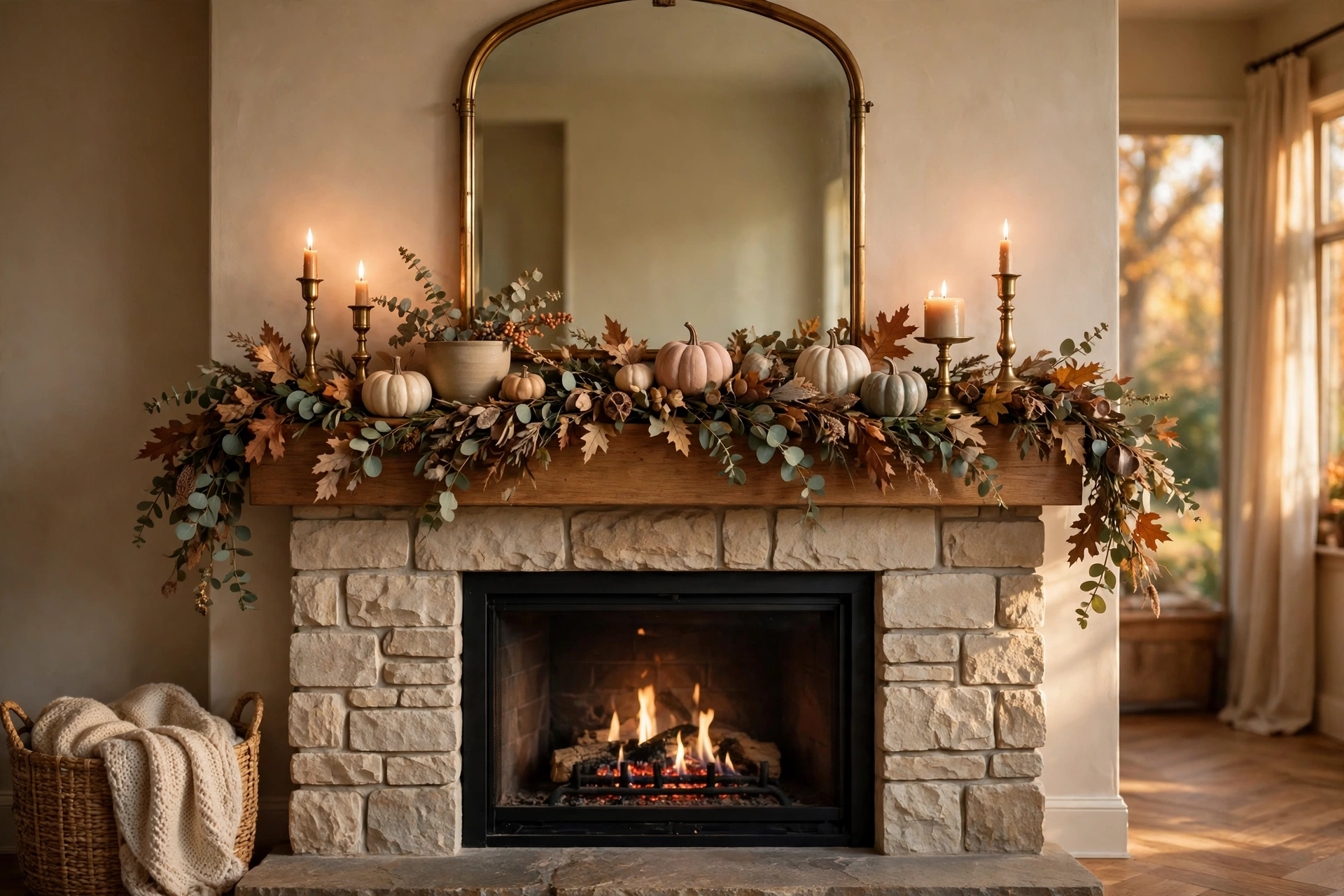
Every mantel needs a dominant piece: a mirror, a large framed print, a wreath, or a pair of substantial candlesticks treated as one unit. As a rule of thumb, an anchor somewhere between half and two-thirds the width of the mantel shelf reads as balanced against the firebox below. Everything else supports the anchor; nothing should compete with it at the same size and height.
Vary the Height on Purpose
A row of objects all the same height looks like a shop shelf. Aim for a gentle skyline: tall pieces flanking the anchor (candlesticks, vases of branches), medium pieces between, and low pieces in front — small pumpkins, a wooden bowl, a flat stack of books. Step back and squint: you want a rhythm of high, low, high, not a plateau.
Group in Odd Numbers
Clusters of three or five read as intentional where pairs can read as static: a trio of pumpkins in graduating sizes, three candlesticks of different heights, five gourds trailing along the shelf. Pairs still suit traditional symmetrical mantels, but treat each pair as one unit and add a third element nearby.
Layer Front to Back
Depth separates a decorated mantel from a lined-up one. Work in three loose layers: back (the anchor, tall frames leaned rather than hung), middle (garland, medium vases, candlesticks), and front (small objects at the shelf’s edge, pieces draped over the front). Leaning frames is an easy win — they overlap the wall zone, cast soft shadows, and swap out in minutes.
Phase One: The Early-Fall Look (September)
In September the light is still bright and the weather barely cool, so the mantel should whisper the season rather than announce it.
🛒 Shop This Look:
Greenery and Neutrals
Start with a base of greenery: a eucalyptus or olive-branch garland draped loosely along the shelf, or tall dried grasses in a heavy vase. Faux greenery earns its keep here because it has to last three months — choose varied leaf sizes and matte finishes, and bend every stem, since un-bent faux stems are the fastest giveaway. Keep the palette quiet: cream, linen, warm wood, stoneware, blackened metal. Interest comes from texture — a woven runner under the garland, rough ceramic beside smooth glass, one white or pale-sage pumpkin as an early nod to harvest. This restraint pays off: every warm color added in October pops against the calm base instead of fighting it.
- Garland or tall greenery in place as the base layer
- Anchor centered, leaned or hung
- Two tall elements for height, one low wide element in front
- Neutrals throughout, texture doing the talking
Phase Two: Deepening the Look for October
October is when the mantel earns its pumpkins — and the base stays exactly where it is. You are adding a layer, not starting over.
Add pumpkins in one color family rather than a carnival mix: all orange against a neutral base, all white and sage for a softer scheme, or heirloom varieties in muted blue-grey. Use the odd-number rule — a cluster of three at one end, a single statement pumpkin at the other, minis scattered along the front edge.
Then bring in warm metals and light. Swap or supplement darker metals with brass, copper, and antique gold, which glow against autumn color: candlesticks in mixed heights, a copper bowl, a brass tray under a pumpkin cluster. Candles at two or three heights make the arrangement feel alive in the evening, when a fall mantel is really seen — tapers in holders, pillars in glass hurricanes, votives in the garland’s gaps. Realistic flameless candles are the safer choice with kids, pets, or a working fireplace; the safety rules below cover the clearances that matter.
Phase Three: The Thanksgiving Version
Thanksgiving asks the mantel to feel abundant and a little more formal, since it now dresses the room where people gather and eat.
Weave in the harvest: dried wheat tucked into the garland, a bowl of walnuts or chestnuts, pomegranates and pears, and deeper color — burgundy, rust, plum, forest green — layered over October’s oranges. A plaid or velvet ribbon threaded through the garland, or bows at its swag points, instantly reads more dressed-up.
One gratitude touch is welcome at Thanksgiving if it stays simple: a small framed print with a short line, wooden letter tiles along the shelf, or a “thankful tree” — a vase of bare branches where guests hang paper leaves noting what they are grateful for. Keep it to one piece; the mantel should still be decor first.
Finally, coordinate with the table. In open-plan rooms the mantel and dining table are seen in the same glance, so echo two or three elements across both — same pumpkin family, same metal, same ribbon. The Thanksgiving table centerpiece ideas guide picks up exactly here.
🛒 Shop This Look:
Garland Options
Eucalyptus. The most forgiving choice: soft blue-green color that suits all three phases, drapes beautifully, and pairs with every metal. Leaf garlands — maple, oak, or mixed — make the strongest seasonal statement and suit October and Thanksgiving best; layer one over a greenery base rather than starting with it in September, and choose matte, varied-color leaves. Dried and natural garlands — grasses, wheat, preserved leaves, pinecones — bring unmatched texture for rustic or neutral schemes, but they are the most fragile and most flammable option here, so keep them well clear of flame and heat. Whichever you choose, drape it in swags rather than a straight line, let the ends trail asymmetrically, and secure it with removable hooks or wire at the back so nothing slides toward the firebox.
Pairing With a Mirror or Artwork
A round mirror over the mantel is a classic for good reason: it bounces candlelight, breaks up the fireplace’s rectangles, and accepts a wreath hung over it in October for an easy layered moment. Framed art leans more personal — a landscape in autumn tones can be the color source the whole arrangement borrows from. Leave breathing room between the frame and your tallest objects, and check the heat clearances below before hanging anything above a working fireplace. The same styling continues out the front door in the Thanksgiving entryway and front porch decor ideas, so guests meet one coherent look from porch to fireplace.
Fireplace Safety: Read This Before Lighting Anything
- Keep the firebox surround clear. Nothing combustible — garland, fabric, paper, dried arrangements — should hang into or sit close beside the firebox opening. A widely used guideline keeps decorations at least 12 inches from the opening on the sides and well above it on the shelf; if your fireplace manufacturer or local code specifies clearances, those numbers win.
- Mind what hangs over the front. Garland swags, banners, and stockings draped below the shelf edge sit in the path of rising heat and stray sparks. When a fire is lit, move draped items up onto the shelf or take them down.
- Dried means flammable. Dried grasses, leaves, wheat, and pinecones ignite easily and burn fast. Never weave them around lit candles, and think twice about using them on a mantel over fires lit nightly.
- Contain candles. Pillars belong in glass hurricanes and tapers in snug, tip-proof holders, with nothing lit under a shelf, frame, or garland tail. Flameless candles remove the risk entirely and are the sensible default over a working fireplace.
- Heat damages decor too. Rising heat warps faux greenery, melts wax and adhesives, and discolors frames. If the shelf feels noticeably warm during a fire, raise artwork, choose heat-tolerant materials, or save the lush arrangement for a non-working fireplace.
- Basics still apply. Working smoke and carbon monoxide alarms, a chimney inspected and cleaned on schedule, and a screen or doors in front of the fire matter more than any styling choice.
No Mantel? Steal the Formula Anyway
Everything above works on any horizontal surface at eye level. A floating shelf takes the identical treatment — anchor art leaned against the wall, garland draped along it, clusters in odd numbers. A console table is arguably better: the lower tier takes baskets or books beneath. A dresser top, piano top, or wide windowsill hosts a scaled-down version — one anchor, one garland, one cluster of three. Electric and ventless fireplaces with a shallow shelf count too; follow the manufacturer’s heat guidance for anything placed above them. Pick the surface your room actually looks at and give it the three-phase treatment.
FAQ
When should a fall mantel go up, and when does it come down?
The greenery-and-neutrals base can go up with the first cool week and earns its place for three months. Add pumpkins in October, enrich for Thanksgiving, and take it all down when you decorate for the winter holidays. Storing garland, anchor, and candlesticks in one labeled bin makes next year’s base a ten-minute job.
How do you decorate a mantel with a TV above it?
Keep everything low and wide: a garland along the shelf, short clusters at each end, nothing tall enough to crowd the screen. The TV is the anchor, so skip the big frame. Use flameless candles only — heat from both the TV and the fireplace rises into the same zone.
Can a fall mantel work in a small living room?
Yes — adjust scale, not stuff. A slimmer garland, one cluster of three pumpkins instead of two, candlesticks instead of bulky vases. A mirror anchor actually helps a small room by doubling light. The formula stays identical; every element just gets one size smaller.
What colors carry a mantel from September to Thanksgiving?
Cream, warm wood, sage, and antique brass work in every phase. October adds orange or heirloom pumpkin tones; Thanksgiving deepens with burgundy, rust, or plum. Because the base never changes, each phase reads as the same mantel maturing rather than three redecorations.
Conclusion
A fall mantel needs neither three shopping trips nor three storage bins. Give it a strong anchor, varied heights, odd-numbered clusters, and layered depth; dress it in greenery for September, pumpkins and warm metal for October, and harvest richness for Thanksgiving; and respect the clearances a working fireplace demands. One thoughtful arrangement carries the room gracefully through the whole season.
🛒 Shop This Look:



