
As an Amazon Associate, I earn from qualifying purchases. This means I may earn a commission if you purchase through links on this page — at no extra cost to you.
Watercolor prints do something few other kinds of wall art can do: they lower the volume of a room. Where a sharp photograph or a bold graphic demands attention, a watercolor wash sits quietly, letting color drift across the paper the way light drifts across a wall. That softness is the whole appeal — and it is also easy to lose. The wrong paper, the wrong frame, or a print hung too high on a bare wall can turn a gentle watercolor into a pale, washed-out afterthought. This guide covers how to choose, print, and hang watercolor printable art so it stays soft.
Start With the Room, Not the Print
Before you fall in love with a particular print, look at the wall it will live on. A watercolor’s pale tones need a wall that lets them breathe. On a white or pale warm wall, soft florals and pastels read clearly. On a deep or saturated wall, the same print can disappear, because there is not enough contrast between the paper’s white space and the wall behind it. If your wall is dark, choose watercolors with stronger color masses — deep botanicals, moody landscapes, saturated abstracts — rather than the palest washes.
Light matters just as much. A north-facing room with cool, even light flatters watercolor’s soft edges. A sunny south-facing wall will bleach pale pigments over time, so keep your most delicate prints out of direct sunbeams, or hang them on a wall the sun never strikes directly. If the only free wall gets strong sun, choose prints with deeper color and protect them behind UV-filtering glazing, covered later in this guide.
Finally, measure the wall. A small print on a large empty wall looks lost, however beautiful the art is. As a rough guide, a single statement print should cover roughly two-thirds of the width of the furniture below it — a sofa, a console, a bed headboard. If the wall is wide and the prints you love are small, plan a cluster rather than forcing one small piece to carry the whole wall.
Choose Subjects That Suit Watercolor
Watercolor flatters some subjects and fights others. It is at its best with florals, botanicals, soft landscapes, skies, ocean washes, and abstracts built from layered color. These subjects use the medium’s strengths: bleeding edges, transparent layers, and gentle transitions. A loose floral or a misty landscape looks intentional in watercolor because the medium itself is loose and misty.
Subjects that need hard edges and fine detail — architectural drawings, detailed portraits, crisp geometric patterns — usually look better in another medium. In watercolor they can come out muddy or vague, and no amount of careful printing fixes a subject the medium was never suited to. If you love geometric art, look for abstract printable art in bolder styles, and keep watercolor for the subjects it handles gracefully.
Line art is a middle case. Minimalist watercolor line drawings — a single botanical stem, a spare contour — work beautifully because the line gives the soft wash a structure to hold onto. If you like that look, minimalist line art printables pair well with fuller watercolor pieces in the same room, giving the eye something crisp to rest on between washes.
Color: How Soft Stays Soft
The most common mistake with watercolor walls is too many palettes at once. A blush floral, a sage landscape, a terracotta abstract, and a lavender wash can each be lovely alone and chaotic together, because watercolor’s pale tones have no strong outlines to separate them. Pick one dominant hue family for the wall — warm blush and peach, cool sage and blue, earthy terracotta and ochre — and let the other prints echo it rather than compete with it.
Neutrals are your rest areas. White space inside the print, a wide mat, and a pale wall between frames all give the eye somewhere to pause. Without those pauses, even a single-palette cluster feels busy. When you are choosing between two prints you love, pick the one whose background is quieter; the print with the calmer background will live more easily on your wall for years.
Room function should shape the palette too. In a bedroom, the softest palettes — blush, beige, pale sage — support rest, and romantic printable art for cosy bedrooms shows how those tones work at bedside. In a home office, slightly stronger watercolor color — dusty blue, muted green — holds attention without shouting, and pairs well with the calmer end of paint colors for home offices. In a workspace that needs focus, office printable art in restrained tones beats bright, high-contrast pieces that pull the eye away from work.
🛒 Shop This Look:
Paper Makes or Breaks It
Paper choice decides whether a watercolor print looks soft or washed out. Use a matte fine-art paper or a heavyweight matte paper, at least 200 gsm, with a slightly textured surface. The texture catches light the way real watercolor paper does, and the weight keeps the sheet flat in the frame instead of rippling with humidity changes.
Glossy photo paper fights the watercolor look. Its shine hardens soft edges, adds glare under room lighting, and makes a watercolor print read like a photograph that lost its contrast. If you are ordering prints from a print shop rather than printing at home, ask for matte or fine-art paper explicitly — the default at many shops is lustre or glossy, which suits photographs and ruins washes.
Weight matters for another reason: thin paper shows every wave and buckle once framed, especially in a bathroom-adjacent hallway or any room where humidity shifts through the day. Heavyweight matte paper stays flat, and its slight tooth gives the ink something to grip, keeping gradients smooth and edges gentle.
Printing at Home Without Washing Out the Color
Home printing is where most watercolor prints go wrong, and it is almost always fixable. In the printer settings, choose the best or photo quality option and select the matte paper type, so the printer lays down the right amount of ink for absorbent paper. The wrong paper setting starves a matte sheet of ink, which is the single most common cause of pale, washed-out prints.
Print one small copy first and check the colors in daylight before committing to a full-size print. Screens run brighter than paper, and soft pastels are the first colors to disappear on the page. If the test print looks pale, raise the saturation slightly in the print dialog and print another small copy rather than guessing at full size. Two small test prints cost far less than one large disappointment.
Keep the file’s original resolution intact — do not let an app downscale it to fit a page — and print from the original file rather than a screenshot or a compressed copy. Watercolor gradients show compression artifacts as banding, those faint stripes across what should be a smooth wash. If a gradient bands, the file has been compressed somewhere along the way; go back to the original download.
Sizing and Placement Rules
Center the print at eye level: the middle of the artwork roughly at the eye level of a standing adult for hallways and living rooms, and slightly lower above a sofa or bed, where viewers are usually seated. Hanging too high is the most common placement error, and it makes even a good print feel disconnected from the room.
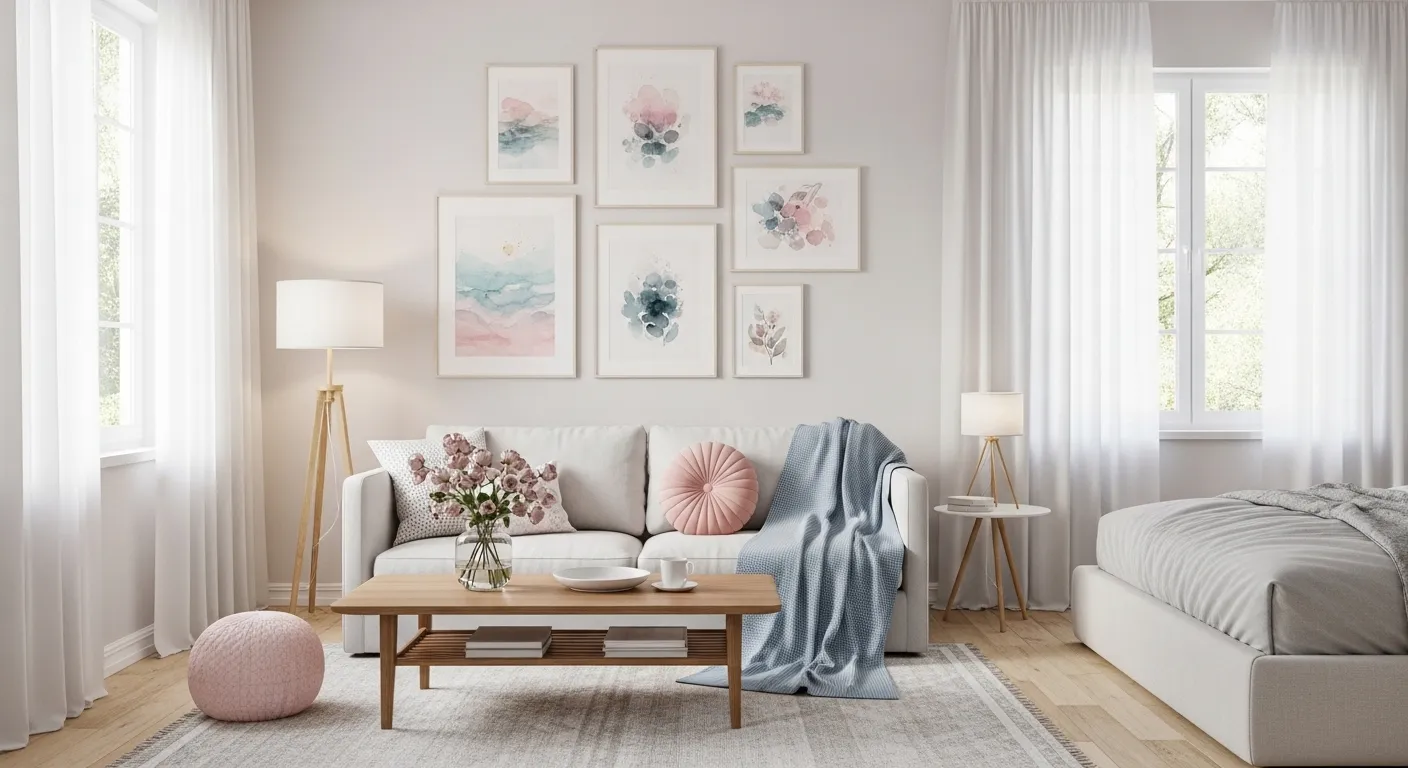
For clusters, treat the group as one shape. Lay the frames on the floor first and arrange them until the outer outline feels balanced, then transfer that arrangement to the wall with consistent gaps between frames — a couple of inches, kept even, reads calmer than gaps that widen and narrow. If you need help with small-wall clusters, small gallery wall ideas covers spacing and balance for tight walls.
Leave breathing room around the group. A cluster crammed into a corner or pressed against a doorframe feels accidental. Give the arrangement a margin of empty wall on all sides, and keep it clear of light switches, thermostats, and vents where possible — practical obstacles that force awkward gaps.
🛒 Shop This Look:
Framing and Glazing for Soft Art
A wide mat is watercolor’s best friend. It gives the wash a quiet border, stops the frame from crowding the art, and makes a modest print feel larger and more considered. White or off-white mats suit most watercolors; a colored mat should pick up a minor tone from the print, never its loudest color, or the mat will shout over the art.
For glazing, standard glass is fine in a room without direct sun, but UV-filtering glass or acrylic is worth it on any wall that gets daylight. Watercolor pigments fade faster than many inks, and pale washes show fading first. Acrylic is lighter and shatter-resistant, which matters for large frames and for any wall above a bed or a child’s play area; glass is heavier and more scratch-resistant, which suits smaller frames in adult spaces.
Frame color should stay quiet: natural wood, white, black, or pale gold. A loud or ornate frame competes with exactly the softness you chose watercolor for. When in doubt, choose the simplest frame that holds the print safely — the art should be the most interesting thing on the wall, not its border.
Hanging Without Damaging Prints
Match the hanging method to the frame’s weight. Small framed prints suit adhesive strips within the strip’s printed rating; medium frames need a nail or hook into the wall; large or heavy frames need a fixing into a stud or a proper hollow-wall anchor. Never hang a heavy frame from a single adhesive strip and hope — the failure mode is a frame on the floor and a torn print.
For renters, picture ledges are a strong option: one ledge, screwed into studs once, holds a rotating cast of prints that lean rather than hang. Ledges also solve the watercolor cluster problem, because you can rearrange prints by sliding them along the shelf instead of drilling new holes for every change of heart.
Keep prints out of steamy rooms. A watercolor above a bathroom towel rail or beside a kitchen kettle will ripple and spot over time, however well framed. If a hallway near a bathroom is the only spot, choose a well-sealed frame and check the print each season for early signs of moisture damage.
Mistakes That Harden a Soft Print
Glossy paper is the first mistake, and the easiest to avoid once you know it. Direct sun is the second — a print that looked perfect in June can be a ghost by September if it hangs in a sunbeam. Too-small prints on big walls are the third: one tiny wash on a long empty wall reads as an afterthought, not a statement. Cluster small prints, or choose a larger size, rather than leaving a small piece to carry a wall alone.
Clashing frames are the fourth. Mixed frame styles can work in a gallery wall, but for watercolor specifically, keep the frames within one quiet family — all natural wood, or all thin black — so the frames do not add visual noise to art whose whole point is quiet. Overcrowding is the fifth: watercolor needs white space around it, on the wall as well as inside the print. If the wall feels busy, remove a frame before adding one.
Care and Rotation
Dust framed prints with a dry microfiber cloth, never a damp one, and never spray cleaner directly onto glazing — spray the cloth, then wipe, so no liquid creeps under the frame edge onto the paper. Check prints on sunny walls each spring for fading at the edges, which shows before the center fades.
Rotation suits watercolor particularly well. Because prints are inexpensive to produce, you can swap a spring floral for an autumn landscape without guilt, and the wall stays fresh while the stored prints stay safe in a flat, dry place between turns. A small collection of four or five prints, rotated through the year, gives a room more life than one expensive piece left unchanged for a decade.
🛒 Shop This Look: