
As an Amazon Associate, I earn from qualifying purchases. This means I may earn a commission if you purchase through links on this page — at no extra cost to you.
Yes, you can hang wall art in bathrooms if you choose moisture-resistant options and ensure decent ventilation. Best choices are metal prints, acrylic prints, sealed canvas, or framed pieces with moisture-resistant backing. Avoid unsealed paper prints, valuable originals, and anything with exposed wood in steamy bathrooms.
Best Art Types for Bathrooms
- Metal prints: Completely waterproof, vibrant colors. Best option.
- Acrylic prints: Sealed and moisture-proof. Premium look.
- Sealed canvas: Varnished canvases resist humidity well.
- Framed with sealed backing: Use frames with full dust covers and silica packets inside.
What to Avoid
- Unframed paper posters (warp and mold)
- Exposed wood frames (swell and crack)
- Valuable originals (not worth the risk)
- Anything directly above the shower
Our 60-Day Humidity Test
We placed three art types in a bathroom with daily showers (no exhaust fan): a metal print, a sealed canvas, and a framed paper print. After 60 days, the metal print was perfect, the canvas showed slight edge curling, and the paper print had visible warping. Ventilation makes a huge difference — with an exhaust fan, all three would fare better.
Understanding Bathroom Humidity Zones
Not every spot in a bathroom experiences the same moisture, and where you hang matters as much as what you hang. Think of the bathroom in three zones. Zone 1 — the splash zone: inside the shower or tub surround, directly above the tub, and the wall the showerhead faces. Humidity here is extreme and constant; hang nothing here except purpose-made waterproof pieces (tile murals, sealed metal prints rated for wet areas). Even metal prints have limits when directly sprayed daily. Zone 2 — the steam zone: walls within a few feet of the shower or tub, and any wall in a small bathroom with no exhaust fan. Steam reaches these walls every shower and condenses on cool surfaces. Sealed, moisture-resistant art works here, but paper-based pieces will eventually suffer. Zone 3 — the dry zone: the wall by the door, the wall opposite the shower in a larger bathroom, and powder rooms with no shower at all. Humidity here is barely above normal household levels, and almost any art survives with basic precautions.
Ventilation redraws these zones. A bathroom with a properly sized exhaust fan run during and for 20 minutes after every shower effectively shrinks Zone 1 to just the shower interior and moves most walls into Zone 3. A bathroom with no fan and a closed door keeps every wall in Zone 1 or 2 permanently. Before choosing art, honestly assess your ventilation — it is the variable that matters most, more than the art type itself.
The simplest test: after a hot shower, check the mirror. If it is fully fogged and stays fogged for 20+ minutes, your bathroom runs wet and you should treat every wall as Zone 1–2. If it clears within minutes, you have decent airflow and Zone 3 options open up.
Hanging Hardware That Survives Moisture
Art fails in bathrooms as often from the hanging hardware as from the art itself. Standard picture-hanging wire rusts, cheap sawtooth hangers corrode, and adhesive strips lose grip in humidity and drop frames without warning.
Use stainless steel or brass hardware — D-rings and wire in stainless, or brass hooks — which will not rust in humid air. Avoid plain steel wire and uncoated nails. For heavier pieces, stainless steel French cleats distribute weight and hold firmly; they also stand the frame slightly off the wall, which improves airflow behind the piece and reduces the chance of moisture trapping and mildew on the wall.
🛒 Shop This Look:
Skip adhesive hanging strips in steamy bathrooms entirely. They are rated for normal indoor humidity, and bathroom steam cycles degrade the adhesive over months until the bond fails suddenly. If you must avoid holes (renters), use them only in Zone 3 powder rooms with no shower, and check the bond monthly.
Whatever hardware you use, leave a small air gap behind the frame. Bumpers (small adhesive pads) on the frame’s bottom corners hold it slightly off the wall, letting air circulate instead of trapping condensation between frame and paint. This one detail prevents the mildew outline that appears behind tightly hung frames in humid bathrooms.
How to Seal and Protect a Framed Print for the Bathroom
If you want to hang a favorite print in the bathroom rather than buying a metal or acrylic piece, you can moisture-proof a standard frame with a few steps. This works for Zone 2 and 3 placement — not for the splash zone.
Step 1: Seal the print itself. Spray the printed side with two light coats of archival clear sealant (matte), letting each coat dry fully. This makes the paper surface moisture-resistant. Do not soak it — light mist coats, built up gradually.
Step 2: Use glazing. Frame the print behind glass or acrylic, not open. Acrylic (plexiglass) is lighter and will not shatter if it falls, which matters in a bathroom; conservation-grade acrylic also filters UV. Make sure the print does not touch the glazing — use a mat or spacers so condensation on the inside of the glass never contacts the paper.
Step 3: Seal the back. This is the step most people skip, and it is the most important. Cover the entire back of the frame with kraft paper dust cover (or acid-free backing board), sealed at the edges with tape. Moisture enters frames from the back far more than the front. Tuck one or two silica gel packets inside before sealing — they absorb the humidity that does get in. Replace the packets yearly.
Step 4: Choose the right frame material. Sealed wood, metal, or molded polymer frames all work. Avoid raw or unfinished wood, which absorbs moisture, swells, and eventually cracks the joints. If you love a wood look, choose a frame with a sealed/lacquered finish.
Step 5: Inspect twice a year. Take the piece down, check the back for any mildew spots or warping, replace silica packets, and re-seal any lifting edges of the dust cover. Ten minutes twice a year keeps a framed print safe indefinitely in Zone 2–3 bathrooms.
🛒 Shop This Look:
Art Ideas That Work Especially Well in Bathrooms
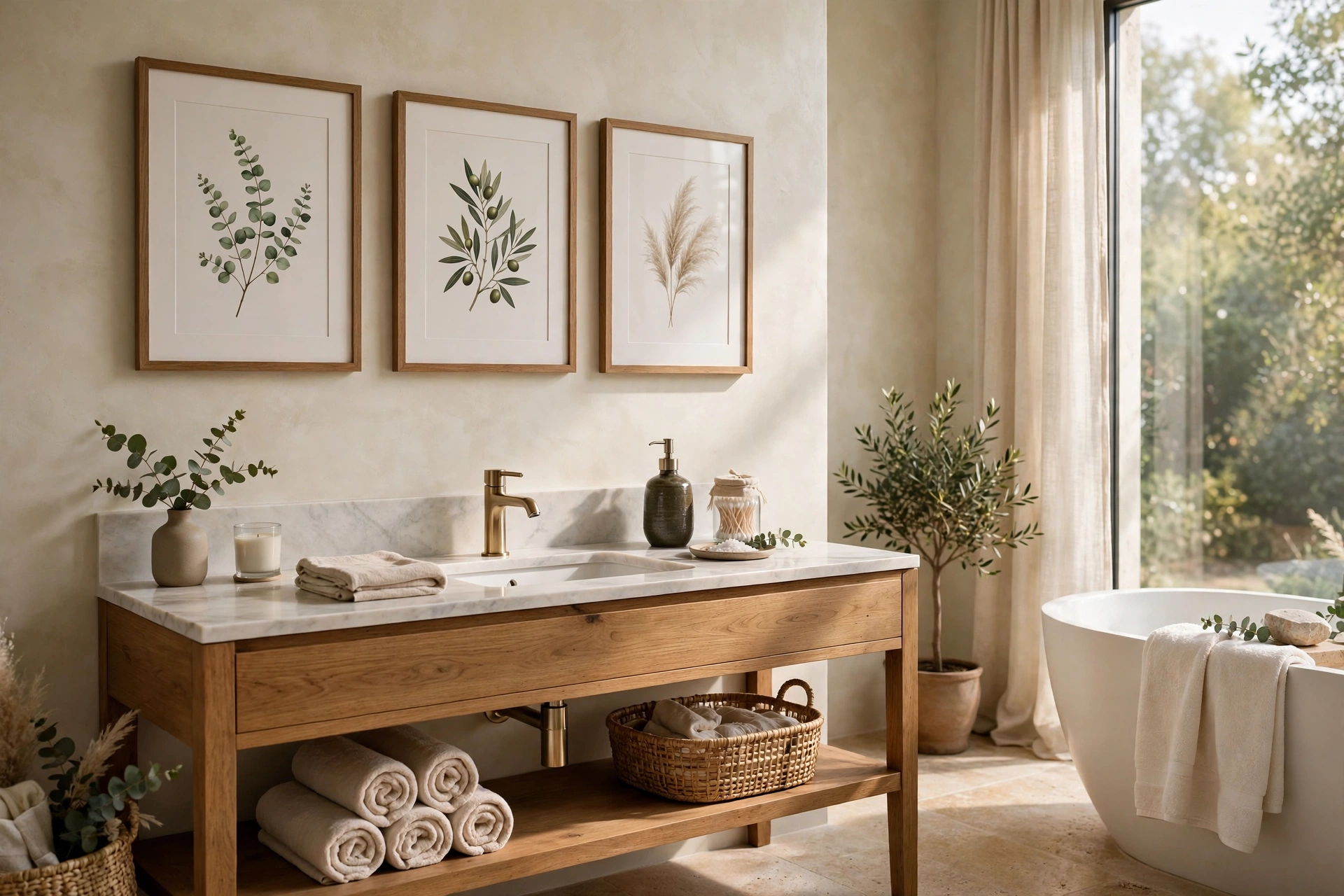
Certain subjects and styles suit bathrooms naturally. Botanical and coastal prints echo the water theme without being literal — ferns, eucalyptus, ocean abstracts, and beach photography feel at home in a bathroom in a way they might not in a living room. Black-and-white photography is nearly indestructible visually: it suits any bathroom color scheme, and monochrome prints show humidity damage less visibly than color pieces if any occurs. Typography and line art — simple quotes, single-line drawings — read cleanly in small spaces and suit the bathroom’s brief-visit nature; you absorb them in a glance.
Scale down. Bathrooms are small, and oversized art overwhelms them. One medium piece (16×20 or so) or a pair of small coordinating prints is the right scale for most bathrooms. Above the toilet is the classic spot — it is Zone 3 in most layouts, it fills the awkward empty wall, and it is at perfect viewing height. Beside the mirror works too, but keep art out of the direct splash path of the sink.
Consider pieces you can rotate. Because bathroom art lives a harder life than art elsewhere, some people keep a small rotation: two or three inexpensive prints swapped seasonally. Rotation means no single piece takes years of cumulative humidity, and it keeps the small space feeling fresh. Inexpensive art plus rotation beats one precious piece slowly deteriorating.
Maintenance: Keeping Bathroom Art Looking Good
Even the right art in the right zone needs occasional attention. Wipe metal and acrylic prints with a soft dry cloth every few months — never spray cleaner directly on them, as liquid can seep behind edges. For framed pieces, the twice-yearly back inspection described above is the whole maintenance routine.
Watch for the early warning signs: slight rippling at the edges of a print, a musty smell when you take a frame down, tiny dark spots on a mat or backing board, or condensation regularly forming on the glazing. Any of these means the piece is telling you the location is too wet — move it to a drier wall or a drier room before the damage becomes permanent. Art is replaceable; the lesson is free the first time only if you act on it.
Finally, run the exhaust fan. It is the cheapest art-preservation device in the bathroom, and it protects the paint, the grout, and the mirror as well. Twenty minutes after every shower. If your fan is loud, old, or weak, replacing it is one of the highest-value small upgrades a bathroom can get — for the art and for everything else.
Placement Tips
Hang away from direct water spray. Above the toilet or beside the mirror are safest. Ensure at least some airflow — a bathroom with no ventilation will damage any art eventually.
One last rule of thumb: if you would hesitate to hang a piece there because of the steam, trust that instinct — move it to the hallway or bedroom instead. Bathrooms reward art that is moisture-proof, replaceable, or both, and punish sentimentality. Choose accordingly and your bathroom walls will look intentional for years.
🛒 Shop This Look:



