
As an Amazon Associate, I earn from qualifying purchases. This means I may earn a commission if you purchase through links on this page — at no extra cost to you.
To find your perfect wall art size, measure your wall width and the furniture below (if any), then calculate: for art above furniture, multiply furniture width by 0.66 (minimum) and 0.75 (maximum). For standalone walls, art should fill 60-75% of the available wall space. Our calculator below does the math for you. Related: Free Wallpaper Roll Calculator: How Many Rolls Do You Need.
How to Use This Guide as a Calculator
Above Furniture Formula
Step 1: Measure furniture width (e.g., 84″ sofa)
Step 2: Multiply by 0.66 = 55″ (minimum art width)
Step 3: Multiply by 0.75 = 63″ (maximum art width)
Result: Your art should be 55-63″ wide
Standalone Wall Formula
Step 1: Measure wall width (e.g., 120″)
Step 2: Subtract 24″ for breathing room = 96″
Step 3: Multiply by 0.7 = 67″ ideal art width
Quick Reference Table
Sofa 60″: Art 40-45″ wide
Sofa 72″: Art 48-54″ wide
Sofa 84″: Art 55-63″ wide
Sofa 96″: Art 63-72″ wide
Queen bed 60″: Art 40-45″ wide
King bed 76″: Art 50-57″ wide
Console 48″: Art 32-36″ wide
Height Calculator
Center of art = 57″ from floor (standard). Above furniture: bottom of frame = furniture top + 6-8″. For a 36″ high console, frame bottom at 42-44″, so a 24″ tall piece centers at 54-56″ — close to ideal.
Gallery Wall Sizing
Treat the entire arrangement as one piece. Measure the outer dimensions of your planned layout and apply the same 60-75% rule. Leave 2-3″ between frames.
How to Measure: A Step-by-Step Walkthrough
Accurate sizing starts with accurate measuring. Grab a metal tape measure (fabric ones stretch), a pencil, and a notepad or phone, then work through this sequence:
- Measure the furniture width. For art above a sofa, console, bed, or sideboard, measure the full outside width of the furniture piece — not the cushion width, the entire frame. Write it down in inches.
- Measure the wall. Measure the full width of the wall section where the art will hang — between doorways, corners, or architectural breaks, not the entire room wall if the art only occupies part of it.
- Measure the available height. Note the ceiling height and the top of the furniture. The vertical space between furniture top and ceiling is your height budget — art plus the gap above furniture must fit comfortably within it.
- Note the viewing distance. Art in a hallway viewed from 3 feet away reads differently from art across a 15-foot living room. Larger rooms and longer viewing distances call for the upper end of every size range — small art disappears across a room.
- Record everything in one place. Wall width, furniture width, ceiling height, viewing distance. Sizing decisions get much easier when all four numbers are in front of you instead of half-remembered.
Measure twice before ordering — art is expensive to ship back, and custom framing is non-returnable.
Worked Examples: Six Common Scenarios Solved
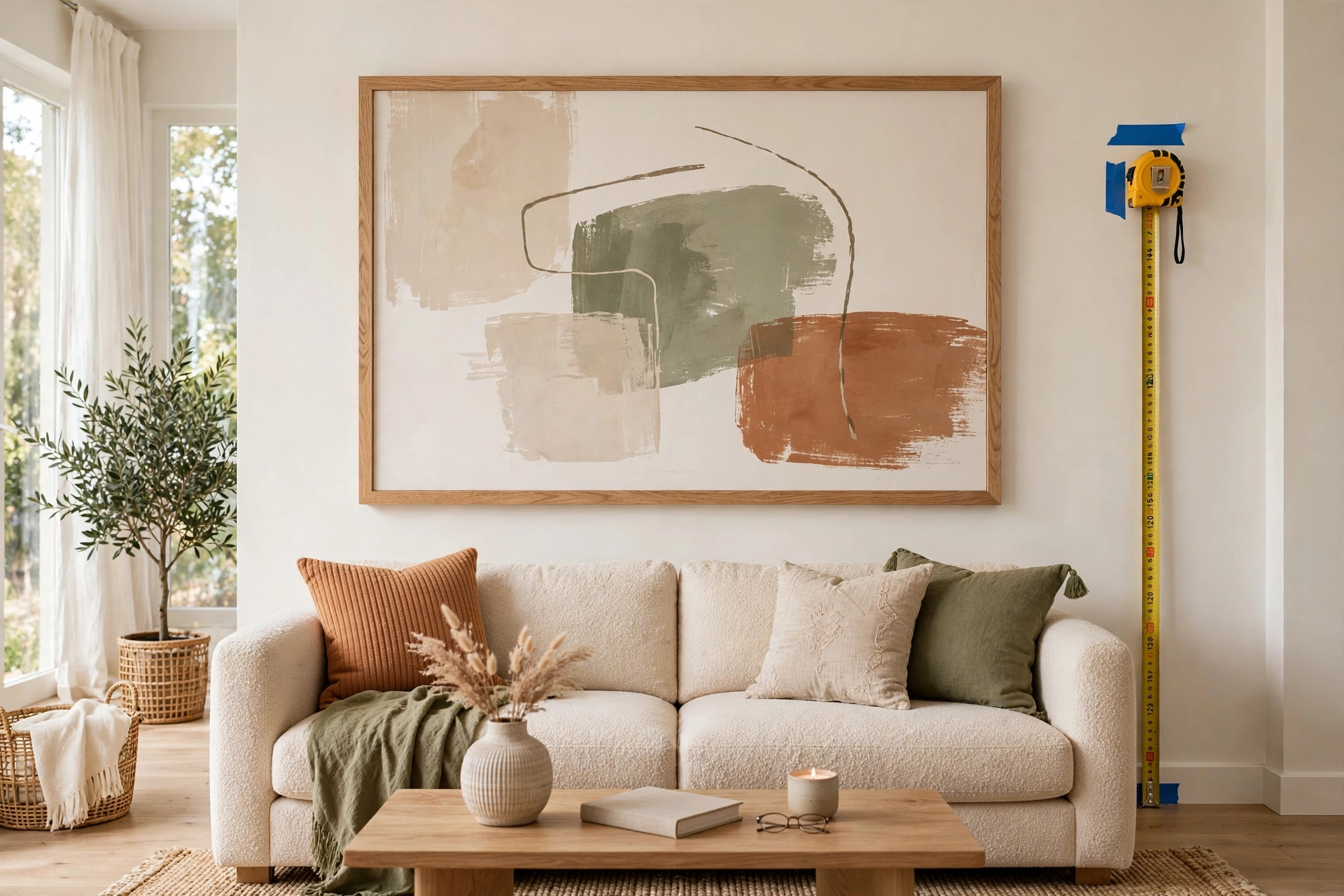
Scenario 1: Art above an 84-inch sofa. Furniture width 84″ × 0.66 = 55″ minimum; × 0.75 = 63″ maximum. Target art (or arrangement) 55–63 inches wide. Height: sofa back is typically 32–36 inches; hang the frame’s bottom edge 6–8 inches above it. A 40×60-inch piece fits beautifully. Common mistake: hanging a 24×36-inch print that looks like a postage stamp over the sofa.
🛒 Shop This Look:
Scenario 2: Art above a king bed (76 inches wide). 76 × 0.66 = 50″; × 0.75 = 57″. Target 50–57 inches wide. Because beds are viewed mostly straight-on and the headboard occupies vertical space, a wide horizontal piece (or a pair of 24-inch squares side by side = 48–51 inches with gap) suits best. Hang the bottom edge 8–12 inches above the headboard.
Scenario 3: Art above a 48-inch console in an entryway. 48 × 0.66 = 32″; × 0.75 = 36″. Target 32–36 inches wide. Entryways are viewed briefly and from close up, so the middle of the range works well. A 30×30-inch square or 24×36-inch portrait piece both land in range. Mirror alternative: a 32-inch round mirror follows the same math.
Scenario 4: Art above a 72-inch dining sideboard. 72 × 0.66 = 48″; × 0.75 = 54″. Target 48–54 inches wide. Dining rooms are viewed from seated height across the table — generous sizing reads well. A 40×50-inch landscape piece or a triptych of three 16×20-inch frames (totaling ~52 inches with gaps) both work.
Scenario 5: Standalone wall, 10 feet (120 inches) wide, no furniture. Subtract 24 inches breathing room = 96″; × 0.7 = 67″ ideal art width. A 48×68-inch oversized piece, or a gallery arrangement measuring roughly 60×40 inches overall, fills the wall without crowding it. On standalone walls, err toward the larger end — empty wall around properly scaled art looks intentional; too-small art looks lost.
Scenario 6: Staircase wall. Staircase art follows the stairs’ angle rather than level hanging — arrange pieces so their centers follow an imaginary line parallel to the stair slope, roughly 57 inches above each tread nosing (measured vertically). Treat the arrangement as one unit sized to the wall section, keeping 6–8 inches of clearance from the stair rail line.
Standard Frame Sizes and What They’re Good For
Knowing common sizes helps you shop and plan. These are the standard ready-made frame dimensions and their best uses:
- 8×10″ and 11×14″: Desk, shelf, and small-wall accents. Too small to hang alone on any wall — use in groups, on consoles, or in gallery arrangements.
- 16×20″: The smallest size that can hold a wall solo in a small space (powder room, hallway niche). More commonly used in pairs, triptychs, or gallery walls.
- 18×24″: Good above small consoles, in bedrooms, or as part of arrangements. A single 18×24 over a full-size sofa is undersized.
- 24×36″: The versatile workhorse — suits queen beds (in pairs), medium consoles, dining rooms, and small standalone walls.
- 30×40″: Strong single-piece size for sofas, king beds, and medium standalone walls.
- 36×48″ and larger: Statement sizes for large sofas, great rooms, and tall walls. Above 40×60 inches, expect to order custom or from large-format retailers.
Orientation guidance: Match the art’s orientation to the space — wide horizontal pieces suit sofas, beds, and consoles (furniture is wider than tall); portrait orientation suits narrow walls, spaces between windows, and tall narrow niches; square works almost anywhere and is the easiest to place. When torn between orientations, landscape over furniture and portrait on empty narrow walls is the reliable default.
Hanging Height Rules That Matter More Than Width
Perfectly sized art hung at the wrong height still looks wrong. These rules handle the vertical dimension:
- The 57-inch rule: In galleries and museums, art centers hang at 57 inches from the floor — average human eye level. Use this for standalone walls and hallways. It feels slightly low in homes with tall ceilings, which is correct — art relates to people, not to ceiling height.
- Above furniture: The bottom of the frame sits 6–8 inches above the furniture top (sofa back, console surface, headboard). This connects the art to the furniture visually — floating too high disconnects them into two unrelated elements.
- High ceilings: Do not raise art to “fill” tall walls — that is what larger art or stacked arrangements are for. Keep the 57-inch center (or the 6–8 inch furniture gap); fill upper wall space with taller pieces, not higher-hung ones.
- Above mantels: Bottom of frame 6–12 inches above the mantel shelf, accounting for decor that will sit on the mantel. Leave clearance for tall candlesticks or vases.
- Gallery walls: Center the entire arrangement at 57 inches, not each individual piece. The composition’s midpoint is what the eye reads.
When One Piece Isn’t Enough: Diptychs, Triptychs, and Gallery Walls
Sometimes the right width cannot be found in a single piece — or the budget does not stretch to one huge frame. Multi-piece arrangements solve both problems, sized as one unit:
🛒 Shop This Look:
Diptychs and triptychs: Two or three related pieces hung with 2–3 inches between them. Measure the total outside width (including gaps) and apply the same 2/3-to-3/4 rule. Triptychs are especially useful over wide sofas and beds — three 20×24-inch pieces with 3-inch gaps total roughly 66 inches wide, perfectly filling the space above an 84-inch sofa at a fraction of one large piece’s cost.
Gallery walls: Measure your planned arrangement’s total outside dimensions and size the composition to the wall or furniture using the standard formulas. Keep 2–3 inches between frames consistently — even spacing is what makes varied frames read as one intentional piece. Plan on the floor first: lay the arrangement out, measure the total footprint, then transfer to the wall with paper templates.
The gap rule: Gaps between pieces in a multi-part arrangement should be uniform and modest (2–4 inches). Wide, uneven gaps break the “one unit” illusion and the eye reads separate small pieces instead of one composition — which defeats the sizing purpose.
Frequently Asked Questions
Should art be wider or narrower than the furniture below it?
Narrower — specifically two-thirds to three-quarters of the furniture’s width. Art wider than the furniture looks top-heavy and unstable; art at half the furniture’s width or less looks lost. The 2/3–3/4 band is the range where the pairing looks deliberately composed.
How big should art be in a room with high ceilings?
Bigger than you think — tall walls swallow standard sizes. Scale up at least one size from what the furniture math suggests, or stack two pieces vertically. A 24×36-inch print that suits an 8-foot ceiling looks timid under a 12-foot one. When ceilings exceed 10 feet, think in terms of filling vertical space with larger or stacked art rather than hanging standard sizes higher.
Can art be too big?
Yes — art that exceeds about 85% of the furniture width below it, or that leaves less than 6 inches of breathing room to adjacent walls, trim, or ceilings, overwhelms the space. Oversized art also physically dominates small rooms regardless of wall space. The upper bound matters as much as the lower one.
Does frame width count in the measurement?
Yes — measure the total outside dimensions including the frame. A chunky 3-inch frame adds 6 inches to the total width, which can push a borderline piece into the right range or an already-large piece over it. When the calculator gives you a target width, that is the framed width.
What if my wall has a light switch or thermostat in the middle of it?
Size the art to the usable wall section, not the full wall — treat the obstacle as a boundary. Alternatively, choose two smaller pieces flanking the obstacle, or shift the arrangement’s center off the obstacle. Never center art directly over a visible switch; the eye goes to the interruption, not the art.
🛒 Shop This Look:



