
As an Amazon Associate, I earn from qualifying purchases. This means I may earn a commission if you purchase through links on this page — at no extra cost to you.
By Ella Knight
Small apartments are perfect for gallery walls because they turn blank walls into focal points without taking up floor space. The 15 best ideas include vertical arrangements above doorways, mini galleries on narrow hallway walls, picture ledges for damage-free hanging, and compact 2×2 grids above desks. Keep frames under 11×14 inches and stick to a cohesive color palette to avoid visual clutter.
Why Gallery Walls Work in Small Spaces
Every square inch counts in a small apartment. Gallery walls use vertical space — your walls — instead of precious floor space. They also make rooms feel intentional and finished, which is especially important when you’re working with 500 square feet.
15 Space-Smart Ideas
1. The Doorway Topper
Hang 3-4 small frames above a doorway. This often-wasted space becomes a mini gallery.
2. Hallway Runner
A single row of 5×7 frames down a hallway creates a gallery feel without overwhelming the narrow space.
3. Above-the-Desk Grid
A tight 2×3 grid of 8×10 frames above your desk adds personality to a work zone.
4. Kitchen Mini Gallery
Small food prints or vintage ads in 5×7 frames brighten up kitchen walls.
5. Bathroom Art Cluster
3-4 small moisture-resistant prints above the toilet or beside the mirror.
6. The Ledge Solution
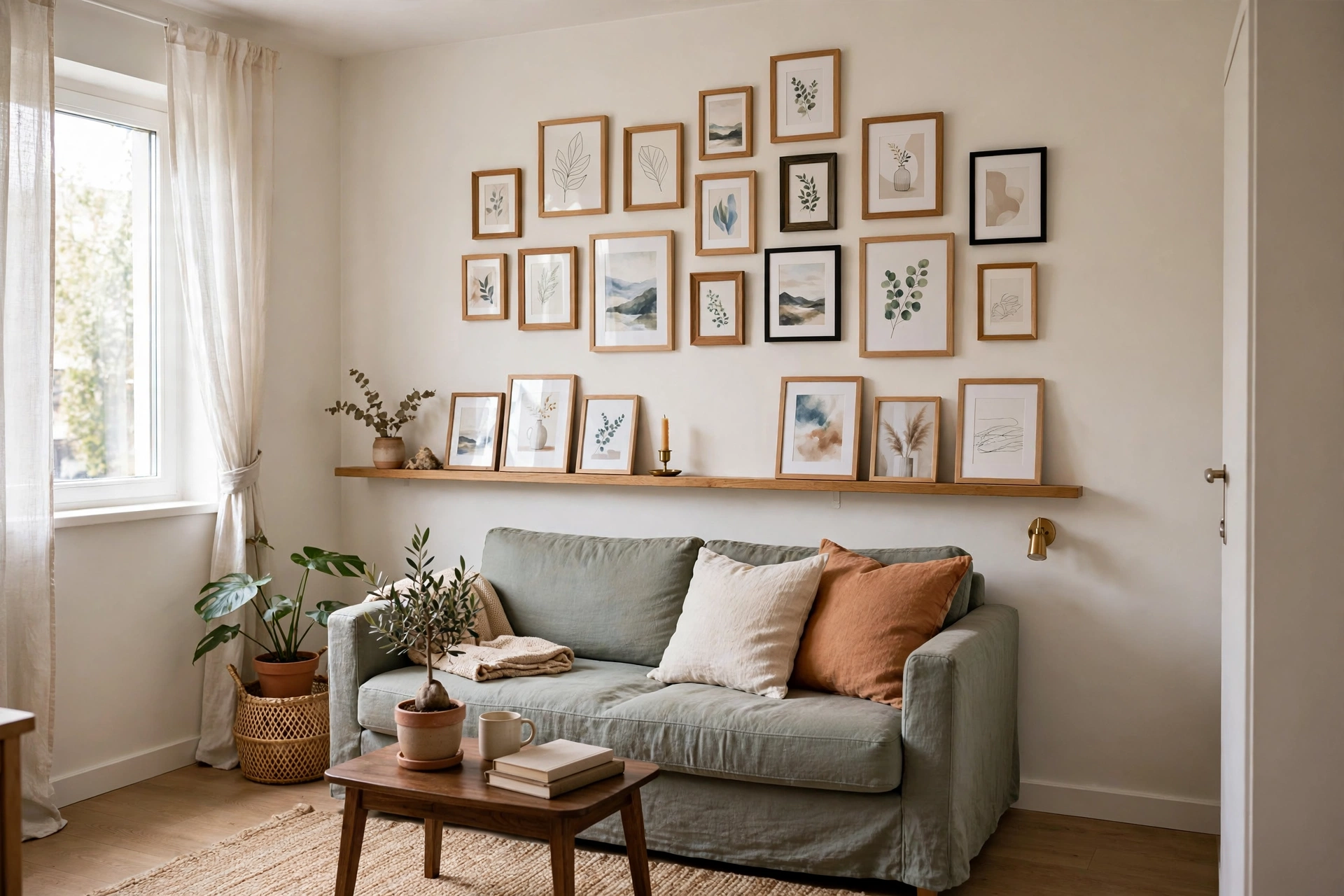
Picture ledges let you lean frames without putting holes in walls — ideal for renters.
7. Vertical Column
Stack 4-5 frames vertically in a narrow wall section between windows or doors.
8. Closet Door Gallery
Use adhesive hooks to hang lightweight frames on closet doors.
🛒 Shop This Look:
9. Above-Bed Compact
A 3-frame horizontal arrangement above the bed — keep total width under 60% of bed width.
10. Entryway Welcome
2-3 frames beside the front door create an inviting entry in even the tiniest foyer.
11. Corner Gallery
Wrap a small arrangement around a corner for unexpected visual interest.
12. Shelf-Top Frames
Lean small frames on floating shelves mixed with plants and books.
13. The Single Statement
Sometimes one large piece (24×36) has more impact than many small ones in a tiny room.
14. Washi Tape Gallery
For ultra-renters: tape unframed prints directly to walls with decorative washi tape.
15. Rotating Display
Use clipboards or clip frames to swap art seasonally without new holes.
Renter-Friendly Hanging Tips
- Command strips hold up to 16 lbs — enough for most gallery frames
- Picture ledges need only 2-3 screws for the entire display
- Always use a level — crooked frames are more noticeable in small spaces
Making Small Walls Look Bigger With Art
Art doesn’t just decorate a small apartment — used strategically, it changes how big the space feels. The core principle is that the eye follows visual lines, so you can use your gallery wall to stretch a room’s perceived dimensions. Want a low ceiling to feel taller? Build your arrangement vertically, stacking frames in a column that draws the eye upward. Want a narrow hallway to feel wider? Run a single horizontal row that pulls the gaze along the wall’s length.
Scale is the other lever. In a small room, one common mistake is hanging art that’s too small for the wall, which makes both the art and the room feel timid. Your gallery should still cover a generous portion of the wall — roughly 60–70% of the available width. A bold, full arrangement makes the wall feel like a designed feature rather than an afterthought, and paradoxically makes the room feel more intentional and therefore larger.
Color does quiet work here too. Art with light backgrounds and plenty of negative space keeps a small wall feeling airy, while very dark, heavy pieces can make the wall advance toward you. That doesn’t mean avoiding dark art — just balance it: pair a dramatic dark print with lighter pieces around it. And consider adding one mirror to the mix. A mirror in a gallery wall bounces light and doubles the sense of depth; from across the room, it reads as a window you don’t have.
Finally, mind the edges. Leaving a few inches of bare wall as a border around your arrangement gives the eye resting space, which reads as calm and spacious. A gallery that runs edge-to-edge on every side can feel like it’s closing in — the salon style’s maximalist cousin works better in rooms with space to spare.
Damage-Free Hanging Methods That Actually Work
Renters’ biggest fear is the move-out wall inspection, so let’s be specific about what each damage-free method can actually hold. Adhesive picture-hanging strips are the workhorse: the large sizes are typically rated to around 16 pounds per set, which covers most frames up to 11×14. The rules that make them work are non-negotiable — clean the wall with rubbing alcohol first, press the strips firmly for a full 30 seconds, and wait an hour before hanging. Most failures come from skipping the wait. They also need flat, smooth surfaces; on textured or bumpy walls, adhesion drops dramatically.
🛒 Shop This Look:
For heavier pieces, a picture ledge is the smartest renter investment. One narrow shelf, mounted with two or three screws, holds an entire rotating gallery of leaned frames — and when you move, you’re patching two or three small holes instead of twenty. Patching a screw hole takes five minutes with spackle; patching twenty nail holes takes an afternoon. Lean frames at a slight angle, overlap them casually, and mix in small plants or books for a styled look.
For the truly hole-averse, there are lighter-duty options with honest limits. Washi tape holds unframed prints and posters beautifully and peels off cleanly, but it won’t hold glass-fronted frames. Small adhesive hooks handle lightweight frames and canvases. And removable adhesive putty works for postcards and tiny prints on smooth walls, though it can leave an oily mark on some paints — test behind furniture first.
Whatever method you choose, photograph your walls on move-in day. If a strip does pull a paint chip on the way out, you’ll know exactly what “normal” looked like, and a dab of matching paint fixes most sins. Most landlords care about holes and damage, not about art that was hung responsibly.
Curating Art on a Small-Apartment Budget
Small apartments and small budgets usually go together, but a gallery wall is one of the cheapest high-impact projects in home decor. The strategy is to spend on presentation, not on the art itself. A $3 printable in a $12 frame with a proper mat looks like a $60 piece; a $60 poster taped to the wall looks like a $3 poster.
Start with what you already own: your phone’s photo library. Almost everyone has a dozen genuinely good photos — travel shots, city scenes, portraits with great light — that would look striking printed at 8×10 or 11×14. Converting a set to black and white gives instant cohesion across mismatched subjects, and black-and-white photography flatters nearly every interior style.
For variety, printable art marketplaces offer original designs for the price of a coffee. Look for sellers with strong reviews and high-resolution files (300 DPI at your print size). Print at a local shop rather than at home — commercial printers produce richer color on better paper for just a few dollars a sheet. Public libraries are an underrated source too: vintage book illustrations, maps, and botanical plates can be scanned and printed, and many libraries offer free high-resolution scanning.
Frames are where thrift stores shine. You’ll regularly find solid wood frames for a couple of dollars; a coat of spray paint in matte black, white, or brass unifies mismatched finds into a set. Check the glass or acrylic before buying — replacing a broken pane costs more than the frame is worth. And don’t overlook the frame sections of discount home stores, where multi-packs of simple gallery frames often beat buying individually.
Three Layout Templates That Always Work in Small Apartments
When wall space is limited, starting from a proven template beats improvising. These three layouts are sized for typical apartment walls and use frames you can find anywhere.
Template 1: The Vertical Column. For the narrow wall between a window and a door, or the strip beside a bookshelf. Stack four 8×10 frames vertically with 2-inch gaps — total footprint about 10 inches wide by 46 inches tall. Start the top frame around 70 inches from the floor. This layout draws the eye up, making ceilings feel higher, and it fits walls that can’t hold anything wider. Use a unifying element — all black frames, or all black-and-white images — so the column reads as one intentional piece.
Template 2: The Compact Grid. For above a desk, dresser, or console. A 2×2 grid of 11×14 frames with 2-inch gaps covers about 24 by 34 inches — substantial presence without overwhelming. Grids are the most forgiving layout for beginners because the math does the design work. Keep the bottom of the grid 6–8 inches above the furniture. For extra polish, use identical frames and a cohesive image series: four botanical prints, four travel photos, four abstract prints in one palette.
Template 3: The Ledge Row. For renters who want zero holes beyond the shelf itself. Mount one 36-to-48-inch picture ledge and lean 4–6 frames of varying sizes along it, overlapping slightly. The beauty of the ledge is rotation: swap art seasonally, layer a small plant or object in front, and never patch a hole. Lean larger frames at the back and smaller ones in front for depth. One ledge over a sofa or console delivers gallery-wall impact with a single afternoon’s work.
Whichever template you choose, tape the outline on the wall first with painter’s tape and live with it for a day. In a small apartment you see every wall constantly, so a layout that feels right on day three — not just day one — is the one to hang.
🛒 Shop This Look:



