
As an Amazon Associate, I earn from qualifying purchases. This means I may earn a commission if you purchase through links on this page — at no extra cost to you.
To style kitchen countertops without clutter, follow the 50% rule (keep half clear), group items on trays in odd numbers, vary heights with cutting boards and plants, and limit yourself to 2–3 styled zones. Start by removing everything, then add back only beautiful daily essentials. The result is a kitchen that looks intentional and stays functional.
Step 1: Clear Everything Off
Start with a blank slate. Remove every single item from your counters — appliances, decor, everything. Clean the surfaces thoroughly. This reset lets you see the actual space you’re working with and prevents the “just add more” trap.
Step 2: Identify Your Zones
Most kitchens have 2–3 natural zones. Common ones:
- Coffee/breakfast zone: Near the coffee maker or toaster
- Cooking zone: Near the stove
- Sink zone: Around the sink and dishwasher
You’ll style each zone separately rather than scattering items randomly.
Step 3: Apply the 50% Rule
At least half of each counter section should remain completely clear. This isn’t just aesthetic — you need workspace for actual cooking. If a section is 4 feet wide, decor should occupy no more than 2 feet.
Step 4: Use the Tray Method
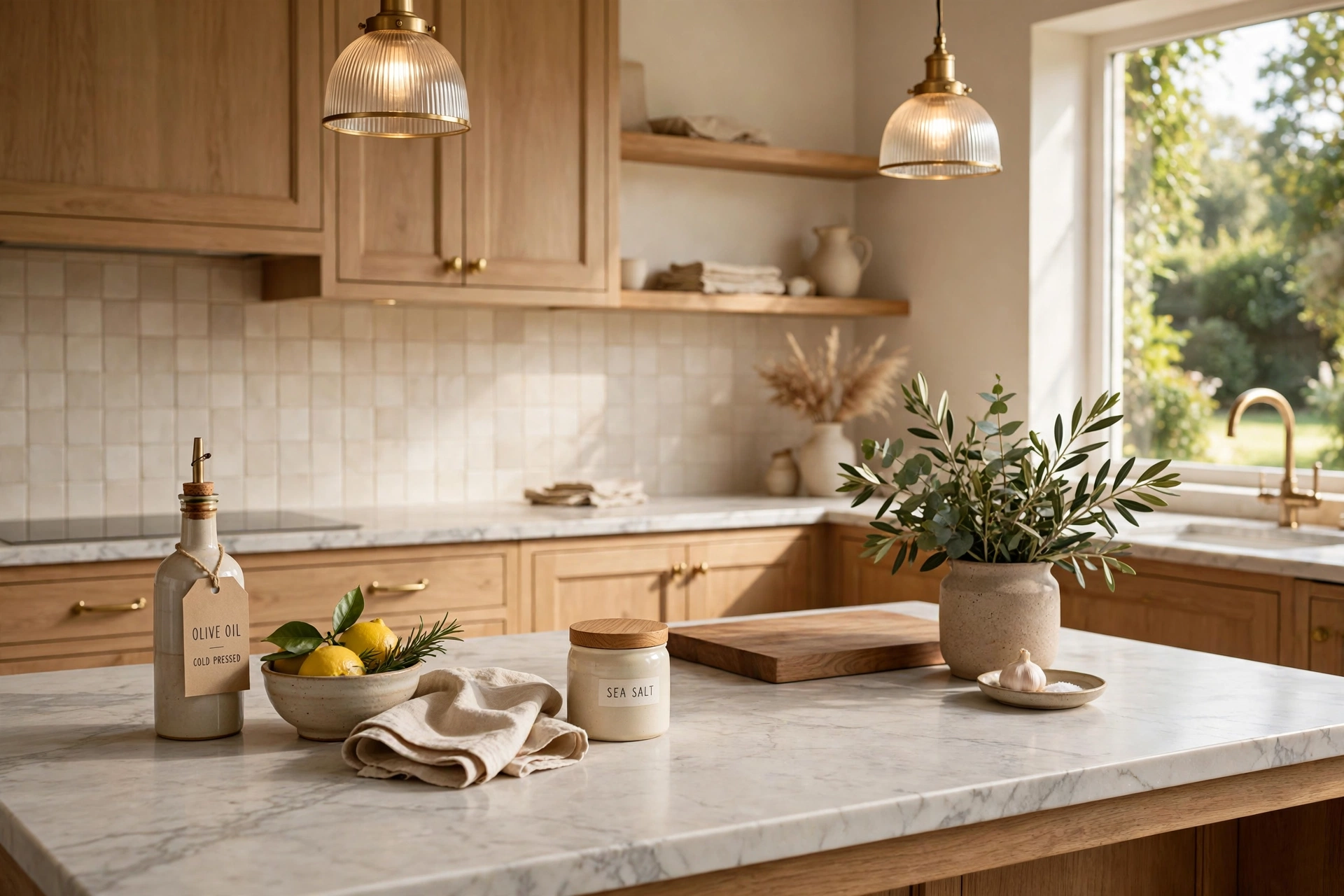
Place a tray, cutting board, or low basket in each zone. Then arrange 3–5 items on or around it. The tray creates a visual boundary that makes random items look intentional.
What Goes on the Tray
- Olive oil + salt cellar + small plant (cooking zone)
- Soap dispenser + hand towel + succulent (sink zone)
- Coffee canister + mug + small candle (coffee zone)
Step 5: Vary Heights
Flat arrangements look boring. Create visual interest with height variation:
- Tall: Cutting board leaning against backsplash, tall vase, paper towel holder
- Medium: Utensil holder, potted herb, candle
- Low: Tray, bowl of fruit, soap dispenser
Aim for a triangle shape in each vignette — tall in back, medium in middle, low in front.
Step 6: Add Something Living
Every styled counter needs one living element. Options:
- Small potted herb (basil, rosemary, thyme)
- Succulent in a pretty pot
- Fresh flowers in a bud vase
- Bowl of fresh fruit (counts as living!)
Step 7: Edit Ruthlessly
Step back and look at each zone. Remove one item from each. Then remove one more. What looks “sparse” to you probably looks “clean” to everyone else. Less is genuinely more on counters.
Common Mistakes to Avoid
Too Many Small Items
Five tiny knick-knacks look like clutter. One medium statement piece looks like decor. When in doubt, go bigger and fewer.
Blocking Workflow
Never place decor between the sink, stove, and fridge (the work triangle). These paths must stay clear.
Matching Everything
Coordinated is good; matchy-matchy is boring. Mix wood, ceramic, glass, and metal for texture variety.
Forgetting Function
If you have to move three decorative items to make toast, your styling has failed. Every piece should either be used daily or be easily movable.
Quick Styling Formulas
Minimalist: Cutting board + single plant + nothing else.
Cozy farmhouse: Wooden tray + mason jar utensils + gingham towel + small pumpkin (seasonal).
Modern: Marble tray + black soap dispenser + sculptural object + orchid.
Small Appliances: Display or Store?
Appliances are the biggest clutter culprits because they are bulky and used irregularly. Apply the daily-use test ruthlessly:
- Stays out: used at least 4–5 times a week. For most households that is the coffee maker and possibly the toaster. These earn counter space — style around them rather than resenting them.
- Gets stored: used weekly or less — stand mixer, food processor, blender, air fryer. These live in a cabinet, pantry, or on an appliance garage shelf. An appliance garage (a cabinet with a roll-up or lift door at counter level) keeps them accessible without visual bulk.
- The coffee station exception: if coffee is a ritual, give it a dedicated zone with everything corralled on one tray — machine, canister, mugs on hooks beneath a shelf, sugar bowl. A styled coffee station reads as intentional; a coffee maker plus scattered mugs reads as clutter.
- Knife blocks vs. magnetic strips: a wall-mounted magnetic knife strip frees a full square foot of counter and looks sculptural. If you keep a block, choose a slim universal block over the wide traditional kind.
Styling for Your Kitchen’s Actual Style
Modern / Minimalist Kitchens
Less is more, and materials matter most. One sculptural object (a ceramic vase, a stone bowl), one living element, and beautiful everyday tools in matching finishes. Decant dish soap and hand soap into matching dispensers — mismatched plastic bottles are the fastest way to ruin a minimalist counter. Keep the palette to two or three materials: stone, wood, and one metal.
Farmhouse / Cottage Kitchens
Warmth comes from wood, woven textures, and vintage touches. A wooden dough bowl with fruit, a crock of well-worn utensils, a small framed print leaned against the backsplash. Open shelving styling should echo the counter: group in threes, mix heights, leave breathing room. Seasonal swaps (a pumpkin in fall, fresh herbs in spring) keep it feeling alive rather than staged.
Traditional Kitchens
Symmetry and classic materials: a pair of matching canisters flanking the range, a silver or brass tray with decanters, a proper flower arrangement rather than a single stem. Traditional kitchens can carry more objects than modern ones, but the grouping rules still apply — cluster, do not scatter.
Eclectic / Colorful Kitchens
Color is the decor. Let a collection shine — vintage pitchers, colorful ceramics — but contain it: one shelf or one tray, not spread across every surface. The 50% rule matters even more here because colorful objects have higher visual weight.
The Backsplash Zone: Using Vertical Space
Counters feel less cluttered when some styling moves up the wall:
- A single floating shelf above a clear counter section holds the pretty things (small art, a plant, matching canisters) while the counter below stays workspace-clear.
- A rail system (like a stainless bar with S-hooks) hangs utensils, mugs, and small baskets on the backsplash — everything accessible, nothing on the counter.
- Lean, don’t stack: one large cutting board leaned against the backsplash adds height and warmth with zero footprint. Two or three leaned boards in varied woods look curated; a stack of ten looks like storage.
- Under-cabinet lighting transforms styled counters after dark — a $30 LED strip makes a simple tray vignette look professionally designed and makes the kitchen feel larger.
Seasonal Refreshes Without the Clutter Creep
Seasonal styling keeps the kitchen feeling fresh, but holiday decor is how clutter creeps back. The system: one seasonal swap per zone, stored in a single labeled bin per season.
- Spring: fresh herbs in the cooking zone, a small vase of tulips or daffodils, lighter textiles.
- Summer: a big bowl of citrus or stone fruit, a carafe for infused water, airy linen towel.
- Fall: a small pumpkin or gourd cluster on the tray, a candle in a warm scent, wooden tones forward.
- Winter: evergreen sprigs in a vase, a bowl of pomegranates or clementines, a chunky knit towel.
When the season ends, everything goes back in the bin — no orphans left behind to become permanent clutter.
The Weekly 5-Minute Counter Reset
Styled counters stay styled only with maintenance. Once a week: remove everything from one zone, wipe it down, and put back only what belongs — the tray, its items, the plant. Toss the dead flowers, recycle the mail pile that migrated there, return the appliances that crept out. Five minutes per zone keeps the whole kitchen at its styled baseline instead of slowly reverting to before.
Styling for Small Kitchens and Galleys
Small kitchens need the styling rules adjusted, not abandoned:
- One zone, not three. A galley kitchen gets a single styled vignette — usually at the end of the counter or on the windowsill — not a zone per section. One beautiful moment beats three cramped ones.
- Go vertical exclusively. When counter space is measured in inches, everything decorative moves to the wall: a small shelf, a rail with hooks, art leaned on the backsplash. The counter stays 100% functional.
- The windowsill is prime real estate. A row of small potted herbs on the sill gives you the living element, the height variation, and the styling — with zero counter footprint.
- Magnetic and mounted: magnetic knife strip, wall-mounted paper towel holder, hanging fruit basket. Every item moved off the counter is visual space gained.
- Edit to one texture story. Small kitchens read busy fast — pick one material narrative (warm wood + white ceramic, or black + brass) and let everything speak it. Restraint reads as calm; variety reads as clutter at this scale.
The “Company’s Coming” 15-Minute Polish
For the days when the kitchen needs to look its best fast:
- Clear to the 50% rule — everything non-essential into a bin, dealt with later (5 minutes).
- Wipe the visible surfaces — counters, stovetop front, faucet. Shine reads as clean more than actual deep-cleaning does (4 minutes).
- Set the vignettes — straighten the tray, fluff the plant, fold the towel neatly, put out the fruit bowl (3 minutes).
- Lighting and scent — under-cabinet lights on, overhead dimmed, something simmering (citrus peels and herbs in water) or a candle lit (2 minutes).
- Floor check — quick sweep of the visible floor area (1 minute).
Fifteen minutes, and the kitchen looks intentionally styled rather than merely clean — because at this point, the systems do the work and you just run the checklist.
— Ella Knight
🛒 Shop This Look:
🛒 Shop This Look:
🛒 Shop This Look:



