
As an Amazon Associate, I earn from qualifying purchases. This means I may earn a commission if you purchase through links on this page — at no extra cost to you.
By Ella Knight
Choose salon style for an eclectic, collected look with mixed frame sizes arranged organically — best for living rooms and creative spaces. Choose grid style for a clean, orderly appearance with identical frames in perfect rows — best for bedrooms, offices, and hallways. Salon style is more forgiving of imperfections; grid style demands precision but delivers striking visual order.
Salon Style: The Details
What It Looks Like
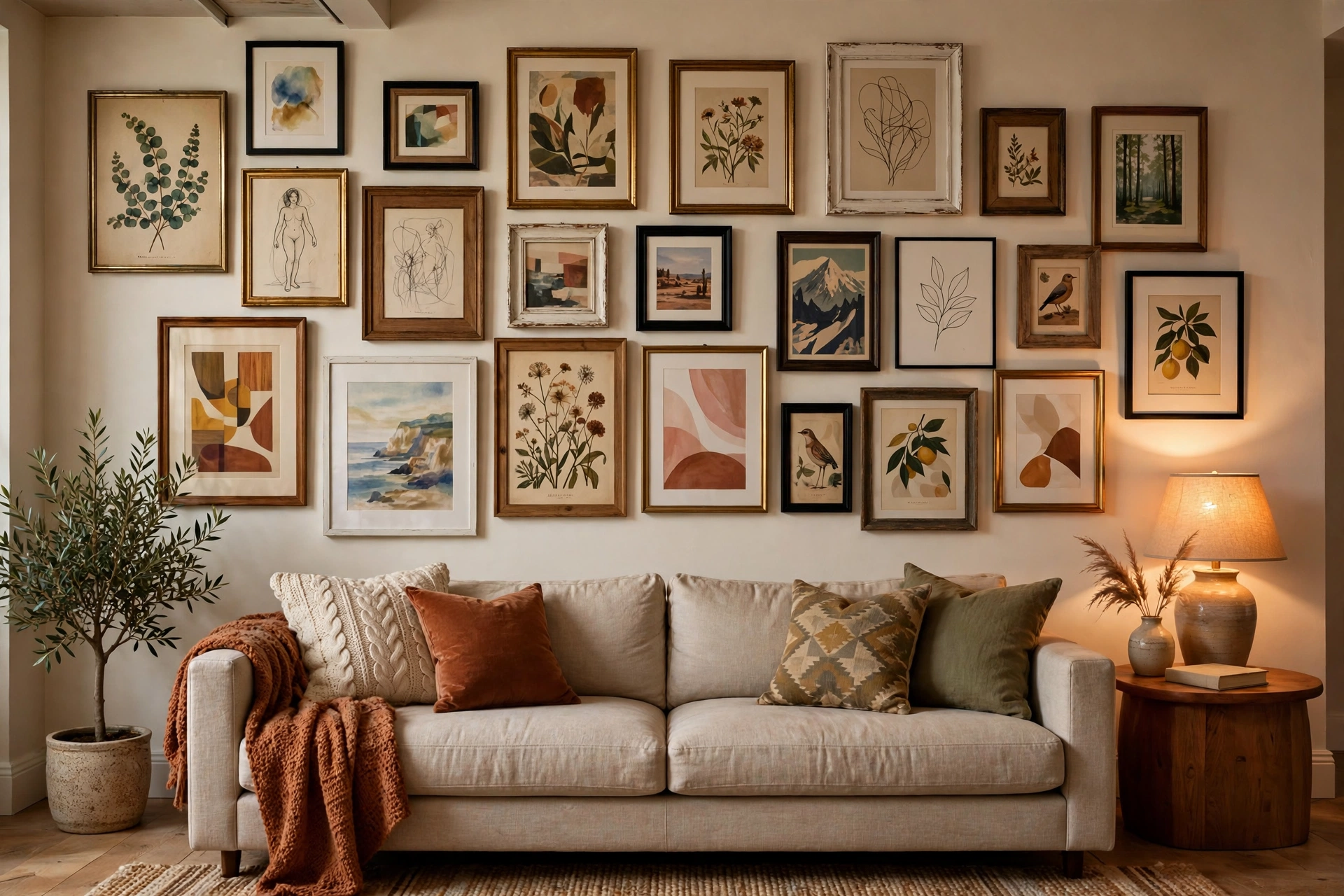
Frames of all sizes fill the wall edge to edge, often floor to ceiling. Think Parisian art salon or a maximalist collector’s home.
Best For
- Living rooms and dining rooms
- Eclectic, bohemian, or maximalist decor
- Displaying large collections
- People who enjoy an evolving display
Pros and Cons
Pros: Forgiving of imperfect spacing, easy to add to over time, high visual impact.
Cons: Can look cluttered if not curated, harder to plan, requires many pieces.
Grid Style: The Details
What It Looks Like
Identical frames in perfect rows and columns with exact spacing. Think modern art gallery or a high-end hotel.
Best For
- Bedrooms and home offices
- Modern, minimalist, or Scandinavian decor
- Hallways and staircases
- People who crave visual order
Pros and Cons
Pros: Clean and calming, easier to plan, looks intentional with fewer pieces.
Cons: Unforgiving of crooked hanging, can feel rigid, limited flexibility.
Side-by-Side Comparison
We styled the same wall both ways. The salon style felt warm and personal but took 3 hours to arrange. The grid took 45 minutes and felt serene but slightly formal. Your room’s purpose should guide the choice: active social spaces suit salon style; restful private spaces suit grids.
Can You Mix Both?
Yes — use a grid for the main arrangement and add a small salon-style cluster nearby, or use a grid on one wall and salon style on another in the same room.
🛒 Shop This Look:
How to Plan Each Style Step by Step
Salon and grid walls demand completely different planning approaches. Here’s the right method for each.
Planning a salon wall: Start by gathering everything you might hang — more pieces than you need. Lay them on the floor and identify your anchor (largest or boldest piece). Place the anchor first, roughly centered where the wall arrangement will go. Build outward organically, filling gaps with smaller pieces, keeping 2–3 inch spacing. Step back frequently — salon walls are judged holistically, not by measurement. When the floor layout feels balanced, transfer to paper templates on the wall (trace, cut, tape, live with it for a day). Hang from the center outward. Total planning time: 2–4 hours for a large wall. The salon method rewards intuition and iteration; don’t rush the floor stage.
Planning a grid wall: Start with math, not art. Decide your grid dimensions (2×2, 3×3, 2×4) based on wall size and frame availability. Calculate total width and height: (frame dimension × count) + (gap × (count − 1)). Mark the grid’s outer rectangle on the wall with painter’s tape. Choose your art to fit the grid — this is the reverse of salon planning, where art comes first. Either use a true series or enforce strict discipline (all B&W, all one palette). Hang the center frame of the middle row first, level obsessively, and build outward. Total planning time: 1–2 hours, mostly measuring. The grid method rewards precision; don’t eyeball anything. Related: Choose Kitchen Pendant Lights: Size, Height & Style Guide.
The hybrid plan: If you’re mixing both styles in one room, plan the grid first (it’s the less flexible element) and let the salon cluster respond to it. Place the grid on the more formal wall (above the console, in the hallway) and the salon cluster on the more relaxed wall (the big living room wall). Keep one unifying element between them — same frame color, same mat color, or shared palette — so the room reads as one design with two expressions rather than two unrelated projects.
Mixing Styles in One Home
Most homes shouldn’t commit to a single gallery style everywhere — different rooms have different jobs, and the style should follow. Here’s how to mix salon and grid across a home without visual whiplash.
Assign by room function. Public, social spaces (living room, dining room, entryway) suit salon style’s warmth and storytelling. Private, restful spaces (bedroom, bathroom, home office) suit the grid’s calm order. Transitional spaces (hallways, staircases) can go either way — linear salon-style rows work beautifully in hallways, while a grid suits a formal stairwell. When every room’s style matches its function, the mix feels intentional rather than indecisive.
Unify across styles. The trick to mixing is a through-line: one element that appears in every gallery wall in the home. It could be frame color (all black frames, salon or grid), mat color (all white mats), a recurring accent color in the art, or even a consistent subject thread (all travel photography, mixed with art). This single constant tells the eye that the variety is curated, not random. Related: How to Create a Symmetrical Gallery Wall.
Mind the sightlines. In open-plan homes, you see multiple walls at once. Avoid placing a maximalist salon wall directly opposite a strict grid where both are visible simultaneously — the contrast can feel jarring. Instead, let styles transition gradually: salon in the living area, a looser grid in the dining space visible beyond it, strict grid in the hallway around the corner. Think of it as a gradient from expressive to orderly as you move toward private spaces.
Let one style dominate. A 70/30 split feels designed; a 50/50 split feels undecided. If your home leans eclectic, let salon style dominate with one or two grid moments as calm counterpoints. If your home leans minimal, let grids dominate with one salon wall as the expressive exception. The minority style becomes a feature precisely because it’s rare.
Cost and Time: What Each Style Really Demands
Beyond aesthetics, the two styles differ dramatically in what they ask of your wallet and your weekends. Here’s the honest accounting.
🛒 Shop This Look:
Salon style costs: More pieces (typically 10–20 for a full wall), but each piece can be cheap — thrifted frames, printable art, personal photos. Expect roughly $150–400 for a generous salon wall built over time, or under $100 if you’re resourceful with thrift stores and your own photography. The hidden cost is time: 3–5 hours of planning and hanging for a large wall, plus the ongoing time of evolving it. Salon walls also demand more wall repair over time as arrangements shift — budget for spackle.
Grid style costs: Fewer pieces (4–16), but they must match — identical frames in the right sizes, which usually means buying new rather than thrifting. A 3×3 grid of 11×14 frames with mats runs roughly $120–250 depending on frame quality. The art inside can be inexpensive prints since the structure does the visual work. Time investment is lower but more intense: 2–3 hours of precise measuring and hanging, done once and enjoyed for years.
The framing trap: Both styles share one budget killer — custom framing. A single custom frame can cost more than an entire thrifted salon wall. The rule for both styles: stick to standard sizes (5×7, 8×10, 11×14, 16×20) where ready-made frames and pre-cut mats are cheap and plentiful. The moment you need an odd size framed, costs triple.
Time over years: Salon walls are a hobby — you’ll spend pleasant hours tweaking, adding, and rearranging over the years. Grid walls are a project — intense upfront, then done. Choose based on which relationship with your wall sounds more appealing, because both are valid and they suit different temperaments.
Evolving Your Wall Over Time
Gallery walls aren’t static installations — they’re living displays. But salon and grid styles evolve very differently, and knowing this upfront prevents future frustration.
Growing a salon wall: This is where salon style shines. New pieces slot into gaps, clusters expand outward, and the wall absorbs new finds gracefully. The only rule: maintain your unifying elements (frame colors, palette, spacing) as you add, or the wall drifts from “curated” to “accumulated.” Every year or two, do a full audit: remove what no longer earns its place, respacing as needed. A salon wall that’s edited regularly stays beautiful indefinitely; one that’s only added to eventually becomes clutter.
Refreshing a grid: Grids resist growth — you can’t add a tenth frame to a 3×3 — but they welcome content swaps. Keep the frames and change what’s inside: rotate art seasonally, swap photos annually, or reinvent the entire grid’s contents every few years while the structure stays. This is actually the grid’s secret strength: total transformation without a single new nail hole. Some grid owners keep a “next exhibition” folder of prints waiting for the annual swap.
When to switch styles entirely: Life changes warrant style changes. The maximalist salon wall of your eclectic twenties might feel chaotic in your calmer thirties — and that’s fine. Converting a salon wall to a grid (or vice versa) is a weekend project that reuses most of your frames. The art collection you’ve built is style-agnostic; only the arrangement changes. Give yourself permission to outgrow a style without guilt — the wall serves you, not the other way around.
Document the journey: Photograph your wall once a year. Over time, these photos become a visual diary of your taste evolving — and they’re incredibly useful when you want to recreate a past arrangement you loved. The best gallery walls aren’t the ones that never change; they’re the ones that change thoughtfully.
🛒 Shop This Look:




1 thought on “Salon Style vs Grid Style Gallery Wall: Which to Choose?”
Comments are closed.