
As an Amazon Associate, I earn from qualifying purchases. This means I may earn a commission if you purchase through links on this page — at no extra cost to you.
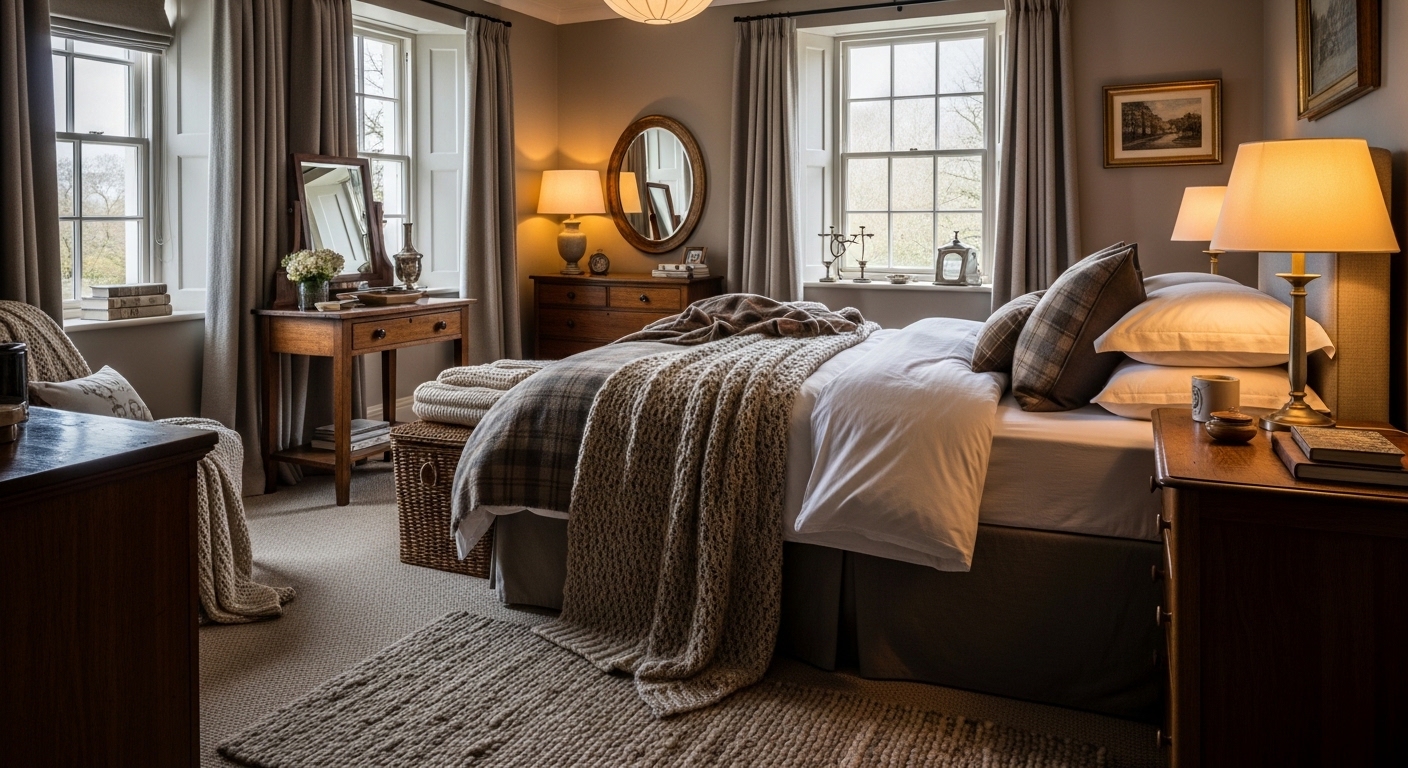
A Scottish bedroom works when it feels warm, settled, and a little rugged — not when it looks like a gift shop. The difference is restraint. Tartan, dark wood, wool, and soft lamplight are strong ingredients, and strong ingredients turn loud fast when they all compete. The rooms that get this right pick one hero, repeat its colors quietly elsewhere, and let the rest of the room stay calm.
🛒 Shop This Look:
What makes a bedroom feel Scottish
Scottish style is not a costume. It comes from three materials that suit cold rooms: wool for warmth, dark wood for weight, and stone or stone colors for grounding. A room that uses those three materials with a muted palette reads Scottish even without a single tartan cushion. A room that piles on tartan, antlers, thistles, and castle prints reads like a theme, and themes get tiring to sleep in.
Start by deciding what your room already gives you. Dark wood floors or a wooden bed frame are a head start — you need less tartan, not more. A plain room with white walls and light furniture needs more textile warmth to get there. Work with what exists before buying anything new.
Tartan: one hero, quiet echoes
Tartan should appear in one strong place and echo in one or two small ones. The classic hero is the bed: a tartan duvet cover or a tartan quilt folded across the foot of the bed. Everything else tartan in the room should be smaller and quieter — a cushion, a throw, a lampshade trim — and it should share colors with the hero rather than introduce a second tartan family.
Two different tartans in one room almost always clash, because each carries its own red, green, blue, or yellow balance. If you already own two tartan pieces you love, keep them in different rooms. Within one bedroom, one tartan, repeated at different scales, looks intentional. Two tartans look accidental.
Scale matters as much as color. Large-scale tartan on bedding reads bold and traditional. Small-scale tartan on cushions reads quiet and can sit near the bedding without fighting it. If your bedding tartan is loud, choose cushions in a solid color pulled from the tartan — a deep green, a muted red, a warm brown — instead of a second pattern.

Best for making tartan bedding the focal point of a cozy Scottish bedroom.
How much plaid is too much
The honest test is simple: stand in the doorway and count the patterned surfaces. Bedding, one cushion, and a throw is plenty. Bedding, two cushions, a throw, curtains, a rug, and a chair cover is too much — the eye has nowhere to rest, and the room feels busy instead of cozy. When in doubt, remove one patterned piece and live with the room for a week. Most people do not put it back.
Curtains are the place where tartan most often goes wrong. Tartan curtains on every window turn the walls into pattern. If you want tartan at the window, use it on one window only, or choose a windowpane check — a quiet grid in one color — instead of a full tartan. Solid linen curtains in a color from your bedding do the same warming job without the visual noise.
Dark wood: the room’s backbone
Dark wood bed frames, dressers, and nightstands give a Scottish bedroom its weight. The wood does not need to match exactly — a dark walnut bed with an oak dresser works when both are genuinely dark or mid-toned and neither is glossy orange. What fights the look is a mix of very pale wood and very dark wood with nothing between them. If your furniture spans that range, bridge it with mid-toned pieces: a wooden bench at the foot of the bed, a wooden tray on the dresser, a framed print in a mid-wood frame.
Old and new wood can mix. A inherited dresser next to a new bed frame looks collected rather than mismatched when the hardware is consistent — swap mismatched knobs for simple dark metal ones and the pieces start to belong together. Avoid painting good dark wood white to “brighten” the room; you lose the very weight that makes the style work, and the room ends up neither Scottish nor bright.
Wall colors that suit tartan
Tartan needs calm walls. Warm neutrals — soft cream, warm beige, muted sage, gentle stone gray — let the pattern and wood do the talking. A single accent wall in a deep, muted tone (forest green, deep navy, warm charcoal) works behind the bed, where it frames the headboard instead of competing with it. Two or more bold walls fight the bedding and shrink the room visually.
Test wall color against your actual bedding, not against a paint chip in the store. Hold the fabric next to the painted wall in evening light, which is when you will actually see the room. Cool white walls make warm tartan look orange; warm cream walls make it look rich. The undertone of the wall matters more than the color name on the can.
Layered bedding that actually warms
Scottish warmth is layered, not thick. The working formula is: a duvet in a washable cover, a quilt or coverlet folded across the middle of the bed, and a wool throw across the foot. Each layer can be added or removed as the night cools, which matters more than one very heavy blanket. Wool throws beat synthetic fleece here — wool breathes, so you stay warm without waking up overheated, and it holds its shape for years.
Make the bed so the layers look deliberate. The duvet cover should be smooth and tucked at the foot, the quilt folded back to show about a third of the bed, the throw placed across the foot with its ends even. A bed made this way invites you in; a bed with every layer pulled to the pillow looks like storage.

Biddy Murphy 100% Irish Wool Plaid Throw Blanket, 54″ x 71″, Tartan Blackwatch
Best for layering wool and plaid throws for warmth in a cozy Scottish bedroom.
Rugs on wood floors
A rug in a Scottish bedroom should warm the floor where your feet land, not cover the wood entirely. The standard placement is a rug that extends from under the lower two-thirds of the bed out to the sides, so you step onto wool, not cold floor, in the morning. A rug that stops at the bed’s edge and leaves a cold strip on each side fails at its one job.
Choose a traditional pattern — a faded floral, a simple border, a muted geometric — in colors already in the room. A bright new rug with high-contrast colors will dominate a room that is otherwise muted. Older-looking, lower-contrast rugs sit quietly under furniture and let the bedding lead.
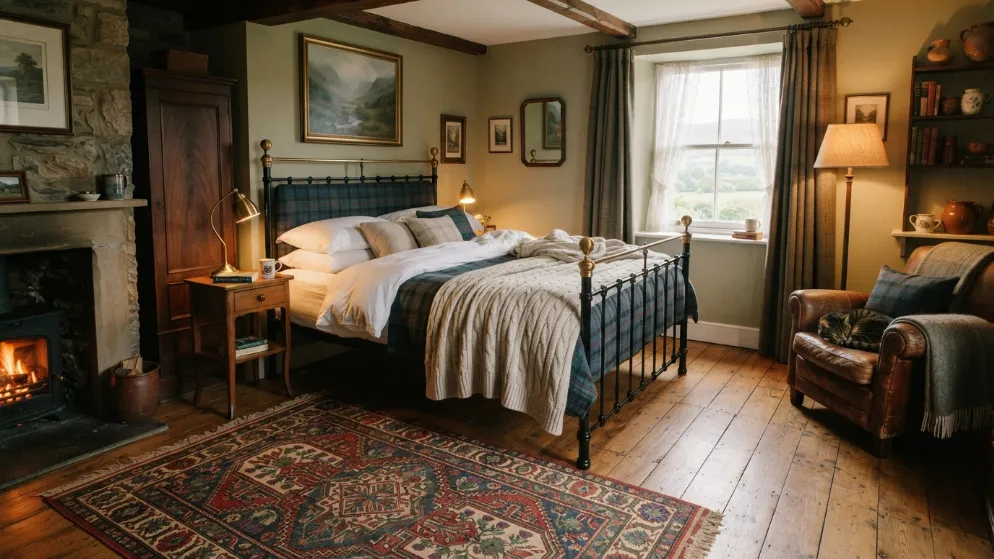
Best for tying the room together with a traditional wool rug in a classic pattern.
Cushions and throws without clutter
Two or three cushions on a bed look finished. Five or more look like a display, and you will spend every night moving them to the floor. Keep the sleeping pillows at the back, one pair of decorative cushions in front, and optionally one smaller cushion or a bolster. The decorative cushions should relate to the room: one tartan or one solid color from the tartan, never both a tartan and a competing floral.
Throws follow the same rule. One wool throw on the bed and, if you have a reading chair, one on the chair is enough. A throw draped over every surface reads as clutter, not coziness. Fold throws neatly rather than tossing them — a folded throw looks intentional, a tossed one looks like laundry.

Best for adding muted tartan cushions to a bed or chair for a timeless Scottish look.
Windows: layer for cold rooms
Scottish bedrooms are often cold rooms, and window treatment is where comfort is won or lost. The practical layering is blinds or a sheer for daytime privacy, plus lined curtains for the night. Lining matters: unlined linen curtains look beautiful and do almost nothing against a cold window, while lined curtains noticeably cut the draft you feel when you walk past.
Hang curtains high and wide — the rod near the ceiling and extending past the window frame on both sides — so the window looks larger and the curtains stack on the wall, not over the glass. Curtains that just cover the window frame make the window look small and the room feel cramped. For a reading nook by the window, this layering also controls glare: sheer by day for reading light, curtains drawn at night for warmth.

Elrene Home Fashions Brighton Windowpane Plaid Blackout Window Curtain, 52″ x 84″, Linen, 1 Panel
Best for layering linen plaid curtains with blinds or sheers for privacy and warmth.
Lighting: warm, low, and layered
One overhead light ruins a Scottish bedroom. The room needs three kinds of light at low warmth: bedside lamps for reading, one soft ambient source (a floor lamp or a dimmed overhead), and optionally a small light in the reading corner. Warm-toned bulbs matter more than expensive fixtures — a cool white bulb makes wood look gray and tartan look harsh, while a warm bulb makes both look rich.
Bedside lamps should be tall enough that the light falls on your book, not in your eyes — the shade’s bottom edge roughly at shoulder height when you sit up in bed. Matching lamps look tidy, but two different lamps in the same material family (both bronze, both wood-based) look collected and intentional. Put the main lights on dimmers if you can; the ability to lower the light in the evening is the single cheapest way to make a bedroom feel cozy.
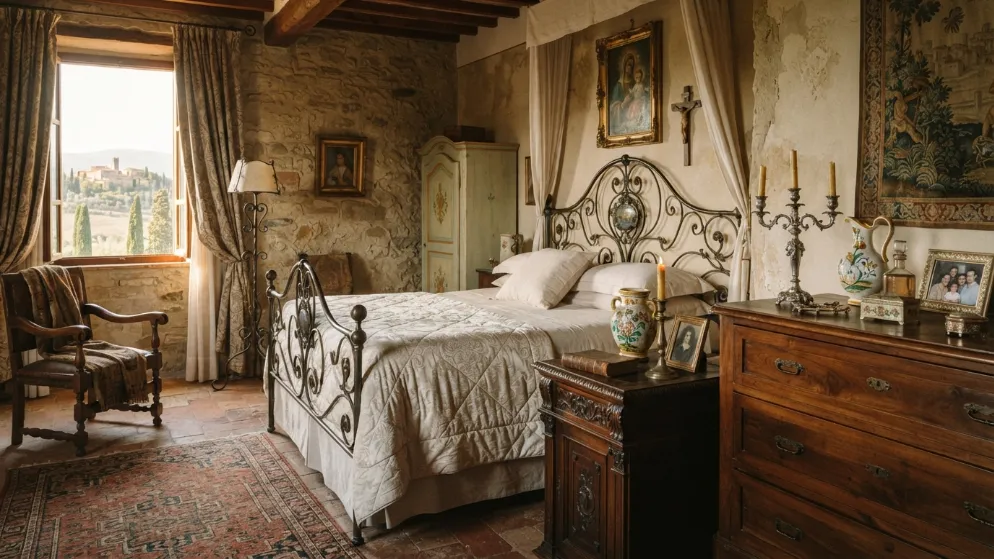 PARTPHONER Touch Control Traditional Table Lamp Set of 2, Vintage Bedside Lamps, 3-Way Dimmable, Bronze Finish
Best for adding warm, traditional lighting near the bed or reading area.
The reading nook, done properly
A Scottish bedroom earns its cozy reputation in the reading corner: a comfortable chair, a small table, a lamp, and something to put your feet on. The chair should be one you can sit in for an hour — deep enough to curl up in, with arms at a height that supports a book. A beautiful chair you avoid sitting in is decoration, not a nook.
Place the nook near the window for daytime light and near a lamp for evening light. A small wall shelf or a narrow bookcase beside the chair keeps books within reach without needing a large piece of furniture. For ideas on dressing the wall behind a reading chair, see cozy reading nook wall decor — the wall treatment should stay quiet so the chair and light remain the focus.
Small Scottish bedrooms
Small rooms need the same ingredients in smaller doses. Choose one tartan piece (the throw, not the full bedding set), one dark wood piece (the bed frame, not the whole suite), and let paint and textiles do the rest. A small room with tartan bedding, tartan curtains, and a tartan chair cover feels crowded; a small room with tartan bedding, solid curtains, and one tartan cushion feels considered.
Storage must hide in a small Scottish bedroom, because the style already brings visual weight. Under-bed boxes for out-of-season bedding, a dresser instead of open shelving, and a closed wardrobe keep the room calm. Open shelves full of books and objects fight the layered-textile look and make the room feel busy.
Budget: where money shows
Spend first on what touches your body: bedding, the rug under your feet, and the bedside lamp you use every night. These are the pieces you feel daily, and cheap versions show immediately — thin bedding, a rug that slides, a lamp that glares. Save on wall art, decorative cushions, and small accents, which can be found secondhand and swapped easily.
Secondhand is a genuine advantage for this style. Dark wood furniture, wool throws, and traditional rugs all improve with age, and older pieces often have the patina new furniture tries to imitate. Check the joints and the smell before buying used upholstery; check the frame and the drawers before buying used wood furniture. A solid used dresser beats a new flat-pack one in this room every time.
Mistakes that break the look
The most common mistakes are all versions of too much: too many tartans, too many patterns, too many themed objects. The second most common is cold light — cool bulbs, bare overhead lighting, no bedside lamps — which makes even good furniture look unwelcoming. The third is ignoring the floor: bare cold wood with no rug makes the room feel unfinished no matter how good the bedding is.
Another mistake is buying a full matching bedroom suite. Matching suites look like a showroom, not a home, and they leave no room for the collected pieces that give Scottish style its character. Buy the bed first, then add pieces one at a time as you find ones you actually like.
A starter plan
Week one: paint or confirm the wall color, and sort the lighting — warm bulbs, bedside lamps, a dimmer if possible. Week two: bedding layers and the rug, sized to the bed. Week three: curtains (lined, hung high and wide) and one tartan accent. Week four: the reading chair and its lamp, then stop. Live with the room for a month before adding anything else. The pieces you still want after a month are the ones worth buying.
For more bedroom ideas in the same spirit, see more bedroom ideas.
🛒 Shop This Look:
That order matters: light and bedding first, because they change how the room feels every single day; decoration last, because it only changes how the room looks. A Scottish bedroom built in that order feels cozy on the first night, not after the last accessory arrives.
🛒 Shop This Look:
🛒 Shop This Look: