
As an Amazon Associate, I earn from qualifying purchases. This means I may earn a commission if you purchase through links on this page — at no extra cost to you.
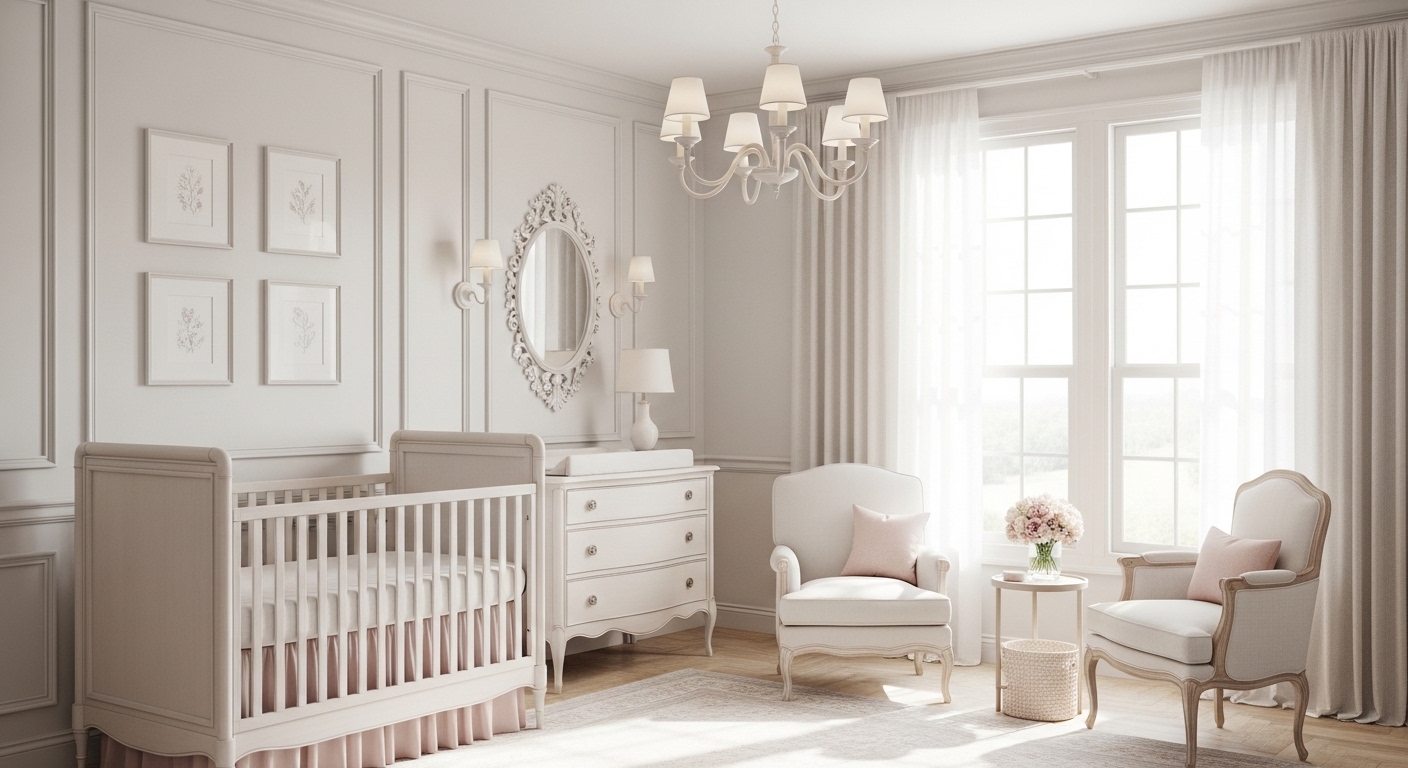
A French nursery is not a theme. It is a feeling: soft light, pale colors, natural materials, and furniture that looks like it has a history, arranged so the room feels calm rather than busy. The French approach to a baby’s room favors restraint over decoration, quality over quantity, and pieces that will still suit the room when the baby becomes a toddler. This guide works through how to get that feeling without turning the nursery into a stage set, and without buying everything at once.
What makes a nursery feel French
The feeling comes from a few consistent choices rather than from any single item. The palette stays pale and warm: whites that lean warm rather than stark, soft creams, pale greys, and muted pastels used sparingly. The materials stay natural: wood, cotton, linen, and wicker rather than shiny plastics. The furniture stays simple in shape, often with curved details or turned legs, rather than bold and blocky. And the room stays uncluttered, with space around each piece so the eye can rest.
What it is not matters as much as what it is. It is not a room covered in cartoon characters, not a room where every surface holds a decoration, and not a room that tries to look expensive through ornament. A French nursery looks collected rather than purchased in one trip, which means it is fine, and even desirable, for the room to come together gradually. One good chair, one beautiful blanket, and a calm wall color will do more than a matching set of everything bought in a single afternoon.
The palette: pale, warm, and restrained
Start with the walls, because they set the tone for everything else. A warm white or a very pale cream gives the room its light and lets furniture and textiles provide the color. If you want a tint, keep it muted: a pale sage, a dusty blue, or a soft blush, used on all walls or as a single accent wall, will read as French; a bright or saturated color will not. Test the color in the room at different times of day, because nursery light changes from morning to evening and a color that looks soft in daylight can turn cold under evening lighting.
Use stronger colors only in small doses. A deeper tone on a single piece of furniture, a patterned blanket, or a framed print gives the room depth without breaking the calm. Avoid using more than two or three colors in the room, and let one of them dominate. The result should feel like a pale room with gentle accents, not a colorful room that happens to have pale walls. This restraint is also practical: a calm palette is easier to adapt as the child grows, because new bedding or a new chair will still coordinate with it.
The crib as the centerpiece
The crib is the largest piece of furniture in the room and the natural centerpiece, so choose it with care. A simple wooden crib with curved lines or turned spindles suits the French feeling better than a bold, modern design, and a white or natural wood finish will coordinate with the pale palette. Check that the crib meets current safety standards for your country, that the slats are close enough that a baby’s head cannot pass between them, and that the mattress fits snugly with no gaps at the edges. These are not style choices; they are the baseline for any crib, whatever it looks like.
Bedding should be simple and safe. A fitted sheet on a firm mattress, with no loose blankets, pillows, or soft toys in the crib during sleep, is the standard safe arrangement for a baby’s sleep space, and it also suits the French look, which favors clean lines over piled-up softness. Save the beautiful blankets and decorative pillows for the chair, the changing area, or a basket beside the crib, where they can be admired and used during waking hours without being in the sleep space. A mobile or a canopy above the crib should be securely fixed and positioned so nothing can fall into the crib, and anything hanging should be removed once the baby can reach up and pull on it.
🛒 Shop This Look:
Furniture: old, new, and mixed
A French nursery mixes old and new rather than buying a matching set. A vintage dresser, repainted in a soft color, makes a beautiful changing table and will outlast the changing years as ordinary storage. A second-hand wooden chair, reupholstered in a washable fabric, gives the room character that new furniture rarely has on its own. New pieces should be simple in shape so they sit comfortably beside older ones, rather than competing with them.
When buying second-hand furniture for a nursery, check it more carefully than you would for any other room. Drawers should run smoothly and not tip when opened, any paint should be intact and not flaking, and anything that will be used for changing should be stable and at a comfortable height. Old paint may contain lead in very old pieces, so if the history of a piece is unknown, it is worth checking before it goes into a baby’s room, and repainting with a suitable paint if there is any doubt. A changing table needs a safety rail or a contoured pad, and everything used during changing should be within arm’s reach, so you never have to step away from the baby to fetch it.
Textiles and layering
Textiles do most of the softening work in a French nursery, and they are also the easiest part to change as the child grows. Layer different textures rather than different colors: a linen curtain, a cotton blanket, a knitted throw, and a soft rug will make the room feel rich even when the palette stays pale. Floral patterns suit the French feeling when they are small and muted rather than large and bright, and a classic stripe or a simple toile pattern will age better than a novelty print tied to a particular year.
Choose textiles that can be washed easily, because everything in a nursery will be washed often. Curtains should be washable or easily removed, rugs should tolerate cleaning, and any decorative cushion should have a removable cover. Blackout lining behind curtains helps daytime naps, and it also gives the room a finished look from outside. Keep the number of textiles restrained: a room with a rug, curtains, bedding, and one or two throws already has plenty of softness, and adding more will make it feel cluttered rather than cozy.
Walls: art, color, and restraint
Nursery walls suit gentle art rather than bold statements. Framed prints of animals, botanical illustrations, or simple landscapes in soft colors will suit the room for years, while character-themed art is usually outgrown quickly. Hang art at a height where it can be seen from the chair where you will sit with the baby, not just from the doorway, and keep the frames simple and consistent so the wall feels calm rather than busy.
Wall decals and removable wallpaper are practical options for a nursery, especially in a rented home, because they add pattern without permanent change. If you use them, apply them to one wall or one section rather than the whole room, and check that they adhere well to your wall type, because a peeling decal looks worse than a plain wall. Anything hung above the crib must be fixed securely and positioned so it cannot fall into the crib, and heavy frames should never hang directly over the sleep space. A shelf for books and small objects, fixed firmly to the wall, gives the room personality without crowding the walls, provided the shelf is high enough that a standing toddler cannot reach it and pull objects down.
Lighting: soft layers, not a single bright light
A nursery needs layered lighting, because a single bright ceiling light is wrong for both play and sleep. A soft main light, a dimmable lamp beside the chair for feeding and reading, and a small night light for nighttime checks cover the room’s real needs. Warm light suits a nursery, because it feels calm in the evening and does not make the pale palette look cold. A dimmer on the main light is worth fitting if the wiring allows, because it lets you move from bright play light to soft bedtime light without changing lamps.
Curtains and blinds work with the lighting. A blackout lining helps daytime naps and early bedtimes, while a sheer layer lets daylight in softly during play. Keep cords and chains out of reach, because any looped cord near a crib or a climbing toddler is a hazard, and cordless blinds or cleats that hold cords high and tight are the safer choice. The goal is a room that can be bright and cheerful during the day and dim and calm at night, without any single light dominating.
🛒 Shop This Look:
A small nursery benefits most from the French approach, because restraint is exactly what a small room needs. Choose fewer, better pieces: a crib, a changing dresser that doubles as storage, a chair, and a small shelf will furnish a small nursery completely. Use vertical space for storage, with shelves high enough to be out of a toddler’s reach, and keep the floor as clear as possible, because floor space is what makes a small room feel usable rather than cramped.
If the nursery shares a room with an adult bedroom or a study, define the baby’s area with a rug and a consistent palette rather than a physical barrier, which would make both areas feel smaller. Keep the baby’s furniture together in one zone, so the room reads as two intentional areas rather than one crowded one. A folding screen can work as a visual divider for naps, provided it is stable and cannot be pulled over, but it should never enclose the crib or block airflow around it.
Safety basics that shape the room
Safety decisions shape the layout more than style decisions do, and they should be made first. The crib should stand away from windows, curtains, and any cords, because a baby who can stand will reach for anything within arm’s length. Furniture that a climbing toddler could pull over, including bookshelves and dressers, should be fixed to the wall. Small objects, including buttons, coins, and loose parts from toys, should be kept out of the room or well out of reach, because anything that fits through a toilet-paper tube is a choking risk for a small child.
Electrical outlets should be covered, and any lamp or electrical item should be positioned so its cord cannot be reached from the crib or the changing table. Room temperature matters for comfort: a nursery that is comfortable for an adult in light clothing is usually comfortable for a baby in sleep clothing, and overheating is a greater concern than slight coolness, so avoid placing the crib against a radiator or in direct sun. These are general safety practices, not medical advice, and they are worth checking against current guidance in your country as standards change.
Growing with the child
A French nursery earns its keep by growing with the child rather than needing replacement at every stage. The dresser that served as a changing table becomes ordinary storage. The chair that held feedings becomes a reading chair. The pale walls and simple furniture suit a toddler’s room as well as a baby’s, and new bedding or a new rug can refresh the room without redecorating it. Choosing furniture that is not baby-specific, in colors that are not baby-specific, is the simplest way to make the room last.
Plan the transitions in advance. A convertible crib that becomes a toddler bed extends the life of the largest piece, though it should only be converted when the child is ready and the manufacturer’s guidance allows it. A low shelf of books and toys, introduced when the child can choose independently, turns the room from a baby’s room into a child’s room without new furniture. The room that grows gracefully is the room that was never too themed to begin with.
Mistakes that break the calm
The most common mistake is buying everything at once in a matching set, which makes the room feel like a showroom rather than a collected space. The second is over-decorating: every wall covered, every surface filled, and a mobile, a garland, and a wall of art competing for attention. A French nursery needs empty space to feel calm, and empty space is free. The third is choosing a bold theme that the child will outgrow within a year, which means redecorating just as the room was finally finished. The fourth is prioritizing looks over safety, whether that means a heavy frame over the crib, an unfixed bookshelf, or a beautiful but impractical fabric that cannot be washed.
Avoid these by starting with the walls, the crib, and one chair, then living with the room before adding anything else. Add textiles next, then art, then one or two decorative pieces, stopping whenever the room feels complete rather than continuing until it feels full. A nursery that feels calm on the day the baby arrives, and still feels calm a year later, is a room that was planned with restraint.
🛒 Shop This Look:
A starter plan in order
Work in this order. First, choose the wall color and test it in the room’s light. Second, place the crib away from windows and cords, and check its safety basics. Third, choose the changing dresser and the chair, favoring pieces that will outlast the baby years. Fourth, layer washable textiles in a restrained palette. Fifth, plan layered lighting with a dimmable lamp and a night light. Sixth, hang a small amount of art at chair height, fixed securely. Seventh, fix any climbable furniture to the wall and cover outlets. Eighth, add one or two decorative pieces and stop. The room will feel French not because of any single purchase, but because every choice was calm, natural, and restrained. For the baby’s later rooms, the bedroom ideas hub collects further room guides.



