
As an Amazon Associate, I earn from qualifying purchases. This means I may earn a commission if you purchase through links on this page — at no extra cost to you.
Rose gold arrived in kitchens the way most metals do: slowly, through small objects, until one day the whole room seemed to be wearing it. It is a warm metal with a pink blush, somewhere between copper and gold, and it suits kitchens better than its jewelry origins suggest — provided it is used as an accent, not a theme. This guide covers where rose gold works in a kitchen, what it pairs with, how to keep it from tipping into pink, and the finishes that actually survive cooking.
What rose gold is, and what it is not
Rose gold is not pink paint and it is not copper. It is a gold alloy with enough copper in it to blush warm, and that warmth is its whole appeal in a kitchen: it softens the hard surfaces — steel appliances, stone counters, tile — without the cool distance of chrome or the formality of brass. In small doses it reads as jewelry for the room. In large doses it reads as a color scheme, and that is where kitchens go wrong.
The distinction matters because rose gold’s pink undertone is its risk. A rose gold faucet, a few cabinet pulls, and a pendant light read as warm metal. Rose gold cabinets, a rose gold backsplash, rose gold appliances, and rose gold bar stools read as a pink kitchen, and pink kitchens are much harder to live with than warm-metal kitchens. The metal should appear in three or four places at most, and each appearance should be a functional object — hardware, a faucet, a light — rather than a decorative surface.
Before you buy anything, hold a rose gold sample against your existing kitchen in your actual light. Rose gold shifts dramatically: under warm light it reads golden and rich, under cool light it can read pinker and flatter. If your kitchen has cool-toned lighting or a lot of grey in it, rose gold will lean pink. Warm lighting, warm wood, and cream tones pull it back toward gold. The sample test takes ten minutes and prevents the most common rose gold regret, which is a faucet that looked golden in the store and pink at home.
Where rose gold earns its place
Start with hardware, because it is the cheapest, easiest, and most forgiving place to use rose gold. Cabinet pulls, knobs, and bin pulls in rose gold transform plain cabinets without touching a single large surface, and if you change your mind, you change the hardware back in an afternoon. Choose one hardware style and use it consistently — mixing rose gold pulls with rose gold knobs in a different shape dilutes the effect and makes the metal look accidental.
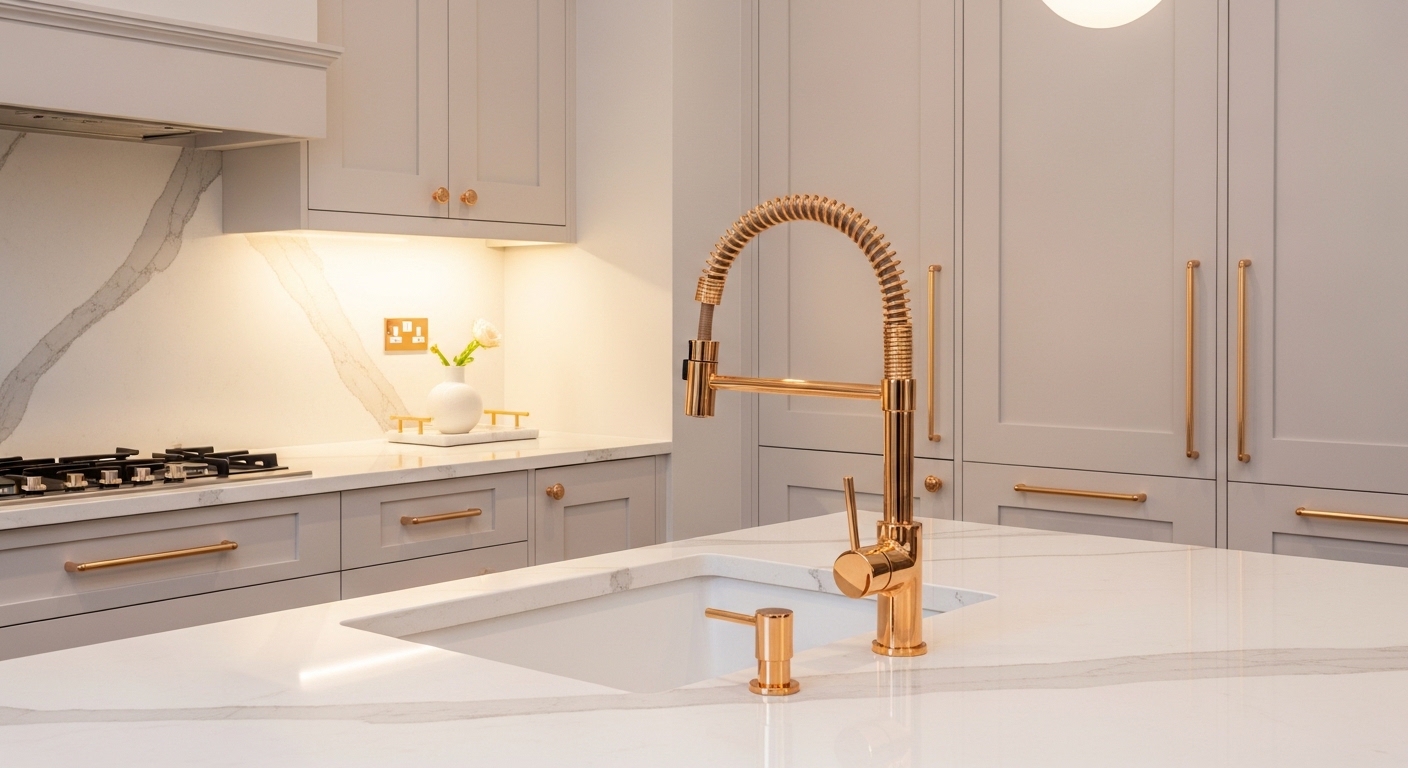
The faucet is the second place, and it is the piece that most defines the kitchen’s metal story. A rose gold faucet works best when it is the only large rose gold object in the room, because a faucet is prominent and the eye goes to it constantly. If your faucet is rose gold, keep the cabinet hardware quieter — smaller pulls, or fewer of them — so the faucet reads as the jewelry and the hardware reads as support. Two large rose gold statements in one kitchen compete. One statement plus quiet support reads intentional.
Lighting is the third place, and it is where rose gold does its prettiest work. A pendant light with a rose gold interior or trim casts a warm glow downward and shows the metal at its best, because the metal is lit from within by its own bulb. Pendant lights over an island or a peninsula are the ideal spot: they are at eye level when you are standing, they are seen from across the room, and they do not touch water or grease the way a faucet does. If you choose only one rose gold move in your kitchen, a pendant light is often the best single choice.
Small accessories come last, and only if the room still wants more: a rose gold kettle, a utensil holder, a soap dispenser, a tray. These are the easiest to overdo, because each one is small and each one feels harmless, and together they tip the room from warm metal into themed. Pick one or two, not a shelf full. The test is the same as for any accent: remove it and see if the room feels worse. If it feels the same, it was decoration, not design.
What pairs with rose gold, and what fights it
Rose gold’s best partners are the colors and materials that share its warmth without competing with its pink. White and cream are the safest: a white kitchen with rose gold hardware reads clean and warm at once, and it is the combination most likely to age well. Marble, especially white marble with soft grey veining, is the classic partner, because the stone’s cool veining balances the metal’s warmth and the combination reads expensive without trying.
Wood is the second great partner, particularly warm and mid-tone woods. A wooden cutting board, wooden shelving, wooden bar stools, or a butcher-block section of counter softens rose gold and keeps it from feeling precious. The wood gives the metal something earthy to sit next to, which is exactly what a working kitchen needs. A rose gold kitchen with no wood in it can feel like a display. A rose gold kitchen with wood in it feels like a kitchen.
Deep colors are the dramatic partners, and they work when used as a backdrop rather than a competitor. Navy cabinets with rose gold hardware are a well-loved combination because the dark blue makes the warm metal glow, and the metal keeps the navy from feeling cold. Deep green works the same way. The rule is one deep color, used on cabinets or one wall, with rose gold as the metal accent. Two deep colors plus rose gold is a crowded palette, and the metal stops reading as jewelry and starts reading as one more color to manage.
What fights rose gold is mostly other metals used carelessly. Chrome and rose gold together can work, but only with a clear hierarchy: one dominant metal, one supporting metal, and a reason for both. A kitchen where the faucet is chrome, the hardware is rose gold, the appliances are steel, and the lighting is brass has four metals arguing, and no single one reads intentional. If your appliances are stainless steel — and most are — that is already your second metal. Keep rose gold as the accent metal and let steel be the workhorse, and do not add a third.
🛒 Shop This Look:
How bold should you go: the rose gold spectrum
Rose gold kitchens exist on a spectrum, and knowing where you sit on it prevents both timidity and excess. At the quiet end is hardware only: rose gold pulls and knobs on otherwise neutral cabinets. This is the safest entry point, the easiest to reverse, and honestly enough for most kitchens. At the middle is hardware plus one statement: a faucet or pendant lights. At the bold end is hardware plus faucet plus lighting plus a backsplash accent or colored cabinets.
The bold end is where regret lives, because it is the hardest to reverse and the most sensitive to trends. A rose gold faucet can be swapped. Rose gold cabinets cannot, at least not cheaply. If you are drawn to the bold end, ask yourself whether you love rose gold specifically or whether you love the idea of a warm, distinctive kitchen. If it is the second, a deep green or navy kitchen with rose gold hardware gives you the distinctiveness with a fraction of the commitment, and the cabinets will still look good if you later swap the hardware.
Red kitchen decor sits further along the boldness spectrum, and comparing the two is instructive: red demands dose control because it dominates, while rose gold demands restraint because it tempts you to add one more piece. Different risks, same discipline — decide the dose before you start buying.
A useful dose test: photograph your kitchen, then count the rose gold objects in the photo. One to three reads as an accent. Four to six reads as a theme. More than six reads as a collection, and collections belong on a shelf, not spread across a working kitchen. If your count is above six, remove the smallest pieces first — the accessories, not the hardware — and watch the room calm down.
Finishes that survive a real kitchen
Rose gold finishes vary enormously in durability, and a kitchen is the hardest room in the house for a finish: steam, grease, acidic splashes, constant touching, and cleaning products. The finish you choose matters more than the shade you choose.
Lacquered or sealed rose gold finishes hold up best, because the seal protects the metal color from water, steam, and cleaning. Unlacquered or living finishes will change over time — they darken, spot, and develop patina — which some people love and some people hate. If you love patina, choose unlacquered deliberately and accept the change. If you want the faucet to look the same in five years as it does today, choose lacquered and check the manufacturer’s care instructions before you buy, because some sealed finishes are damaged by abrasive cleaners or vinegar solutions.
Cleaning is simple if you keep it gentle: a soft cloth, warm water, a drop of mild soap, dry immediately. The enemies are abrasive pads, harsh descalers, and leaving water to sit on the finish, all of which dull or spot rose gold faster than they would chrome. Around the faucet and sink, where water sits constantly, this matters daily, not occasionally. A quick wipe after washing up takes seconds and preserves the finish for years. A neglected faucet develops water spots that are much harder to remove than to prevent.
One caution about cheap rose gold: very inexpensive rose gold hardware and faucets are often plated thinly over a base metal, and thin plating wears through at touch points — the edge of a pull, the handle of a faucet — revealing a different metal underneath. That wear looks like damage, not patina. Spending a little more on hardware from a maker that states its plating or finish thickness is worth it here, because hardware is touched dozens of times a day and cheap plating shows it within a year.
Rose gold on a budget, and in small kitchens
Rose gold does not require a renovation, and the budget path is genuinely good in this style because the best moves are small. Hardware first: a full set of pulls and knobs changes the whole kitchen’s metal story for a modest cost, and it is a job most people can do in an afternoon with a screwdriver and a template. Lighting second: one pendant light over an island or sink. Accessories last, and only one or two.
Kitchen ideas on a budget that look expensive follow the same principle of spending where the eye goes — hardware, lighting, and one focal point — rather than spreading a small budget thinly across everything. Rose gold fits that principle perfectly, because a little of it goes a long way and a lot of it costs a lot.
In a small kitchen, rose gold needs even more restraint, because every object is closer to every other object and the metal accumulates visually. One rose gold move — hardware, or a pendant, or a faucet — is usually enough in a small kitchen, and two moves need to be quiet ones. A small kitchen with rose gold hardware and a rose gold faucet can feel jewel-like. A small kitchen with rose gold hardware, faucet, lighting, and accessories feels crowded, because there is no neutral ground left for the eye.
Renters can use rose gold without touching a fixture: a kettle, a utensil holder, a tray, a soap dispenser, a set of towels with a rose gold thread. These are portable, reversible, and genuinely effective, because they sit at eye level and hand level where the metal is seen and touched. The renter’s rule is the same as everyone else’s: one or two pieces, not a shelf full, and let the rest of the kitchen stay neutral.
🛒 Shop This Look:
Walls, shelves, and the rest of the room
Rose gold does not live on cabinets alone, and the walls and shelving around it decide whether the metal feels integrated or pasted on. A backsplash is the most tempting place to add rose gold, and the riskiest: a full rose gold backsplash is a large pink-toned surface that dominates the room and is expensive to change. A safer backsplash move is a neutral tile — white, cream, or soft grey — with a rose gold accent used sparingly, such as a thin trim or a single row of metallic tiles. The neutral tile keeps the room calm. The metallic accent gives the eye something to find.
Open shelving shows rose gold at its best and worst. A few rose gold-accented objects on open shelves — a kettle, a small tray, a set of measuring cups — look collected and warm. Shelves full of rose gold objects look like a store display. If you have open shelving, let most of what sits on it be neutral — white dishes, wood boards, glass — with rose gold as the occasional note, not the melody. Kitchen wall decor ideas cover the broader shelving and wall choices that frame the metal, and the same restraint applies: the wall should support the kitchen, not compete with it.
Wall color deserves the same care as the metal itself. Warm white and cream walls flatter rose gold. Soft grey walls can work if the grey is warm-toned. Stark white walls next to rose gold can make the metal look pinker by contrast, because there is no warmth in the room to pull it toward gold. If your walls are stark white and you cannot repaint, warm the room with wood — a cutting board left out, wooden shelving, wooden stools — and the rose gold will follow the wood toward gold.
Mistakes that turn rose gold pink
The mistakes are consistent, and they all come from excess or mismatch. Too many rose gold objects, so the accent becomes a theme. Rose gold on a large surface, like cabinets or a full backsplash, so the metal becomes a color scheme. Rose gold paired with cool lighting and cool greys, so it leans pink instead of gold. Rose gold mixed with three other metals, so no metal reads intentional. Cheap plating that wears through at touch points. And the quietest mistake: choosing rose gold from a screen, where it always looks more golden than it does in a cool-lit kitchen.
The fix for all of them is dose control plus a sample test in your own light. One to three functional rose gold objects, warm bridges in wood and cream, one dominant metal plus steel, and a sealed finish you clean gently. Done that way, rose gold does what it does best: it warms a hardworking room without shouting, and it still looks good when the trend cycle moves on — because warm metal, used sparingly, was never really a trend at all.
Explore more kitchen ideas for the broader kitchen guides this metal sits alongside.
🛒 Shop This Look: