
As an Amazon Associate, I earn from qualifying purchases. This means I may earn a commission if you purchase through links on this page — at no extra cost to you.
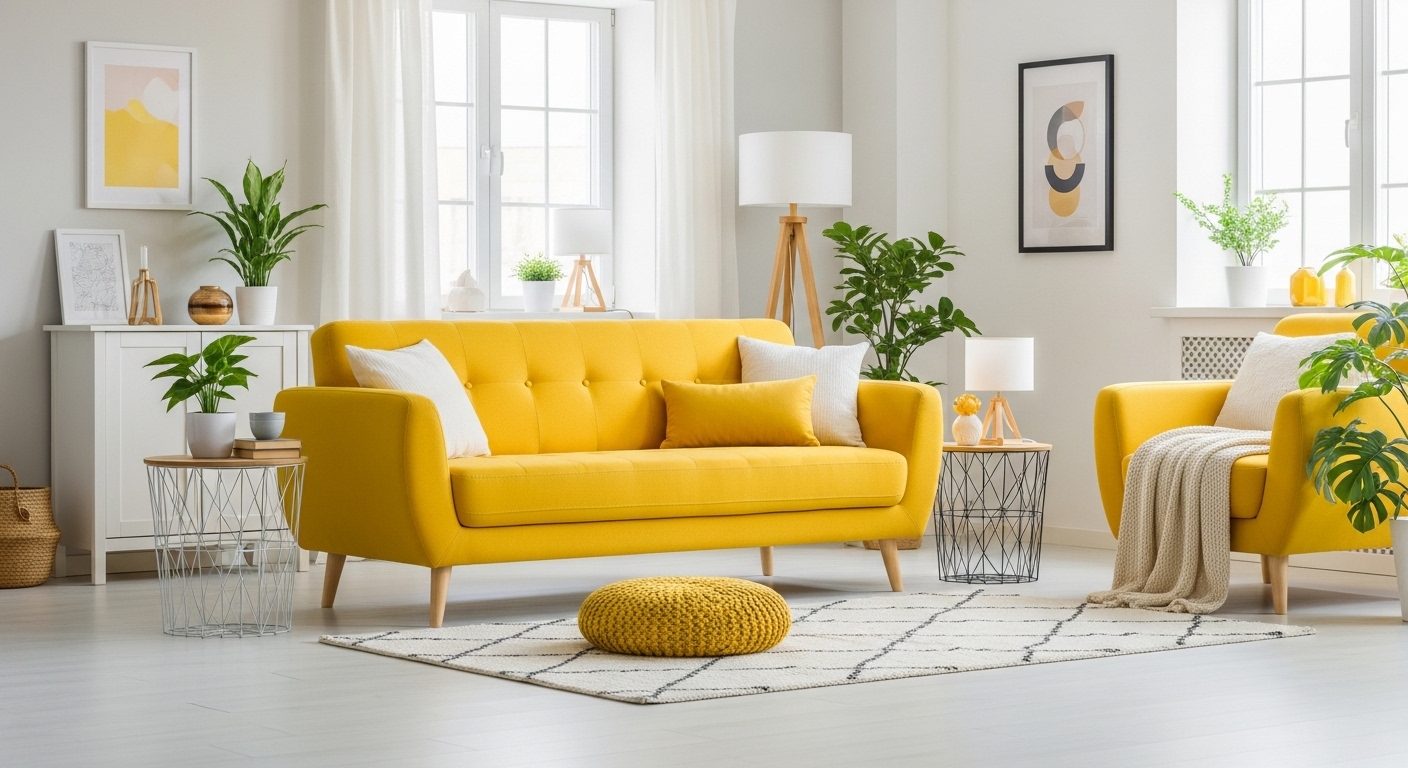
A yellow sofa is the boldest seating decision most people will ever make, and that is exactly why it goes wrong so often. Bought for a burst of sunshine, it lands in a room that was not prepared for it, and within a month it feels loud instead of cheerful. The sofa is rarely the problem. The room around it is. This guide covers how to choose the right yellow, what to pair it with, and how much yellow a room can actually hold, so the sofa feels sunny on purpose rather than accidental.
Choose the yellow before you choose anything else
Yellow is not one color. A lemon yellow is bright, cool, and high-energy. A mustard yellow is warm, muted, and earthy. An ochre sits between them, golden without shouting. A butter yellow is pale and soft, closer to a neutral than a statement. Each one behaves differently in a room, and choosing the wrong one is the mistake behind most yellow-sofa regret.
Start by looking at your light. In a bright, south-facing room, a lemon or vivid yellow will be amplified by the sunlight and can feel electric by midday. That same room handles a mustard or ochre beautifully, because the warmth of the yellow and the warmth of the light agree. In a dim or north-facing room, the opposite happens: a mustard can turn muddy and dull, while a brighter lemon or a clear butter yellow holds its character and lifts the room. This is the single most useful yellow-sofa test, and it costs nothing: hold fabric swatches against the wall in your actual room, morning and evening, for at least two days before ordering.
Then consider the undertone of everything the sofa will sit near. Yellow next to warm wood, brass, and cream reads golden and cohesive. Yellow next to cool grey, chrome, and stark white reads sharper and more modern — which can be striking, but it is a deliberate contrast look, not a default. If your room is already full of cool greys, a warm mustard sofa will fight the room unless you add warm bridges: a wooden coffee table, a jute rug, brass or wood lamp bases. The sofa does not exist alone. It exists against your floor, your walls, and your largest furniture, and all of those vote on whether the yellow works.
One more consideration before you commit: how long do you want to love it? A vivid lemon is thrilling for a season and tiring for five years. A mustard or ochre is less thrilling on day one and much easier to live with in year three. If this is a sofa you plan to keep, lean one shade more muted than your first instinct. You can always add brightness with cushions and throws, which are cheap to change. You cannot easily mute a sofa.
How much yellow can a room hold
The rule that saves most yellow-sofa rooms is simple: let the sofa be the yellow, and let almost everything else be quiet. One large yellow object is a statement. A yellow sofa plus yellow curtains plus yellow art plus a yellow rug is a theme park. The eye needs neutral ground to appreciate the bold piece, and when everything competes, nothing wins.
A workable proportion is roughly this: the sofa carries the yellow, one or two small accents echo it, and everything else stays neutral. The echo matters — a cushion with a thin yellow stripe, a throw with a yellow thread, a small vase — because it makes the sofa look intentional rather than stranded. But the echo should be small. If your echo is as loud as the sofa, you have two statements, and the room starts shouting.
Wall color is where this rule bites hardest. A yellow sofa against a yellow wall is almost always too much, even when the two yellows differ. A yellow sofa against a warm white, a soft grey, or a muted sage wall gives the sofa room to breathe and lets its color read clearly. If you love colored walls, pick a color that contrasts rather than matches: a deep green wall behind a mustard sofa is dramatic and grounded, because the green absorbs some of the yellow’s energy instead of amplifying it. A pale wall behind a pale butter sofa is the gentlest version of the same idea, and it suits small rooms best.
The same restraint applies to pattern. A yellow sofa with a boldly patterned rug and patterned curtains is three loud voices at once. Pair the sofa with a rug that is mostly one quiet color — a natural jute, a soft grey, a cream wool — and let pattern live in one place only, such as a single patterned cushion or a piece of art. Quiet surroundings are not boring. They are what make the bold piece legible.
🛒 Shop This Look:
Neutrals that actually flatter yellow
Not all neutrals treat yellow equally, and the wrong neutral can make a yellow sofa look garish instead of sunny. White is the obvious partner, but stark white next to vivid yellow creates a high-contrast snap that can feel harsh, especially in bright light. Warm white or cream softens that edge and makes the yellow read golden rather than electric. If your walls are stark white and you cannot repaint, warm the room with wood, brass, and cream textiles rather than adding more white.
Grey is the second partner, and it needs care. A cool, blue-grey next to a warm mustard can look muddy, because the two undertones disagree. A warm grey, or a greige with a beige undertone, sits happily next to mustard and ochre. Grey couch living rooms show the same undertone logic from the other side: the grey that works is the one whose temperature matches the room, and the same rule governs the grey you pair with a yellow sofa.
Wood is yellow’s most forgiving partner. Mid-tone and dark woods ground a yellow sofa immediately, because wood reads as a natural material and yellow reads as a natural color — think of sunlight on timber, which is a combination the eye already trusts. A wooden coffee table, wooden shelving, or wooden lamp bases will calm a yellow sofa faster than any amount of white paint. Black metal works similarly in small doses: black frames, black lamp bases, black hardware give the yellow a crisp edge without adding another color to manage.
Green is the accent color most worth considering. A muted sage or olive green sits opposite yellow on the color wheel closely enough to create contrast without clashing, and plants do this job for free. A large plant next to a yellow sofa is one of the easiest styling moves in this whole guide: the green cools the yellow visually, the leaves add texture, and the combination reads fresh rather than decorated. If you keep no live plants, a sage cushion or a piece of green art does the same work in miniature.
Flooring: the decision under the sofa
Flooring is easy to forget and hard to fix, and it votes on your yellow sofa every day. A warm wood floor under a mustard sofa creates a continuous warm field that can feel wonderful or overwhelming depending on the room’s light. In a bright room, that warmth is golden. In a dim room, warm floor plus warm sofa plus warm walls can turn the whole space muddy, and the fix is to break the field with a rug in a contrasting tone — a cool grey or a natural jute that sits between the floor and the sofa.
Grey flooring living rooms are the opposite case, and often the better one for a yellow sofa: a cool grey floor gives a warm yellow sofa a calm stage, and the contrast makes the yellow look intentional rather than accidental. If you have grey flooring and a yellow sofa feels too stark against it, a rug in a warm neutral — cream, beige, or a soft tan — bridges the two temperatures without adding a new color.
Rug size matters as much as rug color. A rug that is too small strands the sofa on a little island and makes the yellow look even louder, because the eye sees a bold object floating on bare floor. A rug large enough for the sofa’s front legs and the coffee table to sit on grounds the whole seating area and gives the yellow a defined territory. In a small room, that territory is what keeps the sofa from taking over visually.
Bold sofa or neutral sofa: the honest comparison
Before you commit to yellow, it is worth asking the uncomfortable question: should this sofa be yellow at all, or should the yellow live somewhere cheaper to change? There is no shame in the second answer. A neutral sofa with yellow cushions, a yellow throw, and yellow art gives you most of the sunshine with none of the commitment, and you can change the palette next year for the price of new cushions.
The yellow sofa earns its place when one of three things is true. First, the room is otherwise quiet enough to carry it — neutral walls, neutral floor, minimal pattern. Second, you genuinely love yellow and have lived with it before, not just admired it in a photograph. Third, you are prepared to style around it for years, which means choosing future purchases — rugs, curtains, art — with the sofa in mind. If none of those is true, a neutral sofa with yellow accents is the smarter buy, and it will look better in year three than a yellow sofa you have grown tired of.
If you do commit, protect the decision with a washable or cleanable fabric. Yellow shows marks more than most colors, and a sofa you are afraid to sit on defeats the sunny, welcoming feeling that made you choose yellow in the first place. A removable, washable cover in a yellow you love is worth more than a delicate velvet in a slightly better shade. The best yellow sofa is the one you actually use without anxiety.
Light changes yellow more than any other color
Yellow is unusually sensitive to light, and this catches people out twice: once when the sofa arrives and looks different from the showroom, and again every evening when the lamps come on. Warm lamplight deepens yellow toward gold, which usually flatters mustard and ochre. Cool daylight or cool-toned bulbs can make a lemon yellow look sharp and a butter yellow look washed out.
The practical fix is to choose your bulbs with the sofa in mind. Warm-white bulbs in the lamps near the sofa will make a mustard sofa glow in the evening. If your room has cool overhead lighting you cannot change, a warm-toned lamp near the sofa creates a pocket of flattering light exactly where the sofa sits. And if you are choosing between two yellows, view both under your evening lamps, not just in daylight — the evening view is the one you will live with most.
Art and cushions need the same light test. A piece of art that looks perfect next to the sofa at noon can clash at seven in the evening when the yellow deepens. This is not a reason to overthink every cushion. It is a reason to live with the sofa for a week before buying the finishing pieces, so you see it in all your room’s lights before you commit to companions for it.
🛒 Shop This Look:
Small rooms, pets, and children
A yellow sofa in a small room works when the rest of the room is disciplined. Pale walls, one rug, minimal pattern, and the yellow as the single statement: that combination makes a small room feel cheerful rather than crowded. What kills a small yellow-sofa room is accumulation — yellow sofa plus patterned rug plus colored curtains plus a gallery wall, all competing in a space with no room for the eye to rest. In a small room, the sofa is already the decoration. Let it be.
For households with pets or children, the fabric decision matters more than the shade decision. A yellow sofa in a performance fabric, a tight weave, or a washable slipcover will survive real life. A yellow sofa in a loose, light, delicate fabric will show every paw print and juice incident, and you will spend more time protecting it than enjoying it. Darker yellows — mustard, ochre — hide wear better than pale butter yellow, which is another reason to lean one shade deeper than your first instinct if the sofa will see heavy use.
Throws are your best friend here, and not just for decoration. A throw in a complementary neutral draped over the most-used seat protects the fabric where it wears fastest, and it can be washed weekly without drama. Choose a throw that looks intentional — a chunky knit, a linen weave — rather than a sheet that screams protection. The goal is a sofa that looks loved, not a sofa that looks guarded.
Seasonal swaps that keep yellow fresh
One advantage of a yellow sofa is how easily it changes mood with the seasons, because yellow pairs with almost every seasonal palette. In summer, white and natural linen cushions plus a jute rug make it feel bright and airy. In autumn, rust, olive, and warm brown cushions deepen it into a harvest feeling. In winter, charcoal and deep green cushions plus a chunky throw make the same sofa feel cozy rather than summery.
The swap that matters most is the throw and cushions, not the big pieces. Changing the rug twice a year is expensive and disruptive. Changing cushions is an afternoon’s work and a small cost, and it is enough to make the sofa feel new again. Keep a small rotation — one summer set, one winter set — stored in a basket or a closet shelf, and the yellow sofa will never have the chance to feel stale.
Be careful with one seasonal trap: adding more yellow in summer. A yellow sofa plus yellow cushions plus yellow flowers plus a yellow throw in July is the theme-park problem again, just seasonally justified. Summer swaps should add white, cream, and natural textures around the yellow, not more yellow. Let the sofa be the sun. Everything else is the sky.
Mistakes that make a yellow sofa feel loud
The common mistakes are all versions of the same error: too much competing color. A yellow sofa against a yellow wall. A yellow sofa with a patterned rug and patterned curtains. A yellow sofa surrounded by other bright furniture, so no single piece can be appreciated. A yellow sofa in a shade chosen from a screen rather than a swatch, so it arrives brighter or muddier than expected. And the quietest mistake: a yellow sofa bought for a photograph rather than a room, in a home where everything else is cool-toned and the sofa has no warm bridges.
Each of these has the same fix: give the sofa neutral ground, warm bridges, and one small echo, and let it be the only loud voice in the room. A yellow sofa styled that way does not feel loud at all. It feels like the warmest seat in the house, which is exactly what you wanted when you chose it.
Explore more living room ideas for the broader room-by-room guides this style sits alongside.
🛒 Shop This Look:



