
As an Amazon Associate, I earn from qualifying purchases. This means I may earn a commission if you purchase through links on this page — at no extra cost to you.
A Scottish coffee table is not a display shelf. It is the surface where people gather when the weather turns, where tea cools while conversation warms up, and where a book stays open because someone means to come back to it. The best Scottish tabletops look collected rather than arranged: dark wood, a touch of tartan, something warm to drink, something worth reading, and light that makes the whole corner feel sheltered. This guide shows how to build that feeling step by step, without turning your living room into a themed set.
Start with the table, not the decor
Styling cannot rescue the wrong table, so check the bones first. A coffee table works best when its length runs about two-thirds the length of the sofa it serves. Much longer and it crowds the walkways; much shorter and it looks lost in front of a long sofa. Height matters just as much: the tabletop should sit level with the seat cushions or an inch or two lower, so setting down a cup feels natural rather than a reach up or a drop down. Leave enough clearance to walk around it comfortably, roughly a generous stride on each side, and make sure drawers or a lower shelf still open without hitting chair legs or the rug edge.
Material sets the tone for everything that follows. Dark stained oak, walnut, and reclaimed pine all suit the Scottish look because they carry visual weight and age gracefully. A glass top can work in a small room where a solid table would feel heavy, but it needs a tray underneath the arrangement to give the eye something solid to land on. Painted tables suit lighter rooms, though a dark top hides ring marks and daily wear far better, which matters on a surface that actually gets used. If you are choosing between two tables, pick the one with a lower shelf or a drawer: hidden storage is what keeps a styled table from sliding into clutter. The room the table sits in matters too, and the Scottish living room guide covers how wall color, seating, and textiles work together around it.
One tray to hold the whole arrangement
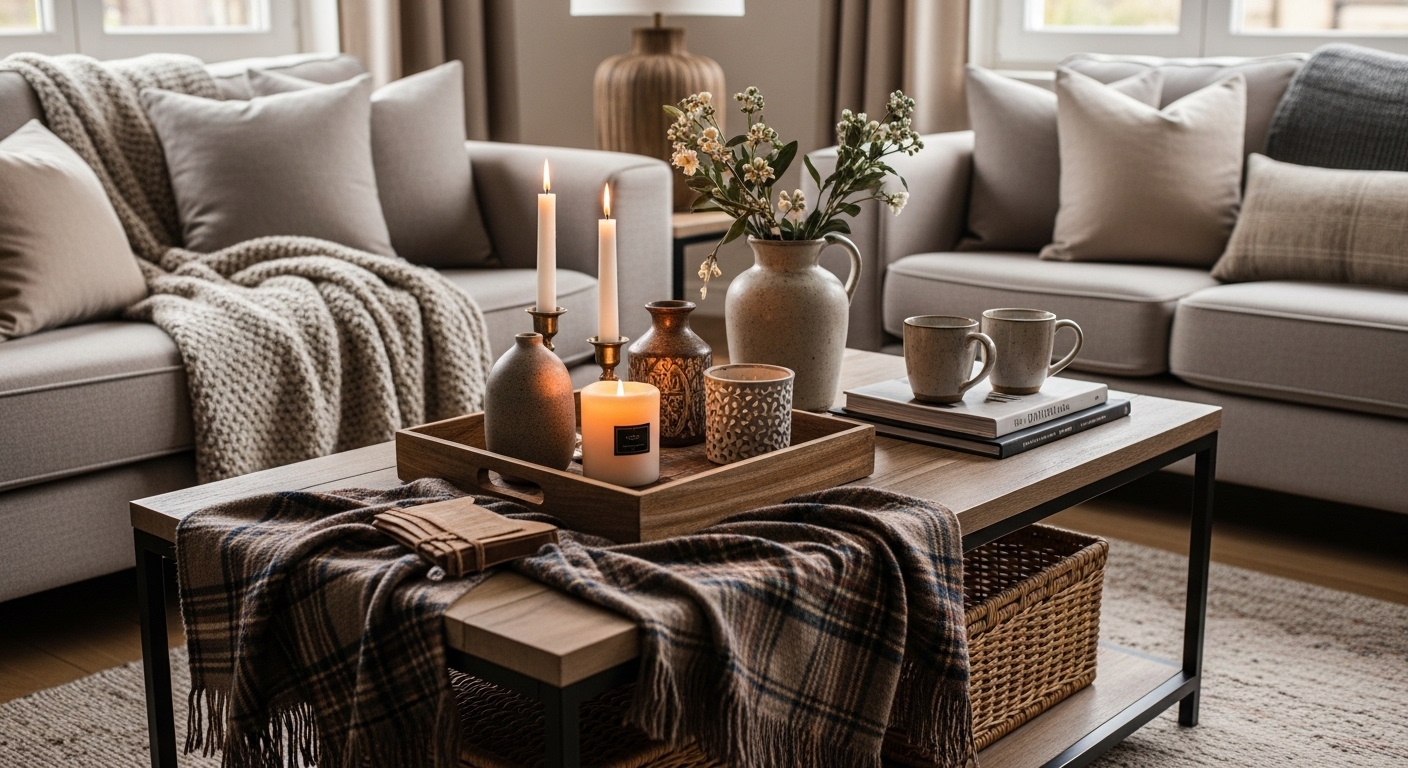
Every calm coffee table has an anchor, and a tray is the simplest one. A single tray gathers the small things into one intentional group, protects the wood from cups and candle wax, and gives you one object to lift when you need the whole surface clear. Choose a tray that contrasts slightly with the table: light wood or woven seagrass on a dark table, dark wood or aged metal on a light one. Round trays soften a rectangular table; rectangular trays sharpen a round one. Either way, the tray should cover no more than half the tabletop, leaving open surface for cups, books, and everyday life.
Inside the tray, work in threes: one tall thing, one low thing, and one flat thing. A tall candlestick or a small vase of stems gives height. A low bowl, a short stack of coasters, or a small box gives weight at the base. A flat object, like a book laid open or a folded linen cloth, grounds the group. If the tray looks busy, remove one item before adding anything else. The goal is a group you can read at a glance, not a collection that needs explaining.
🛒 Shop This Look:
Tartan in one place, not everywhere
Tartan is the fastest way to say Scottish, and the fastest way to overdo it. The rule that keeps it elegant is dose: one tartan element on or near the table, and solids everywhere else. A folded tartan throw draped over one sofa arm, a single tartan cushion, or a tartan runner under the tray all work. Two or more competing tartans in one sightline fight each other and turn the room into a pattern sample book. If your throw is a bold red-based tartan, keep the tray, books, and candle colors quiet: dark wood, cream, charcoal, and brass. If the tartan is muted green or blue, you have more room for warm wood tones and amber candlelight.
Scale matters as much as color. Large-scale tartan reads bold and modern; small-scale tartan reads traditional and quiet. On a small table, a small-scale pattern is safer because it does not visually swallow the surface. And tartan does not have to be fabric: a tartan-patterned book cover, a box, or a single placemat under a vase gives the reference without committing a whole textile to it.
Books that actually get opened
A stack of books is the most honest coffee table decor there is, provided the books are ones someone in the house would actually open. Two or three books, stacked largest at the bottom, look deliberate; five or more look like storage. Vary the heights slightly and turn the top book so its spine faces a different direction from the ones below, which breaks the brick-like look. Choose subjects that invite browsing: landscape photography, local history, cooking, or a novel with a beautiful cover. A book laid open on top of the stack, even to a random page, signals that the table is for use, not for show.
Keep the stack low enough that it never blocks sightlines across the table. When two people sit opposite each other, they should be able to see each other’s faces over the arrangement. If the stack plus the vase plus the candle together rise above eye level when seated, something needs to come down a notch.
Warm light, kept safe
Scottish coziness lives or dies on light. A candle or two on the coffee table, lit in the evening, changes the whole room more than any object you can buy. Use sturdy holders that cannot tip easily, keep flames away from throws, curtains, and paper, and never leave a lit candle burning in an empty room. Battery candles in a lantern give the same glow with none of the worry, and they suit houses with children, pets, or anyone who forgets to blow candles out before bed. A small lantern also adds height and a glass surface that catches light, which helps on a dark wood table.
Layer the light rather than relying on one source. A table lamp on a side table, a floor lamp behind the sofa, and the low glow on the coffee table together create depth. If the coffee table is the only light in the room, it will feel like a spotlight instead of a hearth.
🛒 Shop This Look:
Wool and texture without bulk
Wool is the textile backbone of the Scottish look: a chunky throw, a woven cushion cover, a felted coaster set. The trick is to keep texture close to the seating and off the tabletop itself. A throw belongs folded over a sofa arm or the back of a chair, not pooled on the table where it hides the surface and collects crumbs. On the table, texture comes from smaller things: a linen cloth under the tray, a woven coaster, a wooden bead garland draped once around a candle holder rather than coiled in a pile.
Mix no more than three textures in the table arrangement. Wood plus linen plus one metal, for example, or wood plus wool plus glass. More than three and the eye stops resting and starts inventorying. Natural fibers age better than shiny synthetics here: they soften with use instead of looking tired, and they sit comfortably next to old wood.
Greenery that survives real life
A small plant or a few stems keep a dark wood table from feeling heavy. Choose greenery that tolerates low light and irregular watering, since coffee tables rarely sit in the sunniest spot. A small potted fern, a trailing plant in a heavy pot that will not tip, or a vase of hardy stems all work. Faux stems are a fair choice in a dark corner where nothing living would thrive; the test is whether they look convincing from sofa distance, not under inspection. One arrangement is enough. A plant on the table plus a plant on the floor beside it plus a wreath on the wall turns the corner into a greenhouse.
Scale the greenery to the table. Stems should rise no higher than about one and a half times the height of the tallest object in the tray group, or the plant dominates the arrangement. Trim stems so they do not brush anyone’s face when they lean forward for a cup.
Leave room for everyday use
The most common styling failure is a table so full that nobody dares use it. Reserve at least a third of the surface as open space, permanently. That space holds the cups, the reading glasses, the phone someone sets down, and the plate of biscuits that appears without warning. Coasters should live on the table, not in a drawer: a small stack of stone or leather coasters near the tray edge is both decor and permission to set things down. A small lidded box or a drawer corrals the remote controls and the odds and ends that otherwise colonize the surface.
Think about the table’s daily rhythm. Morning coffee, afternoon reading, evening gathering: each use needs a slightly different clear area. If your arrangement cannot survive one of those uses without everything being moved to the sofa, the arrangement is too precious. Move one item to a side table or a shelf and let the coffee table breathe.
Shift it with the seasons, not a full redo
A Scottish table earns its keep by changing lightly through the year. In winter, the throw gets heavier, the candles get taller, and the books turn to longer reads. In summer, swap the heavy throw for a lighter linen one, trade the candle for a small vase of fresh stems, and let the wood show more. These are ten-minute changes, not redecorating projects. The tray, the book stack, and the anchor objects stay; only the seasonal layer moves. The same light-touch approach works across styles, and the Irish coffee table guide shows how a warmer, softer palette handles the same seasonal shift.
Small rooms and rented rooms
Small rooms need the same principles at a smaller scale. One tray, one book stack, one light source: that is the whole arrangement on a compact table. Choose a nesting table or a lift-top table if floor space is tight, since both give you surface when you need it and tuck away when you do not. Avoid tall centerpieces in small rooms; they chop the sightline and make the room feel divided. Renters can get the full effect without touching the walls: everything on a coffee table is movable by definition, so invest in the tray, the throw, and the books rather than in anything fixed.
Mistakes that make a Scottish table feel like a set
Four mistakes show up again and again. First, matching everything: a tartan throw plus tartan cushions plus a tartan table runner plus tartan coasters reads as a costume, not a room. Second, too many small objects: a dozen tiny items on one table look like a shop display, however charming each one is alone. Third, fragile things at the edges: a delicate vase where an elbow lands will not survive a week. Fourth, ignoring the room around the table: a beautifully styled table in front of a bare wall and a bare sofa looks stranded. Step back and check the whole corner, not just the tabletop.
🛒 Shop This Look:
A starter plan for one weekend
Start Saturday morning by clearing the table completely and cleaning it. Measure it against the sofa and note whether the proportions work; if the table is badly sized, no styling will fix it, and that is worth knowing before you buy anything. Place the tray first, then the book stack, then the light source, stepping back after each addition to check sightlines from the sofa. Add the tartan element last, in exactly one place. Live with the arrangement for a day before buying anything new: use the table for coffee, for reading, for an evening of conversation, and notice what gets moved and what gets used. Sunday, remove whatever never earned its place and keep the rest. That is the whole method: anchor, books, light, one tartan note, and open space for life.
For further reading, the same table-first method adapts to other styles: the Italian coffee table guide, the Mediterranean coffee table guide, and the round coffee table guide each solve the same problems with a different palette, and the living room ideas hub gathers the room-level guides around them.