
As an Amazon Associate, I earn from qualifying purchases. This means I may earn a commission if you purchase through links on this page — at no extra cost to you.
A hundred thousand welcomes is not just something the Irish say. It is something they build rooms around, and in most Irish homes that welcome lands first on the coffee table. This is the surface where tea is poured, where someone pulls up a chair uninvited and stays for an hour, and where the room proves it is for living in rather than looking at. An Irish coffee table should feel warm, worn in the right places, and ready for company at short notice. This guide shows how to build that table: wood first, textiles second, light, tea service, collected objects, and the restraint that keeps warmth from turning into clutter.
Wood first, old and new together
Start with the table itself and the wood around it. Irish rooms favor solid wood with visible grain: oak, pine, and darker stained woods that show their age gracefully. A table that already carries a few marks has a head start, because it does not punish daily use. Mixing old and new wood is part of the look: a vintage-feeling table beside a newer bookshelf, or an old wooden box on a clean-lined table, reads collected rather than decorated. Avoid matching every wood tone in the room exactly; two or three related tones, light oak with a darker walnut accent, for example, feel more natural than one uniform finish everywhere. Check the same basics as any table: length about two-thirds of the sofa, top level with the seat cushions or slightly lower, and enough clearance to walk around it without turning sideways. The same wood-first approach shapes the whole room, and the Scottish coffee table guide shows how a darker, heavier wood palette solves the same problems.
Textiles: wool, linen, and knit, kept off the tabletop
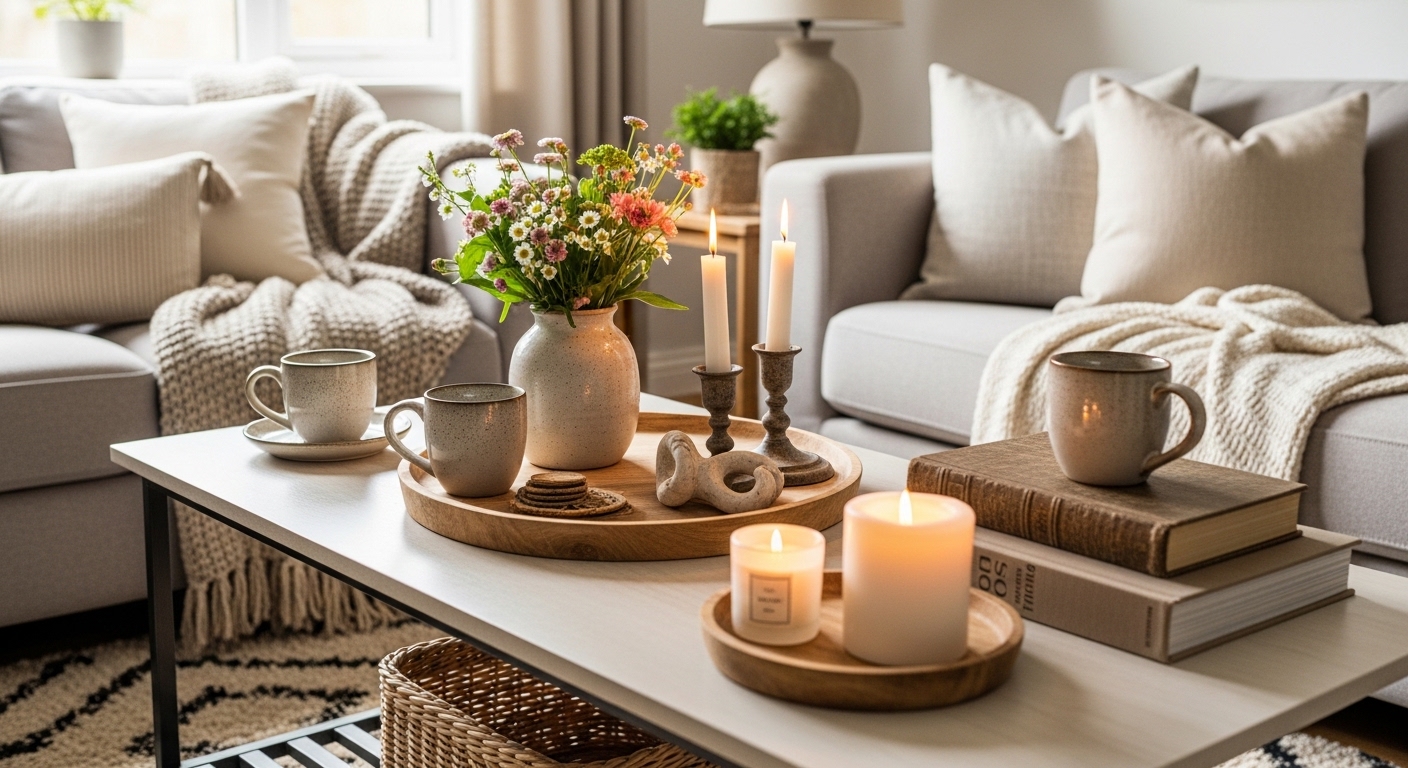
Wool is the defining textile of the Irish look: a chunky knit throw, a woven cushion cover, a felted coaster. Linen softens it, especially in warmer months, when a lighter throw replaces the heavy knit without changing anything else. The key placement rule is that textiles live on the seating, not on the tabletop. A throw folded over a sofa arm, a cushion on the chair beside the table, and a linen cloth under the tray are all working. A throw pooled on the table hides the surface, collects crumbs, and makes the table look like storage. On the table itself, texture comes from small things: a woven coaster set, a linen napkin beside the tea tray, or a wooden bead garland draped once around a candle holder.
Keep the textile palette to three materials at most in the table arrangement. Wool plus linen plus wood, for example, or knit plus leather plus glass. More than three textures and the eye starts inventorying instead of resting. Natural fibers suit this room because they soften with use rather than looking tired, and they sit comfortably next to old wood.
Light: candles, lanterns, and low lamps
Irish warmth is low light, not bright light. A candle or two on the coffee table in the evening, a lantern on the floor beside it, and a table lamp on a side table together create the layered glow the look depends on. Use sturdy candle holders that cannot tip, keep flames clear of throws and paper, and never leave a lit candle in an empty room. Battery candles inside a glass lantern give the same low light with none of the worry, and they suit homes with children or pets. Avoid a single harsh overhead light as the room’s only source: it flattens wood grain and makes the whole corner feel exposed rather than sheltered.
🛒 Shop This Look:
The tea service as styling
The most honest centerpiece on an Irish coffee table is the tea service itself. A teapot, two or three mugs, and a small tray form an arrangement that is also an invitation: sit down, stay a while. Keep the set simple and sturdy rather than precious. Mismatched mugs that people actually reach for look more welcoming than a matched set nobody dares use. A small plate for biscuits beside the tray completes the ritual without adding clutter. If the table is small, keep the teapot in the kitchen and bring the tray out when tea is made; what matters is that the table is ready to receive it, with coasters in place and open surface to spare. Reserve at least a third of the tabletop as permanent open space for cups, books, and whatever appears without warning.
Books, plants, and one story per grouping
Every object on the table should belong to a small grouping with a clear idea. Books form one group: two or three, stacked largest at the bottom, on subjects someone in the house would actually open, kept low enough that people seated opposite can see each other over them. Plants form another: a small potted plant or a vase of hardy stems, scaled so it rises no higher than about one and a half times the tallest object nearby, and chosen for the light the table actually gets. Collected objects form a third: a small wooden box, a stone found on a walk, a candle holder with a history. One story per grouping is the rule. A book stack plus a plant plus a box plus a candle plus a photo frame plus a bowl is not six stories; it is noise. Remove one group before adding anything new.
Plants deserve a practical note: coffee tables rarely sit in the sunniest spot, so choose greenery that tolerates low light and irregular watering, or use convincing faux stems judged from sofa distance. Replace tired stems before they wilt, since a dying plant undoes the room’s freshness faster than an empty vase would.
Color: warm whites, greens, and muted tones
The Irish palette on a coffee table is warm rather than bright: warm white, cream, sage and moss greens, muted gold, and the browns of old wood. Choose one accent and repeat it exactly twice, a green vase and a green cushion on the sofa, for example. Two repetitions read as intention; one reads as accident, and three or more start to feel like a theme. Avoid novelty overload: a room full of themed ornaments reads as a souvenir shop, not a home. One restrained nod, a Celtic knot box or a single framed print, carries more warmth than a shelf of themed objects. The Scottish living room guide shows how a related traditional palette handles the same restraint at room scale.
🛒 Shop This Look:
Shift it with the seasons
An Irish table changes lightly through the year, and the changes take minutes. In winter, the knit throw gets heavier, the candles get taller, and the books turn to longer reads. In summer, swap the heavy throw for linen, trade the candle for fresh stems, and let the wood show more. The tray, the book stack, and the anchor objects stay put; only the seasonal layer moves. This light-touch approach keeps the table feeling alive without a redecorating project every few months, and it means the table never looks out of season for long.
When the table has to work harder
An Irish coffee table rarely serves only tea. Homework spreads across it after school, a craft project takes over a corner, someone writes letters or pays bills at it. Plan for that harder life rather than resenting it. A washable table runner or a large tray under the work zone protects the wood from pens, glue, and paint without changing the look. A lidded basket on the lower shelf or beside the sofa holds the supplies that belong to the current project, so the table can be cleared back to its welcome state in two minutes when guests arrive. Keep one corner of the table permanently work-friendly: a hard surface for writing, good light from a nearby lamp, and nothing fragile within elbow range. When the work is done, the basket goes back on the shelf and the tea tray returns to the center. A table that handles both lives, the working one and the welcoming one, gets used far more than a table kept pristine for company that rarely comes.
Small rooms and rented rooms
Small rooms need the same welcome at a smaller scale: one tray, one book stack, one light source. A nesting table pair or a lift-top table gives extra surface for guests and tucks away when floor space matters. Avoid tall centerpieces in compact seating groups, since they chop sightlines and make the room feel divided. Renters lose nothing here, since everything on a coffee table is movable by definition: invest in the tray, the throw, and the books rather than anything fixed to the walls. A round table can help in a tight room, and the round coffee table guide covers sizing and styling for the circle shape.
Mistakes that turn warmth into clutter
Four mistakes show up again and again. First, too many small objects: a dozen tiny items on one table look like a shop display, however charming each one is alone. Second, fragile things at the edges, where an elbow lands: a delicate vase in the strike zone will not survive a week. Third, a table so full that the tea service has nowhere to land, which defeats the whole welcome. Fourth, ignoring the room around the table: a beautifully styled table in front of a bare wall and a bare sofa looks stranded. Step back and check the whole corner, not just the tabletop, and remove one thing before adding anything new.
🛒 Shop This Look:
A starter plan for one weekend
Saturday morning, clear the table completely and clean it. Measure it against the sofa and check the height against the seat cushions; note honestly whether the table itself works, since styling cannot fix bad proportions. Place the tea tray first, then the book stack, then the light source, stepping back after each addition to check sightlines from every seat. Add one collected object last, in exactly one place. Live with the arrangement for a day of real use: morning tea, afternoon reading, an evening with a guest who stays longer than planned. Sunday, remove whatever got in the way and keep what earned its place. That is the whole method: wood, welcome, light, and open space for whoever walks in.
For further reading, the same welcome-first method adapts to other traditional rooms in the Scottish living room guide and the living room ideas hub, and the Scottish coffee table guide covers the darker, heavier end of the same tradition.



