
As an Amazon Associate, I earn from qualifying purchases. This means I may earn a commission if you purchase through links on this page — at no extra cost to you.
Farmhouse style had its reality-TV era: shiplap on every wall, a word sign above every sofa, and a barn door on every closet. That version is over, and good riddance. What survived is quieter and much harder to fake: rooms that feel collected over time, built from warm wood, honest texture, and furniture that looks used rather than staged. This guide is about that version. It covers how to choose the wood, the palette, and the textures that make a farmhouse living room feel warm instead of themed, and the traps that turn a good idea into a costume.
Start with the feeling, not the checklist
Most farmhouse rooms go wrong before anything is bought, because they start from a checklist of farmhouse objects instead of a feeling. Shiplap, a barn door, a galvanized bucket, a sign that says gather: tick enough boxes and the room still feels like a set, because none of the pieces relate to each other. A collected room works the other way around. It starts from a feeling — warm, a bit worn, unpretentious — and every piece earns its place by supporting that feeling.
Try this test before you buy anything. Stand in the room and name the three things it should feel like at seven in the evening, when the lamps are on and someone is actually sitting down. Warm and calm? Lively and lived-in? Quiet and a bit rustic? Write those three words down. Then hold every candidate purchase against them. A distressed console that reads warm and lived-in passes. A pristine whitewashed sign that reads decorative and new does not, even though it has the word farmhouse on the tag. The three words are your filter, and they will save you from more bad purchases than any shopping list.
The same test exposes the biggest farmhouse trap: matching sets. A matching living room set — sofa, loveseat, chair, all in the same fabric, all from the same collection — reads showroom, not farmhouse. Farmhouse rooms are assembled, not delivered. A sofa in a plain linen-look fabric, a wooden chair that does not match it, a second chair found somewhere else entirely: that mix is what makes the room feel gathered over years rather than bought in an afternoon. You do not need antiques for this. You need pieces that differ in material and tone enough that the eye reads them as chosen one at a time.
The wood question: warm, weathered, or both
Wood does more work in a farmhouse living room than any other material, so get it right and half the room follows. The mistake is treating all wood as interchangeable. A room full of one wood tone — everything the same honey oak, or everything the same grey-washed pine — looks flat and manufactured. A room with two or three wood tones that share a warmth family looks layered.
Pick one dominant wood first, usually the largest piece: the coffee table, the media console, or the shelving. Let that set the temperature. Warm browns — walnut tones, warm oak, honey finishes — push the room toward cozy. Weathered and grey-washed woods push it toward airy and coastal. Both are legitimate farmhouse directions, but mixing them carelessly is where rooms fall apart. A warm walnut coffee table next to a grey-washed console can work if a third element bridges them, such as a rug with both warm and cool tones, or black metal hardware that ties the two pieces together. Without a bridge, the pieces just argue.
Then decide how much wear you actually want. Real wear — a table with a softened edge, a bench with a dented corner — reads as history. Manufactured distressing, the kind where every plank has identical chisel marks in a repeating pattern, reads as a factory trying to fake history, and the eye catches it fast. If you are buying new, choose pieces with simple construction and a natural finish over pieces with heavy artificial distressing. A plain pine bench with a matte finish will age honestly in your home. A heavily distressed piece will look the same in ten years as it does today, which is the opposite of collected.
One practical note: wood and light interact. A dark wood coffee table in a north-facing room can swallow light and make the seating area feel like a cave. In a dim room, lean toward mid-tone woods and let the rug and upholstery carry the warmth. In a bright room, darker woods ground the space and keep it from feeling washed out. Hold a wood sample against the wall in your actual light before committing, morning and evening, because wood changes color dramatically between the two.
🛒 Shop This Look:
The palette: warm whites, not stark white
Farmhouse palettes fail in two opposite directions. One is the all-white room that looks like a clinic: stark white walls, white sofa, white rug, white everything, with no warmth anywhere. The other is the beige avalanche: every surface a slightly different beige until the room looks like it is fading. The palette that works sits between them, and it is built from warm whites plus one or two grounded colors.
Start with a warm white on the walls — one with a creamy or slightly yellow undertone rather than a blue or grey one. The difference sounds subtle and looks enormous once it is on four walls. A cool white makes wood look orange by contrast and makes the room feel cold. A warm white lets wood look like wood and makes the room feel sunlit even on a grey day. Sample at least two warm whites on the wall, not on a card, and look at them in the evening lamplight as well as daylight, because warm whites shift more than you expect.
Then add one grounded color for depth. Sage green, dusty blue, warm charcoal, or a deep rust all work, but pick one and let it repeat in small doses: cushions, a throw, a piece of art, a vase. One repeated color reads intentional. Four accent colors scattered around read chaotic, and the room starts to feel like a farmhouse-themed gift shop. If you want a second accent, let it be a natural material rather than another color — leather, linen, jute, or black metal — because materials add depth without adding color noise.
Brown and cream living rooms follow the same logic with a warmer palette, and the layering principles there translate directly: one dominant neutral, one grounded accent, texture doing the work that color is not allowed to do.
Texture is the real decoration
In a farmhouse room, texture does the job that pattern and ornament do in other styles. A plain linen sofa, a chunky knit throw, a jute rug, a woven basket, a wooden bowl: none of these is loud on its own, and together they make the room feel rich without a single bold print. This is the single most useful farmhouse principle, because it means you can keep the palette quiet and still avoid boredom.
Layer texture by scale. Large-scale texture first: the rug underfoot, the upholstery on the sofa, the curtains. Mid-scale texture second: cushions, throws, a woven basket. Small-scale texture last: a ceramic vase, a wooden tray, a linen napkin on the coffee table. If everything in the room is the same texture scale — all smooth, or all chunky — the room feels one-note. If the scales vary, the eye keeps moving and the room feels complete even with very little color.
Be honest about which textures you will actually live with. A white bouclé sofa looks beautiful in a photograph and shows every mark in a house with dogs, children, or red wine. A washable slipcover in a linen-look fabric gives you nearly all of the look with a fraction of the anxiety. Farmhouse style is supposed to be the style that survives real life. If a texture makes you nervous every time someone sits down, it is working against the style, not for it.
Shiplap, barn doors, and the cliché audit
Two farmhouse features deserve a specific audit before you commit, because both are expensive to undo and both tip easily into costume territory.
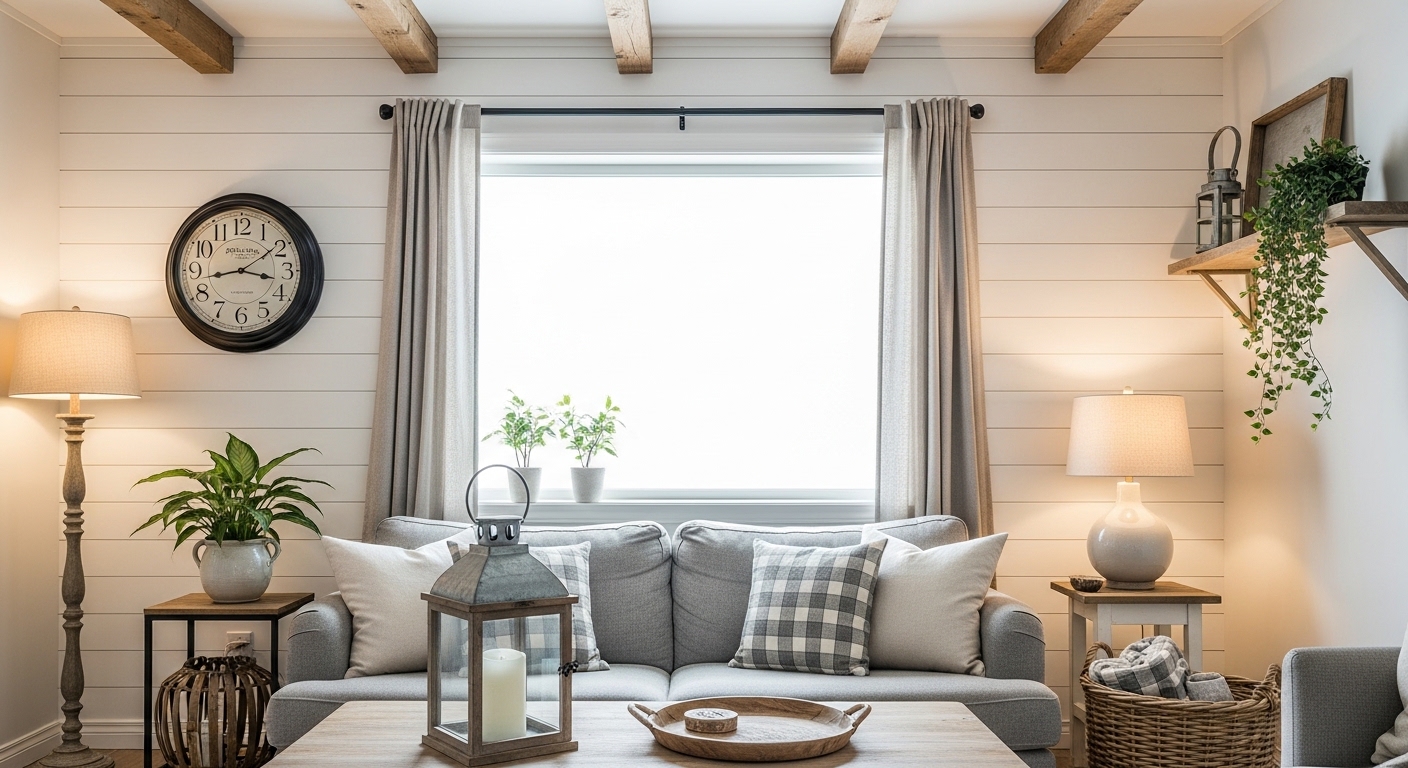
Shiplap works when it solves a problem: a plain wall that needs texture, a fireplace wall that needs a focal point, a long hallway that needs rhythm. It fails when it covers every wall in the room, because then there is no plain surface left for the eye to rest on, and the room feels like the inside of a crate. One shiplap wall, painted the same warm white as the rest of the room so the texture reads as shadow rather than contrast, is usually enough. Painted a contrasting color, it becomes a feature wall competing with everything else. And if your walls are already textured or your room is small, skip it entirely — a rug and wooden furniture will do the farmhouse work without construction.
Barn doors fail more often than shiplap, for a practical reason as well as a visual one. A barn door on a closet that is opened ten times a day is annoying: it slides, it sticks, it blocks the neighboring wall, and it never seals properly. A barn door earns its place on a wide opening that is rarely closed, like a pantry or a media nook, where the sliding mechanism is a genuine solution rather than a decoration. If you are choosing a barn door purely because it looks farmhouse, you are decorating with hardware, and the room will feel it.
Run the same audit on word signs, galvanized buckets used as planters, and faux-antique clocks. Each one asks the same question: does this object do something in this room besides announce the style? A clock tells the time. A basket holds blankets. A sign that says gather does nothing except label the room, and rooms that need labels usually have a deeper problem. Remove the labeled objects and see if the room still reads farmhouse. If it does, it was never depending on them.
Mixing old and new without a museum feel
The most convincing farmhouse rooms mix old and new, and the mix has a ratio worth respecting. Too much old and the room feels like a museum or a thrift store. Too much new and it feels like a catalog. A workable starting ratio is roughly two-thirds new or simple pieces to one-third pieces with visible age: an old wooden crate as a side table, a vintage mirror, a secondhand armchair re-covered in plain fabric. The old pieces give the room its story. The new pieces keep it comfortable and functional.
When you bring in an old piece, let it be a little imperfect and leave it that way. Refinishing an old table to a flawless gloss erases exactly what made it interesting. Cleaning it, oiling it, and living with its dents keeps its character and keeps the room honest. The same applies to new pieces that imitate old ones: buy the simple version, not the distressed version, and let your own life distress it over time. A farmhouse room should look more collected in five years than it does today. If it can only look worse with wear, the pieces were wrong.
One more mixing rule: vary the era slightly, not wildly. A farmhouse room can hold a mid-century chair, a rustic bench, and a plain modern sofa, because all three share simple lines and natural materials. It struggles to hold a Victorian gilt mirror, a chrome-and-glass table, and a log cabin bench, because those pieces belong to different visual languages and the room becomes a collection of statements instead of a room. Shared simplicity is the thread. If a piece is ornate, shiny, or fussy, it needs a very good reason to be in a farmhouse room.
🛒 Shop This Look:
Small farmhouse rooms and rented rooms
Farmhouse style in a small room needs restraint, because every farmhouse element — chunky wood, layered texture, open shelving — takes visual space. The fix is not to abandon the style but to choose fewer, larger gestures. One substantial wooden piece, such as a coffee table or a console, reads more farmhouse than five small rustic accessories scattered around. One large textured rug anchors the room better than three small ones. One wall of open shelving with breathing room beats two walls crammed with objects.
Watch the color temperature in a small room too. Dark woods and deep accent colors that feel cozy in a large room can feel heavy in a small one. If your room is small or dim, keep the big pieces mid-tone, keep the walls warm white, and let the farmhouse feeling come from texture — linen, jute, wood grain — rather than from dark color. A small room with light walls, a mid-tone wooden table, and a woven rug reads farmhouse immediately, without a single dark beam.
Renters have a particular advantage here, because the best farmhouse moves are not structural. You cannot add shiplap or beams, but you do not need to. A large rug, a wooden coffee table, linen curtains hung high and wide, a basket for blankets, and one piece with visible age will carry the style in any rental. Peel-and-stick wood-look panels exist, but they are the riskiest renter move in this style: up close they read as printed plastic, and they fight the honest-materials principle that makes farmhouse work. Spend the same effort on a real wooden tray and real linen instead.
Keeping it clean without killing the warmth
Farmhouse rooms are supposed to look lived-in, but lived-in and dirty are different things, and light fabrics plus wood plus texture can drift into the second if nobody maintains them. Build maintenance into your choices rather than fighting it afterward.
For upholstery, washable covers are the single best farmhouse investment, especially in light colors. A sofa you can strip and wash will look better in year three than a sofa you have been anxiously protecting for three years. For wood, a simple routine — dusting, an occasional wipe with a damp cloth, and an annual oil for unsealed pieces — keeps the grain rich without turning maintenance into a project. For rugs, a jute or wool rug in a busy room will collect dust in its weave; a regular vacuum with a brush head, not just suction, keeps it looking intentional rather than dusty.
Open shelving deserves a special mention, because it is the farmhouse feature most likely to become a dust museum. Shelves full of objects that are never touched gather dust visibly, and dust on display reads as neglect rather than collection. Keep open shelves to objects you actually use — everyday bowls, books you read, a plant you water — and keep the rest behind closed doors. A shelf with six used objects looks curated. A shelf with thirty untouched objects looks like storage that escaped.
A starter plan that does not require a renovation
If you are starting from a plain room, here is an order of work that builds the farmhouse feeling without a renovation, and without buying everything at once.
First, the rug. It sets the scale of the seating area and the texture baseline for everything else. Choose a natural-fiber look — jute, wool, or a wool blend — large enough that the front legs of the sofa and chairs sit on it. A rug that is too small is the most common living room mistake in any style, and in farmhouse it is worse, because a floating rug makes the wooden furniture look scattered.
Second, the largest wooden piece. Coffee table or console, mid-tone wood, simple construction. This is the piece that announces the style, so spend the most care here and the least on accessories.
Third, curtains in a natural fabric, hung high and wide so the window reads larger. Linen-look curtains in a warm white soften the room more than any single accessory, and they cost less than a piece of furniture.
Fourth, texture in small doses: a throw, two or three cushions in different textures rather than different colors, a basket. Stop here and live with the room for a few weeks before adding anything else. Farmhouse rooms improve with time and use, and the worst farmhouse rooms are the ones finished in a single shopping trip. The pause is part of the method.
🛒 Shop This Look:
Mistakes that undo a good farmhouse room
A few mistakes show up so often they are worth naming directly. Buying everything from one farmhouse collection, so the room reads as a showroom set. Covering every wall in shiplap, so there is nowhere for the eye to rest. Choosing a stark white palette that fights the wood instead of warming it. Filling open shelves with objects that are never used. And the most common one: decorating with labels — signs, buckets, and themed objects that announce farmhouse instead of embodying it.
The fix for all of them is the same question, asked about each piece: does this earn its place by being warm, useful, or honestly made? If the answer is that it merely looks farmhouse, it is probably working against the room. Remove it and see if the room feels worse. Usually it feels better, because the pieces that remain have more room to breathe.
A farmhouse living room done well does not photograph as a theme. It photographs as a room where someone actually lives, with wood that has softened, fabric that has been sat on, and objects that were chosen one at a time. That is a slower way to decorate, and it is the only version of farmhouse that still looks good in five years. Start with the feeling, choose fewer and better pieces, let texture do the decorating, and give the room time to become collected rather than trying to buy it collected in a weekend.
Explore more living room ideas for the broader room-by-room guides this style sits alongside.