
As an Amazon Associate, I earn from qualifying purchases. This means I may earn a commission if you purchase through links on this page — at no extra cost to you.
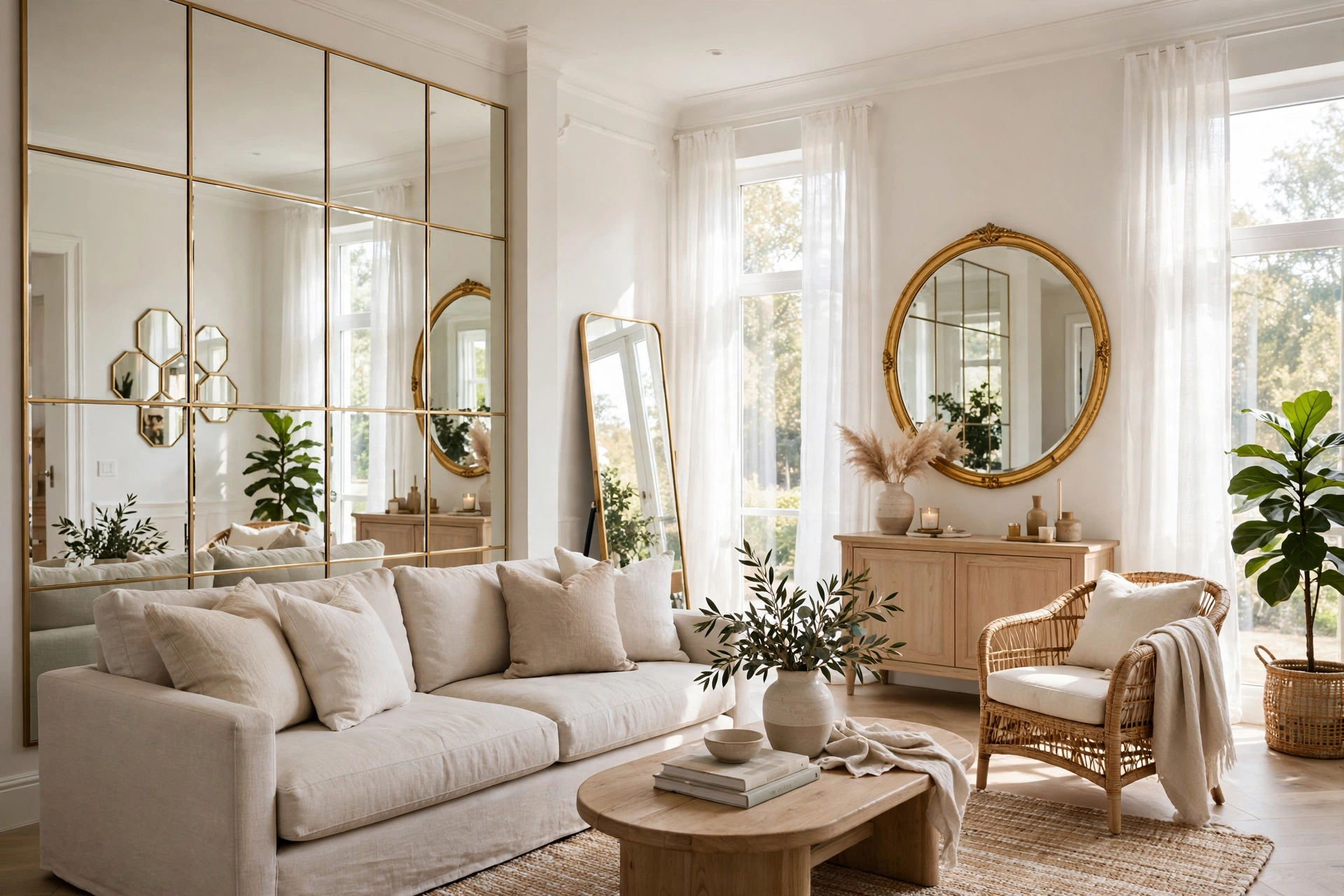
Place large mirrors opposite windows to double natural light and visual space. A floor-length mirror leaning against a wall creates the illusion of a doorway. Mirrored furniture and gallery-style mirror arrangements also expand perceived room size.
Best Mirror Placements
Opposite windows: Reflects light and outdoor views, doubling brightness.
Behind furniture: A mirror behind a console or sofa adds depth.
On closet doors: Mirrored doors make bedrooms feel twice as big.
In narrow hallways: Elongates the space visually.
Across from art: Reflects color and interest around the room.
Size Matters
One large mirror has more impact than several small ones. Go as big as the wall allows — a 3×5 foot mirror transforms a room; a 1×2 foot mirror just decorates it.
What to Avoid
Don’t place mirrors where they reflect clutter — they’ll double the mess visually. Avoid mirror walls in bedrooms facing the bed (disrupts sleep for some). Don’t use tinted or antiqued mirrors if maximum brightness is the goal.
The Physics: Why Mirrors Expand Space
Mirrors do not just decorate — they manipulate depth perception. A mirror doubles the perceived depth along its axis: a 10-foot room with a mirrored wall reads as 20 feet to your visual system. They also double light sources, which matters because brightness is one of the strongest spaciousness cues the brain uses. But the effect only works when the mirror reflects something worth seeing — light, a view, or an attractive part of the room. A mirror reflecting a blank wall or clutter adds nothing and can actually make a room feel busier.
Room-by-Room Mirror Guide
Living Room
The highest-impact spot is on the wall adjacent to the largest window (not directly opposite, which can create harsh glare at certain hours). Adjacent placement bounces soft, indirect light deep into the room. A large mirror above the fireplace or console gives the room a focal point while doubling the chandelier or pendant light. If the living room opens to a dining area, a mirror on the shared sightline visually connects the spaces.
Bedroom
Mirrored closet doors are the classic space-doubler and they earn it — a full wall of mirror in a small bedroom genuinely transforms the feel. For freestanding mirrors, a leaning floor-length mirror in a corner creates a “doorway” illusion and gives you a dressing mirror in one move. Avoid placing a mirror where it reflects the bed directly if that bothers you — some people find the movement reflection distracting when falling asleep. A mirror reflecting the window from beside the bed gives morning light without the bed reflection.
Dining Room
A large mirror on the main dining wall doubles candlelight and makes dinner parties glow — this is why restaurants use them. It also lets the host see guests’ faces reflected, which subtly improves the social feel. Keep it above wainscoting height so it reflects people and light, not chair backs.
Hallways and Entryways
Narrow hallways benefit enormously: a long horizontal mirror on one wall visually doubles the width. In entries, a mirror beside (not opposite) the front door lets you check yourself on the way out without the mirror catching the door swing. Round mirrors soften the hard lines of a narrow passage.
Small Bathrooms
Extend the mirror wall-to-wall above the vanity instead of using a small framed mirror — the uninterrupted reflection doubles the room. A mirrored medicine cabinet gives the expanse plus hidden storage. In a powder room, an oversized or unusually shaped mirror turns the tiniest room into a jewel box.
Home Office / Nook
A mirror behind or beside the desk reflects the window light onto the work surface, reducing the cave feeling of a desk facing a wall. It also lets you see the room behind you, which reduces the closed-in feeling of facing a wall all day.
Size, Shape, and Frame Rules
- Go big or go home. One large mirror outperforms a cluster of small ones for the spaciousness effect. As a rule, the mirror should be at least two-thirds the width of the furniture beneath it, and floor mirrors should be at least 5 feet tall to read as architecture rather than decor.
- Leaning vs. hanging: leaning a large mirror against the wall (secured at the top for safety) reads as relaxed and architectural; hanging reads as formal. Leaning works best in bedrooms and living rooms with baseboard clearance.
- Shape psychology: round and arched mirrors soften rooms full of rectangles (which is most rooms). Rectangular mirrors reinforce architecture and suit modern spaces. An arch mirror adds the suggestion of a window or doorway — the strongest “more space” illusion.
- Frame or frameless: thin frames (or frameless) maximize the reflective area and suit the space-expanding goal. A chunky ornate frame turns the mirror into art — beautiful, but the frame stops the eye and slightly reduces the expansion effect.
- Antiqued and tinted mirrors: gorgeous, but they absorb light rather than bouncing it. Use them as decor, not as space-expanders. For maximum brightness, choose clear, untinted glass.
What to Reflect (and What Never To)
Audit the reflection before you hang. Stand where the mirror will go and look at what it will show:
- Reflect: windows and natural light, greenery and outdoor views, chandeliers and pendant lights, beautiful art, a styled bookshelf, candlelight.
- Never reflect: clutter zones (the desk, the laundry pile, open closets), the TV (doubles visual noise and creates glare), blank walls, the inside of a messy cabinet, or another mirror directly (creates an infinite tunnel that reads as gimmicky, not spacious).
- The tidiness contract: a mirror doubles whatever it sees, so the reflected zone must stay styled. If you cannot keep the reflected area tidy, move the mirror.
Mirrored Furniture and Accents
Full mirrored walls are not the only option. A mirrored side table, dresser, or tray reflects light at furniture level and visually lightens bulky pieces — a mirrored dresser in a small bedroom reads as half its actual mass. Mirrored backsplash tiles in a galley kitchen double the light and the sense of depth. Even small moves — a mirrored tray on the coffee table, mercury-glass votives — scatter light and add sparkle that reads as airiness. The caveat: mirrored furniture shows fingerprints and dust relentlessly. In high-touch spots, it is a maintenance commitment.
Hanging Safely
- Weight matters: large mirrors are heavy (a 3×5-foot mirror can weigh 30–50 pounds). Always anchor into studs or use properly rated wall anchors — never rely on a single nail for anything over 20 pounds.
- Leaning mirrors must be secured at the top with wall brackets or furniture straps, especially in earthquake zones or homes with kids and pets. A falling 5-foot mirror is genuinely dangerous.
- Hang at the right height: the mirror’s center should sit at average eye level (about 57–60 inches) unless it is specifically placed to reflect a window or light fixture — then prioritize the reflection over the rule.
Mirror Styles as Decor
Beyond the space-expanding job, mirrors are legitimate decor — the frame and shape set the room’s tone:
- Arched mirrors: the current classic. The arch suggests a window or doorway, adding architectural interest to flat walls while delivering the full expansion effect. Black-framed arches suit modern rooms; brass or natural wood arches warm up traditional spaces.
- Round mirrors: soften rooms dominated by rectangles (which is nearly every room). A large round mirror over a console or dresser is a foolproof vignette — the circle contrasts every straight line around it.
- Sunburst and starburst: decorative first, reflective second. Use as art that happens to bounce some light, not as your primary space-expander — the frame dominates the function.
- Windowpane mirrors: the divided-light grid mimics a window, doubling the “more windows” illusion. Most convincing when placed where a window could plausibly be — not facing another real window.
- Floor-length cheval mirrors: the freestanding dressing mirror on feet. Functional for outfit checks, and the tilt adjustment lets you aim the reflection at the light source for maximum bounce.
Cleaning and Maintaining Mirrors
- The right technique: microfiber cloth slightly dampened with water, or a 50/50 water-and-white-vinegar solution. Wipe in a Z pattern, not circles — circles redistribute grime. Dry immediately with a second cloth to prevent streaks.
- What damages mirrors: ammonia-based cleaners used repeatedly can degrade the reflective backing at the edges (the black creeping-in effect on old mirrors). Spray the cloth, never the mirror — liquid seeping behind the glass attacks the backing.
- High mirrors and leaning mirrors: an extendable microfiber duster handles monthly dusting; do the full wet clean quarterly. A dusty mirror scatters light instead of reflecting it — maintenance is part of the brightness strategy.
- Desilvering: when the backing fails (dark spots, cloudy edges), it cannot be repaired — only replaced or reframed with new glass. In bathrooms, ventilation is the prevention: run the exhaust fan to keep moisture off the backing.
When Not to Use a Mirror
- Rooms that are already visually busy: a mirror in a cluttered, pattern-heavy room doubles the busyness. Simplify first, then add the mirror.
- Directly facing the front door (per feng shui principles many buyers follow) — whether or not you subscribe, it is worth knowing the convention if resale is on the horizon.
- Where it creates glare on screens: a mirror behind the TV-watching position can throw reflections onto the screen. Test at viewing time before committing.
- Tiny powder rooms with bold wallpaper: sometimes the wallpaper is the feature — a large mirror can fight it. A smaller, beautifully framed mirror complements instead of competing.
🛒 Shop This Look:
🛒 Shop This Look:
🛒 Shop This Look:



