
As an Amazon Associate, I earn from qualifying purchases. This means I may earn a commission if you purchase through links on this page — at no extra cost to you.
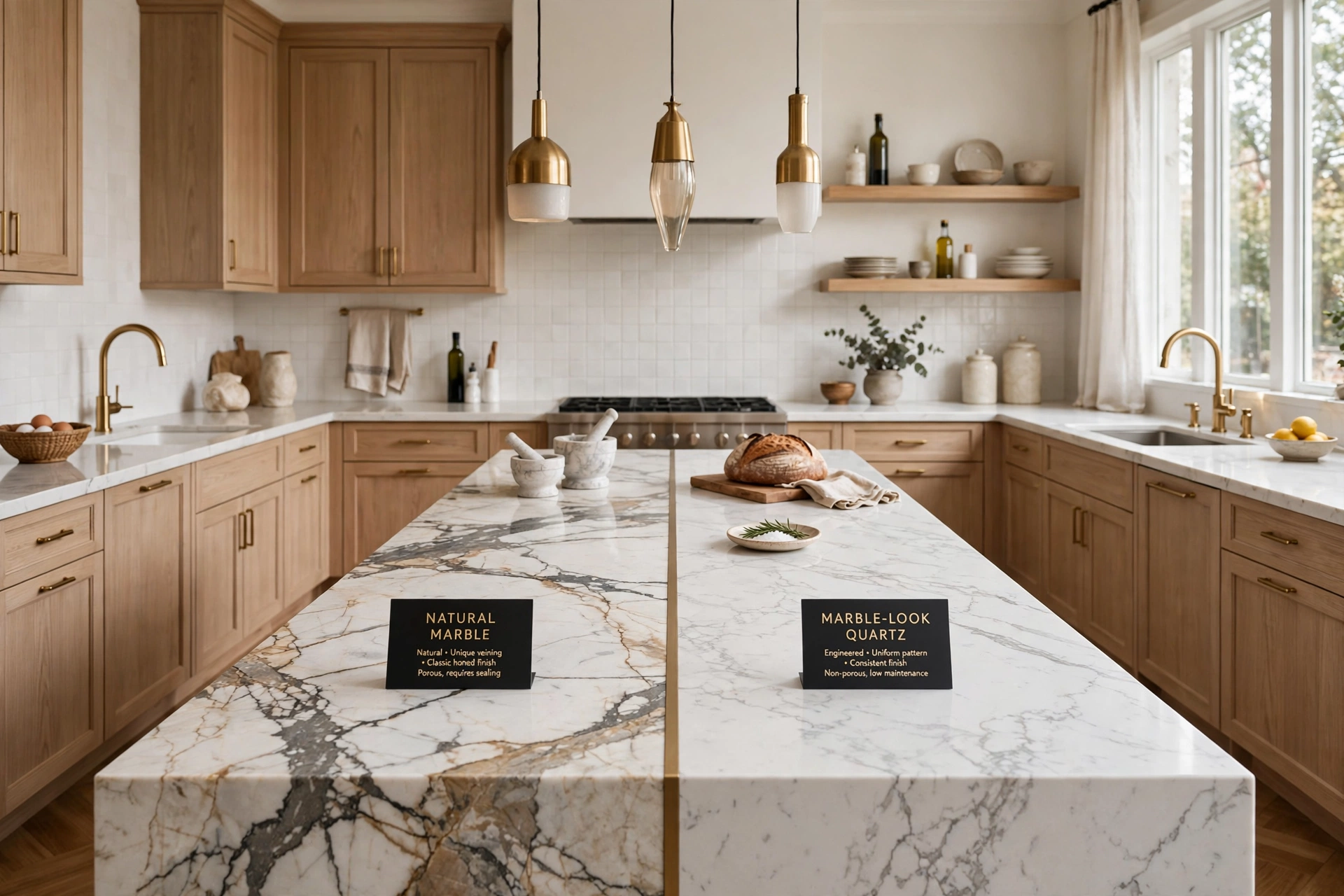
Marble countertops are the dream — and marble-look quartz is the dream’s practical twin. From across the room, a good quartz slab with realistic veining is genuinely hard to distinguish from the real thing. Up close and over years of use, the differences matter enormously. Here’s how to tell them apart, how they compare on everything that counts, and how to choose the right one for your kitchen.
How to Tell the Difference (The 5-Second Tests)
Side by side, here’s what gives each away:
- Temperature: Touch it. Real marble feels cool to the touch and stays cool; quartz warms up faster and feels closer to room temperature. This is the fastest test in a showroom.
- Veining pattern: Marble veining is organic, irregular, and flows continuously across the slab — no two areas repeat. Quartz veining, even on premium slabs, often shows subtle repetition if you look across a large area. Photograph a section and compare it to another section: identical swirls mean quartz.
- Surface variation: Run your hand across marble and you’ll feel micro-variation — tiny pits, subtle texture changes. Quartz is uniformly smooth, almost glassy. That perfection is the tell.
- Edges and seams: Marble seams are harder to hide because the veining won’t match across the joint. Quartz seams can be nearly invisible since the pattern is manufactured and consistent.
- The scratch test (don’t do this in a showroom): Marble scratches with a knife; quartz resists. Marble etches instantly with lemon juice or vinegar; quartz doesn’t react. These are the practical differences that matter in daily use, not just identification tricks.
Real Marble: The Honest Pros and Cons
Pros: Unmatched natural beauty — the depth and movement of real stone can’t be fully replicated. Stays naturally cool, which bakers love for pastry work. Each slab is one of a kind. Develops a patina that many owners come to love. Can increase perceived home value in luxury markets.
Cons: Porous — stains from wine, coffee, oil, and acids if not sealed promptly. Etches on contact with acidic foods (lemon, tomato, vinegar), leaving dull marks. Requires regular resealing (typically yearly). Scratches more easily than quartz. Generally more expensive per square foot installed. Limited to the colors nature provides.
The reality check: marble is a living surface. It will etch, it may stain, and it will show its age. People who love marble love it because of this, not despite it — the patina tells the story of the kitchen. People who want pristine counters forever should not buy marble.
Best for sealing porous marble against wine, coffee, oil and acid stains.
Marble-Look Quartz: The Honest Pros and Cons
Pros: Non-porous — resists stains from wine, coffee, and oil without sealing. Doesn’t etch from acids. Extremely hard and scratch-resistant. Never needs sealing. Consistent pattern (a pro if you want predictability). Generally less expensive than marble installed. Huge range of designs, including veining styles nature never made.
Cons: Not heat-proof — sudden high heat (hot pots straight from the burner) can damage or discolor it; always use trivets. Can look flat or “printed” up close on cheaper slabs. Visible seams on some patterns. Not a natural stone (matters to some buyers). Can discolor with prolonged UV exposure, so it’s not ideal for outdoor kitchens.
BOILMERIT Silicone Trivet Mats, 7.8 inch, 4 Pack
Best for protecting quartz from hot pots straight from the burner.
The quality spectrum matters enormously with quartz. Budget quartz with marble-look veining can look obviously fake — gray squiggles on white. Premium slabs with through-body veining (pattern that goes through the slab, not just printed on top) and realistic variation are the ones that fool people. Always view full slabs, not small samples.
Head-to-Head Comparison
Durability
Quartz wins for daily abuse — it resists scratches, chips less easily, and shrugs off acids. Marble wins on heat tolerance (it’s stone; it handles hot pans better) but loses on everything else. For a busy family kitchen, quartz is the lower-maintenance choice by a wide margin.
Maintenance
Quartz: wipe with soap and water, done. No sealing, ever. Marble: wipe spills immediately (especially acids and oils), reseal annually, use cutting boards and coasters religiously, accept some etching as inevitable. The maintenance gap is the single biggest practical difference between the two.
Best for daily cleaning, polishing and sealing of stone countertops.
Creative Co-op Marble & Mango Wood Hexagon Coasters, Set of 4
Best for protecting marble from drink rings and stains.
Best for protecting counters from knife scratches.
Cost
Both vary hugely by slab, region, and fabricator, so treat these as rough ranges: marble typically runs $75–$200+ per square foot installed, with rare varieties going higher. Marble-look quartz typically runs $70–$150 per square foot installed, with premium realistic designs at the top of that range. The overlap is real — premium quartz can cost more than basic marble. Get quotes for your specific slabs rather than deciding on price alone.
Appearance
From a distance: nearly identical with good quartz. Up close: marble has depth, translucency, and natural variation that quartz approximates but doesn’t fully match. In bright natural light, the difference is most visible — marble glows slightly; quartz looks flatter. Under evening lamplight, even experts can struggle to tell.
Stone Care International Granite & Stone Polish, 24 oz
Best for keeping stone countertops looking polished and finished.
Resale Value
Real marble carries prestige in luxury markets and can be a selling point in high-end homes. In mid-range homes, buyers increasingly recognize quartz as the smart choice and won’t pay a premium for marble’s maintenance burden. Neither is a bad choice for resale; marble is the prestige play, quartz the practical one.
Which Should You Choose?
Choose marble if: you love natural stone and accept patina; you’re a baker who wants a cool work surface; your kitchen is lower-traffic or you’re meticulous about wiping spills; prestige matters for your home’s market; you want a one-of-a-kind slab.
Choose marble-look quartz if: you have kids or a busy kitchen; you want the look without the maintenance; you cook with lots of acidic ingredients; you want predictable patterning across a large island; low maintenance is a priority.
The deciding question: how will you feel about the first etch mark? If the answer is “devastated,” buy quartz. If the answer is “it’s part of the story,” buy marble. Everything else is details.
Shopping Tips for Either Choice
- View full slabs, not samples: A 4-inch sample hides repetition in quartz and doesn’t show marble’s full character. Always look at the actual slab(s) for your project.
- Check the veining at the edges: On quartz, look at whether the pattern continues through the edge (through-body) or stops at the surface (printed). Through-body looks far more convincing.
- Ask about the finish: Honed marble shows etches less obviously than polished (but stains more visibly). Honed quartz is available too and hides fingerprints better than polished.
- Get the seam plan: Ask the fabricator where seams will fall and how they’ll look with your chosen pattern. This matters more for marble (vein matching) than quartz.
- Test with real life: If you can, get a remnant piece and live with it for a week — spill coffee, cut a lemon, leave a wine ring. Your comfort with the results tells you which material fits your life.
Frequently Asked Questions
Can you tell the difference between marble and quartz?
Up close, usually yes: marble feels cooler, has natural micro-texture, and shows no pattern repetition; quartz is uniformly smooth and may repeat its veining across large areas. From across the room with a premium quartz slab, it’s genuinely difficult.
Does marble-look quartz stain?
It’s highly stain-resistant because it’s non-porous, but not stain-proof. Prolonged contact with strong dyes (turmeric, red wine left overnight, permanent marker) can leave marks on some quartz. It resists far more than marble, which stains from brief contact with common kitchen acids and oils.
Which is better for a kitchen: marble or quartz?
For most busy kitchens, quartz — it handles daily abuse with minimal maintenance. Marble suits lower-traffic kitchens and owners who value natural stone character and accept the patina and upkeep. There’s no universal winner; there’s the right material for your habits.
Can you put hot pots on quartz?
It’s not recommended. Quartz resists heat better than laminate or solid surface, but sudden high heat can crack or discolor it. Always use trivets or hot pads. Marble handles heat better, but trivets are still wise to prevent thermal shock on thinner areas.
Does quartz look cheap compared to marble?
Budget quartz can, especially with obviously printed veining. Premium marble-look quartz with realistic, varied veining looks convincingly like stone to most observers. The price difference between budget and premium quartz is largely this realism — it’s worth seeing both in person before judging the category.
Beyond Quartz: Other Marble Alternatives Worth Knowing
Quartz dominates the marble-look conversation, but it’s not the only alternative:
- Quartzite (natural stone): not to be confused with quartz — quartzite is a natural metamorphic rock, harder than marble, with beautiful natural veining. More durable than marble and heat-resistant, but still porous (needs sealing) and typically pricier than quartz. The choice for people who want real stone without marble’s fragility.
- Porcelain slabs: large-format porcelain printed with marble veining. Extremely hard, heat-resistant, UV-stable, and nearly stain-proof. The printed pattern is the limitation — good slabs look convincing, cheap ones don’t. Seams can be visible on large runs. Often the most affordable marble look.
- Marble-look granite: some granites (like White Ice or River White) have soft veining reminiscent of marble, with granite’s hardness and lower maintenance. The look is more speckled than true marble veining, but it’s real stone at a moderate price.
- Solid surface (Corian and similar): marble-look patterns exist, with the unique advantage of nearly invisible seams. Softer than quartz — scratches more easily — but scratches can be buffed out, which you can’t do with quartz or marble.
Each has the same shopping rule: view full slabs, test with real-life spills if possible, and get installed-price quotes before deciding. The “best” alternative depends on your priorities — quartzite for natural stone lovers, porcelain for budget and durability, granite for the middle ground.
🛒 Shop This Look:
🛒 Shop This Look:
🛒 Shop This Look:



