
As an Amazon Associate, I earn from qualifying purchases. This means I may earn a commission if you purchase through links on this page — at no extra cost to you.
The Short Answer
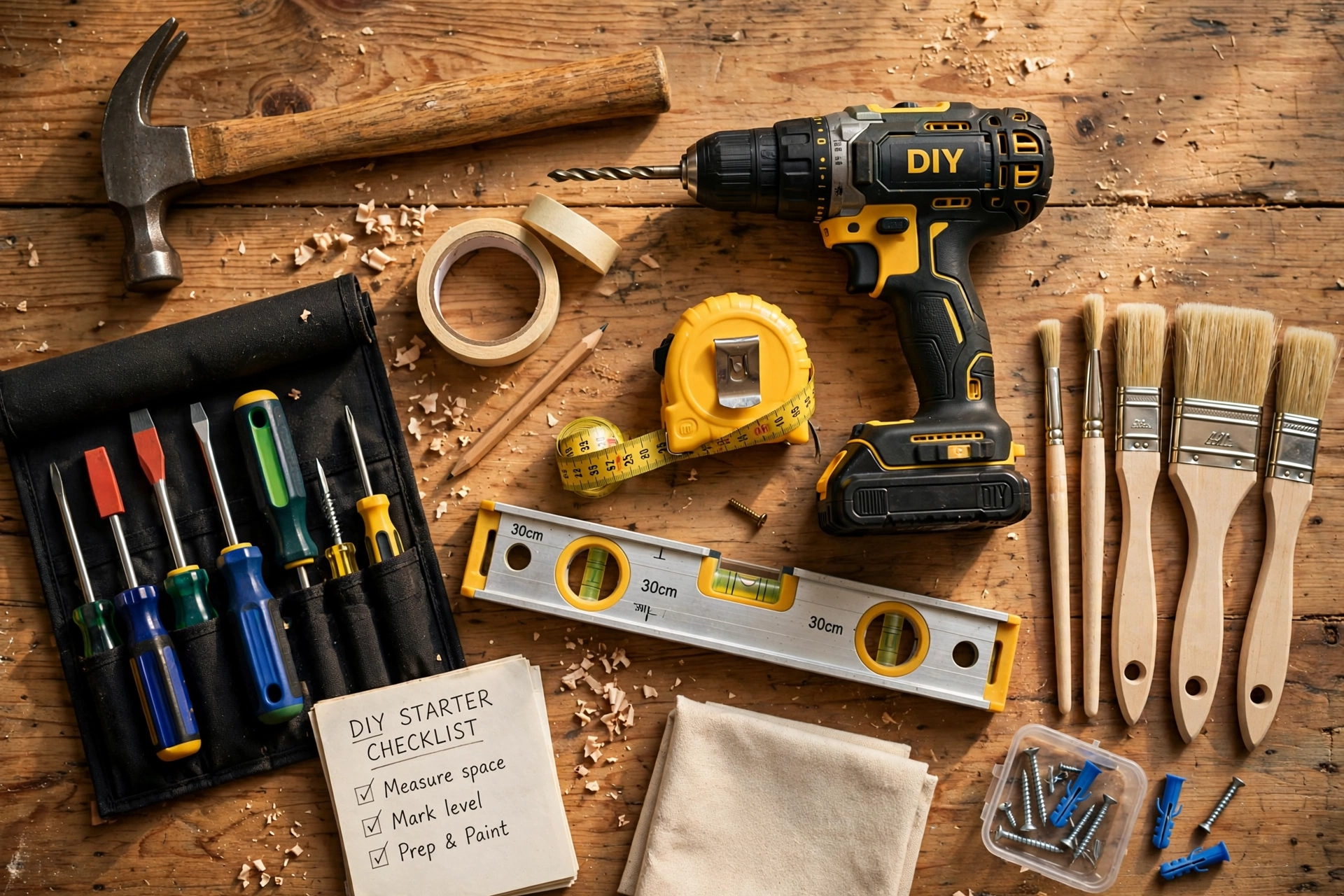
You don’t need a workshop full of expensive equipment to start DIY decorating. A complete beginner kit costs under $100 and handles 90% of home decor projects: a cordless drill ($35-45), hot glue gun ($10-15), 25-foot measuring tape ($8-10), 24-inch level ($10-12), retractable utility knife ($7-9), painter’s tape ($6-8), assorted sandpaper pack ($5-7), quality paintbrush set ($12-18), and a manual staple gun ($14-18). Buy these nine tools first, learn to use them well, and add specialty tools only as projects demand them. Related: What Tools Do You Need for Basic DIY Decor.
Why a Curated Kit Beats Buying Random Tools
Walk into any craft store and you’ll see walls of tempting gadgets — most of which you’ll use once and forget. Beginners waste the most money not on tools, but on the wrong tools: flimsy versions that break mid-project, or specialty items for techniques they haven’t learned yet.
This kit is built around a simple principle: every tool here earns its place by being useful across dozens of project types. A drill hangs shelves, assembles furniture, and makes wall art. A staple gun reupholsters chairs, attaches fabric to frames, and secures upholstery. Nothing on this list is a one-trick pony.
Prices below are typical street prices as of 2026 — check current listings, as sales frequently drop these lower.
The 9 Essential Tools (Buy These First)
1. Cordless Drill/Driver — $35 to $45
Our pick: Black+Decker 20V Max Drill/Driver (around $40 at most retailers)
This is the single most transformative tool a beginner can own. It drives screws, drills pilot holes, hangs curtain rods, assembles flat-pack furniture in minutes instead of hours, and mounts wall decor securely. The Black+Decker 20V Max hits the sweet spot for beginners: enough power for household tasks, light enough to handle comfortably, and the 20V battery platform is affordable to expand later.
What to avoid: Ultra-cheap no-name drills under $25. They have weak batteries that die mid-project, wobbly chucks that won’t hold bits straight, and no torque adjustment — which means stripped screws and damaged walls. Also skip 12V models unless you specifically want something ultra-compact; 20V gives you far more versatility for the same money.
You’ll use it for: Hanging shelves and mirrors, assembling furniture, installing curtain hardware, building simple wood projects, driving screws into wall anchors.
2. Hot Glue Gun (Full Size, Dual Temp) — $10 to $15
Our pick: Gorilla Dual Temp Full-Size Hot Glue Gun (around $12)
The humble glue gun is the workhorse of DIY decor. It bonds fabric, wood, ribbon, faux florals, wreath bases, and lightweight embellishments in seconds. Dual-temperature matters: high temp for wood and heavy materials, low temp for delicate fabrics, ribbon, and foam that would melt under high heat.
What to avoid: Mini glue guns. They seem cute and cheap ($5), but they dispense so little glue per trigger pull that larger projects become an exercise in frustration. The sticks also cost more per ounce. Buy full-size from the start.
You’ll use it for: Wreaths, floral arrangements, attaching trim to furniture, fabric-covered frames, holiday decor, kids’ craft projects, quick repairs.
Pro tip: Buy Gorilla or Surebonder glue sticks in bulk packs — they’re noticeably stronger than dollar-store sticks, and the price difference per stick is pennies when bought in 50-packs (around $8-10).
🛒 Shop This Look:
3. 25-Foot Measuring Tape — $8 to $10
Our pick: Stanley PowerLock 25-foot (around $9)
Every project starts with measuring, and a bad tape measure leads to crooked shelves, ill-fitting frames, and wasted materials. The Stanley PowerLock is the industry standard for a reason: the blade locks firmly, the standout (how far it extends without collapsing) is excellent, and the case survives drops.
What to avoid: 12-foot tapes. They’re cheaper but useless for measuring rooms, walls, or furniture. Get 25 feet minimum.
You’ll use it for: Literally everything — measuring walls for art placement, spacing gallery walls, sizing furniture, cutting fabric and wood to length.
4. 24-Inch Level — $10 to $12
Our pick: Empire 24-inch True Blue level (around $11)
Crooked shelves and tilted frames are the fastest way to make DIY work look amateur. A 24-inch level is long enough to check shelves and furniture, short enough to maneuver easily. The Empire True Blue series has easy-to-read vials and durable aluminum frames.
What to avoid: Tiny 9-inch “torpedo” levels as your only level. They’re fine for small tasks but useless for anything longer than a foot. Also skip phone level apps for anything important — they’re fun but not accurate enough for hanging work.
5. Retractable Utility Knife — $7 to $9
Our pick: Stanley Classic 99 Retractable (around $8)
Opens boxes, trims wallpaper, cuts foam board, scores drywall, trims excess fabric, cuts twine and rope cleanly. A sharp utility knife is safer than a dull one — dull blades require more force and slip more easily. Buy a 100-pack of replacement blades (around $10) and change them freely; treating blades as disposable is the professional approach.
6. Painter’s Tape (Multi-Pack) — $6 to $8
Our pick: ScotchBlue Original Multi-Surface, 3-pack of 60-yard rolls (around $15 for the pack, or $6-8 per single roll)
Far more than just paint masking: it holds templates to walls, marks drill points, creates clean geometric paint designs, protects surfaces during messy steps, and labels everything. Buy the multi-pack — you’ll go through it faster than you expect.
What to avoid: Dollar-store painter’s tape. It bleeds, tears unevenly, and — worst of all — sometimes pulls paint off when removed. Name-brand tape is one of the few supplies where the premium is genuinely worth it.
7. Assorted Sandpaper Pack — $5 to $7
Our pick: 3M Pro Grade Precision variety pack, 60 to 220 grit (around $6)
Every furniture painting or refinishing project needs sanding. This variety pack covers all bases: coarse 60-80 grit for stripping, medium 120 for smoothing, fine 220 for between-coat sanding. The 3M Pro Grade paper lasts significantly longer than bargain sandpaper before wearing out.
You’ll use it for: Prepping furniture for paint, smoothing rough wood edges, distressing painted pieces for farmhouse style, scuffing glossy surfaces so paint adheres.
🛒 Shop This Look:
8. Quality Paintbrush Set — $12 to $18
Our pick: Wooster or Purdy 3-piece set (around $15)
Cheap brushes shed bristles into your paint, leave streaks, and fall apart after one use. A decent 3-piece set (1-inch angled, 2-inch flat, 2.5-inch angled) from Wooster or Purdy will last years with basic cleaning. The angled brushes are essential for cutting clean lines along edges and trim.
What to avoid: Foam brushes for anything larger than touch-ups. They’re fine for small crafts but leave bubbles and uneven coverage on furniture. Also avoid natural-bristle brushes for latex/acrylic paint — use synthetic (nylon/polyester) bristles.
9. Manual Staple Gun — $14 to $18
Our pick: Stanley SharpShooter Plus (around $16)
Reupholstering dining chairs, attaching fabric to headboards, securing dust covers under furniture, mounting chicken wire to frames, attaching insulation — the staple gun handles all the fabric-to-wood connections that glue can’t manage. The SharpShooter Plus has an easy-squeeze handle (important — cheap staple guns exhaust your hand after 20 staples) and a wire guide for fastening cables.
Buy with it: A box of 5/16-inch staples (around $4). This length works for most upholstery without poking through.
4 Nice-to-Have Tools (Add When Ready)
These aren’t essential on day one, but they’ll expand what you can do once you’re comfortable with the basics:
- Small palm sander ($25-35): The Black+Decker Mouse sander (around $30) turns hour-long hand-sanding sessions into 10-minute jobs. Worth it the moment you refinish your second piece of furniture.
- Caulk gun + paintable caulk ($12 total): Fills gaps between trim and walls, seals edges for a professional painted finish. A $6 caulk gun and $6 tube of DAP Alex Plus transforms how clean your paint jobs look.
- Stud finder ($15-20): The Franklin Sensors ProSensor (around $18) finds studs reliably so heavy mirrors and shelves mount securely. Cheaper than patching a wall after a shelf rips out.
- Clamp set ($15-20): Two 6-inch bar clamps (Irwin Quick-Grip, around $8 each) hold pieces together while glue dries — effectively a second pair of hands.
Where to Buy: Getting the Best Prices
Amazon is usually cheapest for the drill, glue gun, and staple gun — watch for bundle deals. Home Depot and Lowe’s often beat Amazon on Stanley and Empire hand tools, especially during holiday sales. Harbor Freight is worth checking for clamps, sandpaper, and utility blades (their hand tools are surprisingly decent; avoid their power tools for anything critical).
What not to do: Don’t buy everything at a craft store like Michaels. Their tool prices run 30-50% above hardware stores. Save Michaels for craft supplies, not tools.
Total Cost Breakdown
| Tool | Typical Price |
|---|---|
| Cordless drill (Black+Decker 20V) | $40 |
| Hot glue gun (Gorilla dual temp) | $12 |
| 25-ft measuring tape (Stanley) | $9 |
| 24-inch level (Empire) | $11 |
| Utility knife (Stanley) | $8 |
| Painter’s tape (single roll) | $7 |
| Sandpaper variety pack (3M) | $6 |
| Paintbrush set (Wooster 3-pc) | $15 |
| Staple gun (Stanley) | $16 |
| Total | $124 |
That’s slightly over $100 at full price — but watch for sales and you’ll land under $100 easily. Home Depot routinely discounts the Black+Decker drill to $35, and Amazon frequently bundles the glue gun with sticks. Buy the drill on sale and the rest at regular price, and you’re at roughly $95.
Frequently Asked Questions
Can I really do DIY decor with just these tools?
Yes. These nine tools cover measuring, cutting, fastening, bonding, painting, and upholstering — the six operations behind the vast majority of beginner decor projects. Specialty tools (miter saw, nail gun, router) matter for advanced woodworking, but most decor projects don’t require them.
Should I buy a tool kit instead of individual tools?
Generally no. Pre-packaged “100-piece tool kits” pad their piece count with dozens of cheap screwdriver bits and Allen keys you’ll never use, while including a flimsy version of each real tool. Buying the nine tools above individually gets you better quality for similar money.
What’s the first project I should try?
A painted accent piece — a thrifted side table or wooden crate. It uses the sandpaper, paintbrushes, and painter’s tape, teaches surface prep and finishing, and the stakes are low since the starting piece was cheap. You’ll learn more from one refinishing project than from reading ten tutorials.
How do I maintain these tools?
Clean paintbrushes immediately after use with soap and water (for latex paint). Wipe the drill’s chuck occasionally and store batteries at room temperature. Replace utility blades often. That’s it — these are low-maintenance tools.
By Ella Knight
🛒 Shop This Look:



