
As an Amazon Associate, I earn from qualifying purchases. This means I may earn a commission if you purchase through links on this page — at no extra cost to you.
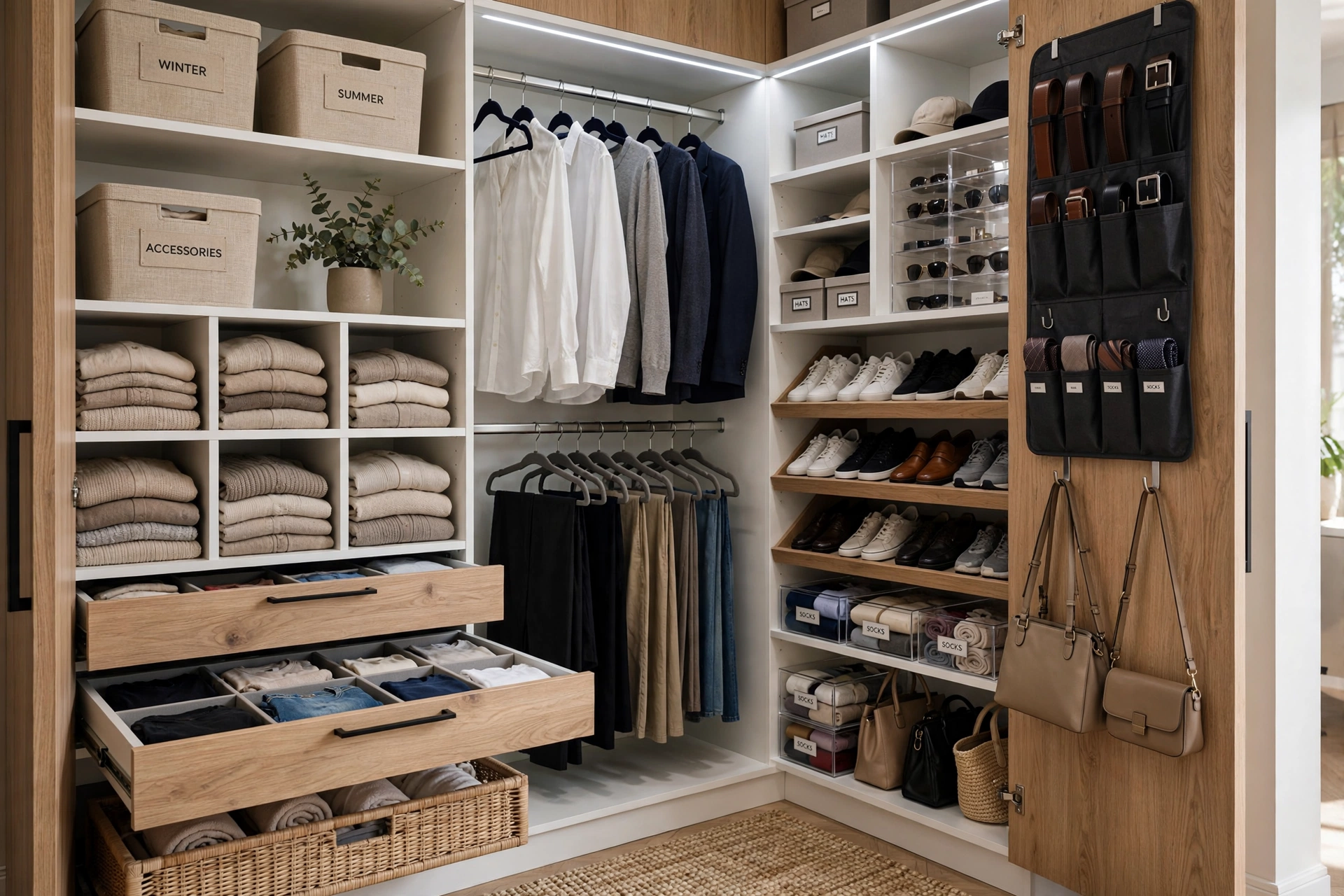
Maximize closet space by adding a second hanging rod, using shelf dividers, installing over-door organizers, and switching to slim hangers. These no-renovation upgrades can double usable closet space in an afternoon.
Double Your Hanging Space
Most closets have one rod with wasted space below. Add a second rod at half height for shirts and pants. Use the upper rod for longer items. This single change doubles hanging capacity.
Use Every Shelf Fully
Add shelf dividers to prevent stacks from toppling. Use shelf risers to create two layers. Store rarely-used items on the top shelf in labeled bins.
Door and Floor Space
Over-door hooks hold bags, robes, and accessories. A narrow shoe rack on the closet floor organizes footwear vertically. Hanging canvas shelves add cubbies without tools.
Switch to Slim Hangers
Velvet slim hangers are half the thickness of plastic ones. Switching 50 hangers saves 12+ inches of rod space — enough for 10-15 more garments.
Seasonal Rotation
Store off-season clothes in vacuum bags under the bed. A closet holding only current-season items feels twice as big.
The Double-Hang System, Done Right
Adding a second rod is the highest-impact closet upgrade, but placement determines whether it actually works. Get the heights right:
- Upper rod: 80–84 inches from the floor. High enough for dresses and long coats to hang without pooling, low enough to reach without a step stool.
- Lower rod: 40–42 inches from the floor. Shirts, blouses, folded pants, and jackets hang clear of the floor with room for a shoe rack underneath.
- The gap between rods: 36–40 inches. Any tighter and hangers collide; shirts on the lower rod need about 36 inches of drop.
- Keep one single-hang section — at least 24 inches wide — for full-length dresses and long coats. A closet that is 100 percent double-hang has nowhere for the long items.
Tension rods work for light loads in rentals, but a closet rod loaded with 40+ garments needs real support. Screw closet-rod brackets into studs or use heavy-duty drywall anchors; a collapsing rod at 2 a.m. is a rite of passage nobody needs. For a no-drill rental option, freestanding double-hang garment racks inside a walk-in closet add the same capacity without touching the walls.
Vertical Space: The Top Shelf and Above
The top shelf of most closets is a graveyard of half-used space — items stacked directly on it waste the 12–18 inches of air above. Reclaim it:
- Stackable bins with lids turn the top shelf into two or three usable layers. Clear bins let you see contents; labeled opaque bins look calmer. Either way, label — unlabeled bins become mystery boxes within a month.
- A second shelf above the first (even a simple mounted board) captures the dead air near the ceiling for luggage, seasonal bins, and keepsakes.
- Shelf dividers every 12 inches keep stacks of jeans, sweaters, and tees from avalanching. Acrylic or wire dividers clamp onto existing shelves without tools.
- Folded-knit rule: sweaters and heavy knits should be folded, never hung — hangers stretch the shoulders. Dedicate shelf space to knits and free the rods for woven shirts.
Doors, Walls, and Corners: The Forgotten Zones
- Inside of the door: an over-door rack with hooks handles tomorrow’s outfit, robes, belts, and bags. For sliding or bifold doors where over-door racks do not fit, adhesive hooks on the door’s interior frame hold lightweight accessories.
- Side walls: the 6–12 inches of wall beside the door frame fits narrow hook rails for necklaces, scarves, and hats. A pegboard panel on a side wall organizes accessories visibly — if you can see it, you will wear it.
- Corners: a corner shoe carousel or tiered corner shelf turns dead corner inches into storage. Lazy-Susan-style turntables on closet shelves bring back items to the front.
- The floor below short hang: this strip (under the 40-inch rod) fits a low shoe rack, boot tray, or pull-out drawers. Measure the clearance first — boots need 16+ inches of height.
- The ceiling: in walk-ins, a mounted bike-hook-style hanger holds handbags by their straps, keeping them shaped and visible instead of crushed on a shelf.
The Hanger Strategy (Beyond Just “Slim”)
Slim velvet hangers are the right call, but the details multiply the gain:
- One hanger type throughout. Mixed hangers snag, sit at different heights, and waste the uniformity dividend. Commit to a single slim style.
- Cascading hooks let you hang 3–5 lightweight items (tank tops, camisoles) vertically on one hanger’s worth of rod — best for the lower rod.
- Pant hangers with clips or a multi-bar design hold 3–4 pairs in the space of one. Folded-over-bar hangers crease less than clip hangers.
- Hang in categories, then by color. All blouses together, light to dark — you will find things faster and notice duplicates you can declutter.
- The reverse-hanger test: turn every hanger backward; after wearing an item, return it normally. In six months, anything still backward is a declutter candidate. This quietly keeps the closet from refilling.
Shoe Storage Without a Shoe Closet
- Daily shoes belong at grab height — an over-door pocket organizer or a low two-tier rack near the closet entrance.
- Heels and dress shoes store best on angled shelves where you can see each pair; stacked boxes hide shoes you will forget you own.
- Boots need shapers or pool-noodle inserts to stand upright — flopped-over boots waste twice the space and crease permanently.
- Off-season shoes go in labeled bins on the top shelf. One pair out per category is the rule: if you own six black ankle boots, three can live in storage.
The Seasonal Rotation System
Rotation is not just “store winter coats in summer” — it is a capacity strategy that keeps the working closet at half full year-round.
- Sort twice a year (when the weather genuinely turns, not by calendar date). Pull everything out, wipe the shelves, and sort into current season, off-season, and declutter.
- Store off-season in vacuum bags or lidded bins under the bed, on the top shelf, or in a storage ottoman. Vacuum bags cut bulky winter volume by half or more.
- Clean before storing. Moths and mildew target worn-once “clean enough” clothes. Wash or dry-clean everything going into storage.
- Keep a small “shoulder season” capsule accessible — a light jacket, a cardigan, one pair of boots — so the first cold snap does not require unpacking everything.
- Use the rotation as a declutter checkpoint. Anything you did not wear all season, in its season, is a strong donate candidate. No guilt — just data.
Keeping It Working: The 10-Minute Weekly Reset
Systems fail without maintenance, but closet maintenance is tiny if the system is sound. Once a week: return strays to their zones, rehang anything draped over chairs, straighten one shelf, and pull one item that no longer earns its space. Ten minutes keeps the doubling effect permanent — the closet stays at its new capacity instead of slowly reverting to chaos.
Closet Systems for Specific Wardrobes
The Workwear Wardrobe
Suits, blazers, and dress shirts need full-length hanging and breathing room — cramming them causes wrinkles that no steamer fully fixes. Dedicate the prime single-hang section to workwear, use wide contoured hangers for blazers (narrow hangers create shoulder dimples), and keep a valet hook or rod on the door for tomorrow’s outfit. Dry-cleaning bags come off immediately — trapped moisture damages fabric and the plastic off-gasses.
The Casual Wardrobe
Jeans, tees, and knits are folding-friendly — this wardrobe type should be shelf-heavy, not rod-heavy. File-fold tees vertically in drawers or bins (KonMari-style) so every shirt is visible; stack jeans in divvied shelf sections by wash. The rods handle only jackets and the few woven shirts. A casual wardrobe in a rod-heavy closet wastes half its capacity.
The Formal/Occasion Wardrobe
Gowns, suits, and delicate fabrics need garment bags, space, and darkness. Store occasion wear in breathable garment bags (never long-term in plastic dry-cleaner bags) on the highest rod or a dedicated section, with cedar blocks for moth protection. Shoes for occasions live in their boxes or dust bags on the top shelf — stacked, labeled, out of the daily fray.
The Kids’ Closet
Lower everything: rods at kid height (they will actually hang things up if they can reach), bins instead of folding (labeled with pictures for pre-readers), and a strict one-in-one-out rule because kids outgrow faster than closets expand. The seasonal rotation matters most here — size changes, not season changes, drive the sort.
Lighting: The Upgrade Nobody Thinks About
Closets are dark, and dark closets hide both clothes and chaos. A battery-operated motion-sensor LED light (or two) transforms usability — you will actually see colors accurately (no more navy-that-looked-black incidents) and you will notice mess before it compounds. Mount one at the top of the door frame aimed inward. For walk-ins, a plug-in strip along the top shelf line. This is a fifteen-minute, few-dollar upgrade with outsized daily impact.
The Capsule Payoff
Every closet organization system works better with fewer, more versatile pieces — which is the quiet argument for a capsule approach in at least part of the wardrobe. You do not need a full capsule wardrobe; just apply capsule logic to the hardest-working section (workwear, usually): a defined palette where everything coordinates multiplies outfit combinations while halving the garments. Fewer garments, better organized, in a closet that finally has breathing room — that is the end state all these hacks are building toward.
🛒 Shop This Look:
🛒 Shop This Look:
🛒 Shop This Look:



