
As an Amazon Associate, I earn from qualifying purchases. This means I may earn a commission if you purchase through links on this page — at no extra cost to you.
Painted cabinets offer unlimited color choices and a clean, modern look but show wear more visibly and cost more to refinish. Stained cabinets showcase natural wood grain, hide minor wear better, and are easier to touch up, but you’re limited to wood tones. Painted suits contemporary and traditional painted looks; stained suits rustic, craftsman, and natural styles. Budget-wise, painted typically costs 10-15% more. Related: What Are Thermofoil Cabinets.
Painted Cabinets: Pros
- Unlimited color options — any shade imaginable
- Clean, crisp appearance that brightens kitchens
- Covers wood imperfections and mixed wood species
- Modern and traditional styles both work
Painted Cabinets: Cons
- Shows chips, scratches, and wear more obviously
- Touch-ups are visible (paint ages differently)
- Higher initial cost
- Can look dated if you pick a trendy color
Stained Cabinets: Pros
- Natural wood grain adds warmth and character
- Hides minor dings and wear better
- Easier and cheaper to touch up or refinish
- Timeless — wood never truly goes out of style
Stained Cabinets: Cons
- Limited to wood-tone palette
- Can look dated (hello, 1990s honey oak)
- Grain patterns vary — less uniform look
- Dark stains can make small kitchens feel heavy
Cost Comparison
Expect painted cabinets to cost 10-15% more than stained, both for new cabinets and refinishing. The extra labor for priming, multiple coats, and fine finishing adds up.
Durability and Maintenance Over Time
The durability story unfolds over years, not weeks, and it favors different finishes at different stages. Painted cabinets look flawless longest when the finish is a factory catalyzed coating — hard, chemical-resistant, and even. But painted finishes chip, and chips on painted cabinets are conspicuous: a dark wood-colored chip in the middle of a white door catches every eye. High-traffic zones (around handles, near the trash pullout, the doors kids slam) show wear first, typically within 3 to 5 years in busy family kitchens. Touch-up paint helps, but touched-up spots age differently than the original finish — they yellow at different rates and catch light differently, so repairs are visible on close inspection.
Stained cabinets wear more gracefully. A small ding in a stained oak door is just wood showing through wood-colored finish — it blends rather than shouts. Scratches can be disguised with stain markers in minutes, and because wood grain varies naturally, minor imperfections disappear into the pattern. This forgiveness is stained cabinets’ quiet superpower in real family kitchens. The finish itself (usually a catalyzed varnish over stain) is equally hard-wearing; it is the visual forgiveness, not the coating toughness, that differs.
Cleaning differs too. Painted cabinets need gentle cleaning — mild dish soap and a damp microfiber cloth. Abrasive cleaners, scouring pads, and harsh degreasers dull painted finishes and can cut through to primer on edges over time. Stained cabinets tolerate slightly more aggressive cleaning, though the same gentle approach extends any finish’s life. Both types suffer near the range: cooking grease aerosolizes and settles on every nearby surface, and if it is not wiped regularly it polymerizes into a sticky film that requires harsh cleaners to remove — which then damages the finish. Run the range hood every time you cook and wipe cabinet fronts near the range monthly; this single habit adds years to either finish.
Humidity and sunlight age both finishes. Steam from dishwashers (especially when opened mid-cycle) blasts the adjacent cabinet doors with moisture and heat — over years, this can soften finishes and swell wood underneath. Direct sunlight fades both paint and stain, though stain fading is often prettier (a gentle mellowing) while paint fading can look uneven. Neither finish is maintenance-free; stained is simply more forgiving of the maintenance you skip.
How Finish Choice Affects Resale Value
Cabinet finish is one of the highest-visibility choices in a kitchen, and buyers react strongly. White and light-neutral painted cabinets have the broadest resale appeal — they photograph well, make kitchens look larger and cleaner in listings, and offend almost nobody. If resale within five years is likely, white or warm-white painted cabinets are the financially safest choice, full stop. Greige and light gray painted finishes also perform well, offering neutrality with slightly more character. Related: Put on Top of Kitchen Cabinets? 12 Ideas That Work.
Bold painted colors (navy, forest green, black) are polarizing by design. Design-savvy buyers may pay a premium for a beautifully executed navy kitchen; traditional buyers see a repainting project and discount accordingly. The math: a bold kitchen narrows your buyer pool but can deepen appeal within it. In hot markets with design-conscious buyers, bold works; in conservative markets or for quick sales, it costs you. Two-tone kitchens (neutral perimeter, bold island) split the difference elegantly — the bold element is contained and easily repainted if a buyer hates it.
🛒 Shop This Look:
Stained cabinets’ resale story depends entirely on the wood and tone. White oak, walnut, and natural maple in current stains read as premium and contemporary — they photograph beautifully and signal quality to buyers. Honey oak and orange-toned stains from the 1990s-2000s read as dated to most buyers under 50 and are among the most commonly cited “must-update” features in listings. The stain itself is not the problem; the specific color era is. A 2020s white oak kitchen and a 1990s honey oak kitchen are both “stained,” but buyers value them worlds apart.
The practical takeaway: if you plan to stay 10+ years, choose what you love — you will live with it far longer than any buyer will. If you might sell within 5 years, weight your choice toward broad appeal: white painted, light neutrals, or current wood tones. And whatever you choose, quality installation and hardware matter as much as finish — buyers notice wobbly doors and cheap hinges faster than they notice paint versus stain.
Two-Tone and Mixed-Finish Kitchens
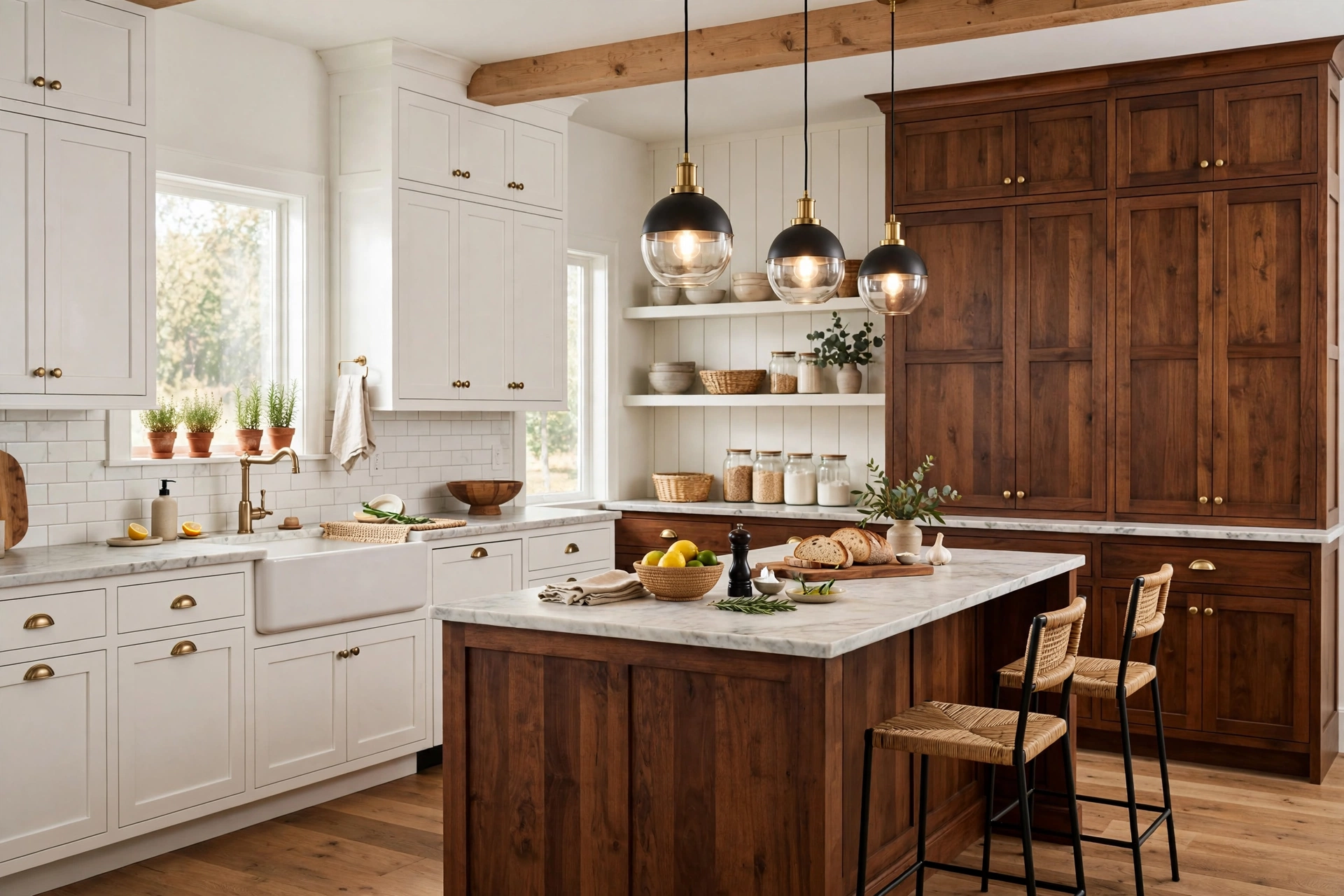
The painted-perimeter-plus-stained-island combination has earned its popularity — it delivers the best of both finishes while solving each one’s weaknesses. The logic: perimeter cabinets (the majority) in forgiving, bright painted finishes keep the kitchen light and easy to coordinate, while the island in rich stained wood becomes the furniture-like focal point that grounds the room. The island takes the most physical abuse (stools, feet, bags), and stained wood hides that wear far better than paint would.
Execution rules keep the mix intentional rather than accidental. Limit the kitchen to two cabinet finishes maximum — three reads as indecisive. The finishes should contrast clearly; a white perimeter with a barely-different cream island looks like a mistake, while white with walnut looks deliberate. Unify with consistent hardware across both finishes — the same pull in the same finish on painted and stained cabinets ties them together visually. Countertops bridge the gap: a stone with both light and warm tones connects white perimeter to wood island effortlessly.
Beyond the classic combo, other mixes work: painted uppers with stained lowers (light above, grounded below — excellent in small kitchens where dark lowers do not overwhelm), stained perimeter with painted island (the inverse, for wood lovers who want one light element), or painted perimeter with a stained range hood or pantry wall as the accent. The principle is always the same: one dominant finish (60-70%), one accent (30-40%), clear contrast, unified hardware. Appliances participate too — stainless steel is the neutral mediator, while black stainless or panel-ready appliances shift the balance and should be factored into the finish plan.
Avoid the common failure modes: mixing two painted colors with no clear hierarchy, combining stained finishes in clashing undertones (orange oak island with gray-washed perimeter fights all day), or adding a third finish “just on the pantry.” Restraint is what makes two-tone look expensive; every additional finish dilutes the effect. When in doubt, photograph the combination — the camera reveals clashes the eye rationalizes in person.
Refinishing Down the Road: What Each Path Involves
Every kitchen eventually needs refinishing, and the two finishes offer very different second acts. Painted cabinets are straightforward to repaint — the existing paint is the perfect primer base after cleaning and light scuff-sanding. Changing white to navy, or refreshing worn white with new white, is a standard professional job taking about a week for an average kitchen. DIY repainting is achievable with patience: the flat Shaker-style doors most painted kitchens use are forgiving, and bonding primers adhere well to sound existing paint. Expect professional repainting to cost a fraction of replacement — typically 20 to 30 percent of new-cabinet cost.
Stained cabinets offer richer refinishing options but demand more skill. Restaining the same color is the easiest refresh — clean, scuff, and apply new stain and topcoat. Changing stain color requires stripping to bare wood first, which is labor-intensive (chemical strippers or extensive sanding) and reveals every imperfection the old stain hid. Going from stained to painted is common and works well: the wood just needs thorough prep (degrease, sand, prime with stain-blocking primer to prevent tannin bleed-through, especially with oak, mahogany, and cherry). Going from painted to stained is the hardest direction — it requires stripping every trace of paint from the wood, which is rarely worth the labor unless the underlying wood is spectacular.
🛒 Shop This Look:
Tannin bleed deserves special attention for anyone painting over stained wood. Tannins are natural wood compounds that migrate through water-based paints as yellow-brown stains, usually appearing weeks after the job looks perfect. Oak, cherry, and mahogany are the worst offenders. Prevention is a shellac-based or oil-based stain-blocking primer — standard latex primer will not stop tannins. If you are hiring this out, confirm in writing that the contractor will use stain-blocking primer; it is the most commonly skipped step and the most common cause of repaint failures over stained wood.
Timeline reality: professional refinishing (either direction) typically takes 5 to 10 working days with the kitchen semi-usable throughout (doors are removed and finished off-site). DIY takes two to four weekends. Either way, refinishing costs dramatically less than replacement and keeps quality cabinet boxes in service — if your boxes are solid plywood and the layout works, refinishing is almost always the smarter money than new cabinets.
Choosing Colors and Stains That Age Well
Trend cycles punish bold choices and reward restraint — but “safe” does not have to mean boring. Among painted finishes, the colors with the longest proven track records are warm white, soft white, greige, and light gray. These have looked current for decades across multiple trend cycles because they function as neutrals, not statements. They also maximize natural light reflection, which flatters every kitchen regardless of size or orientation. If you want personality within safety, put it in the island or a single accent area rather than the full perimeter.
Among bolder painted colors, some age better than others. Navy has the deepest historical roots — it has cycled in and out for a century without ever looking truly dated, especially in traditional and coastal homes. Forest and sage greens have genuine staying power tied to the broader biophilic design movement. What dates fastest: the ultra-specific trend colors (the exact millennial-pink or Gen-Z-yellow of a given year), very dark charcoal in small kitchens, and any color chosen primarily because it was in a magazine that month. Ask yourself: would I still like this if I never saw another kitchen photo again? If yes, it will age fine.
For stains, the aging rule is undertone, not darkness. Warm orange-red undertones (honey oak, golden maple) are what read as “dated 1990s” — it is the undertone era-marker, not the wood itself. Neutral to cool undertones (white oak, natural maple, walnut, weathered gray-browns) read as current and have for decades. Medium tones are the most forgiving across eras; very dark stains show dust and can overwhelm, while very light stains show grime. When selecting a stain, view the sample in your kitchen’s light at multiple times of day — stain undertones shift dramatically between cool daylight and warm evening bulbs, and the showroom’s lighting flatters everything.
The meta-principle: choose finishes you would still choose if trends did not exist. Kitchens last 15 to 25 years; trends last 3 to 5. The happiest kitchen owners are not the ones who chased the perfect trend moment but the ones whose cabinets still make them happy a decade later — which almost always means a finish chosen for the home, the light, and personal taste rather than the algorithm.
Which Should You Choose?
Choose painted if: you want a specific color, prefer a clean modern look, or your kitchen needs brightening.
Choose stained if: you love natural wood, want lower maintenance, or prefer timeless warmth.
Consider both: stained island with painted perimeter is a popular compromise.
🛒 Shop This Look:



