
As an Amazon Associate, I earn from qualifying purchases. This means I may earn a commission if you purchase through links on this page — at no extra cost to you.
Scottish living rooms are easy to recognize and hard to fake. The real ones feel held together by weight: dark wood, thick wool, a fire or something that stands in for one, and light that comes from lamps rather than the ceiling. The fake ones look like a gift shop exploded — tartan on every surface, antlers on the wall, a different pattern fighting for attention in each corner. The difference is not budget. It is restraint. A Scottish room works when a few strong elements do the talking and everything else stays quiet enough to let them.
🛒 Shop This Look:
🛒 Shop This Look:
What makes a room read as Scottish
Strip away the souvenirs and Scottish design comes down to four things: natural materials used honestly, furniture built to be sat on rather than looked at, pattern used sparingly, and warmth treated as a practical problem before it is a decorative one. Old Scottish houses had thick walls, small windows, and long dark winters, so rooms were built to hold heat and hold people. That history still explains the look: closed-in seating groups, heavy curtains, rugs over cold floors, and lamps placed where people actually sit.
That also tells you what to skip. You do not need a castle, a clan crest, or anything with a stag on it. If a piece would look at home in a hunting lodge gift shop but nowhere else, it is costume, not design. The test for every addition is simple: would this room still feel Scottish if you removed the tartan? If the answer is no, the room is tartan wearing a room. Build the bones first — wood, wool, warm light, solid seating — and let tartan be the accent that confirms the style rather than the only thing carrying it.
Tartan: one hero pattern, used on purpose
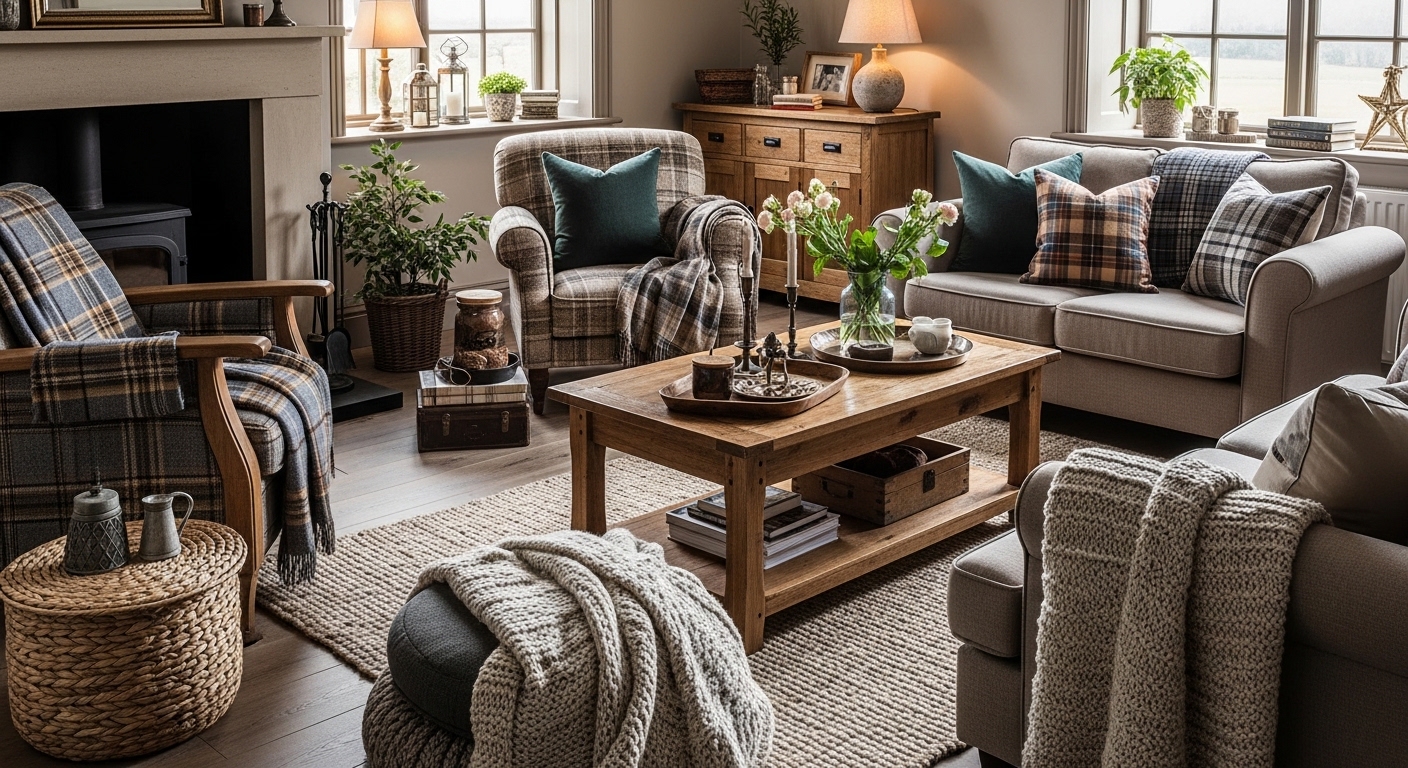
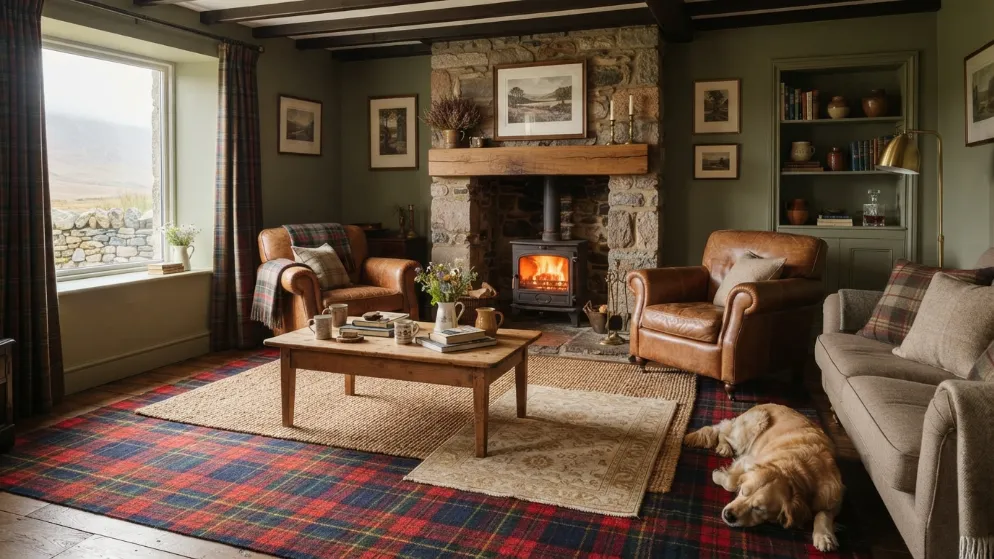
Tartan is the fastest way to signal Scotland and the fastest way to ruin a room. The rule that keeps it working is one hero pattern per room. Pick one tartan — a muted Royal Stewart, a soft Black Watch, a quiet dress tartan in faded reds and greens — and let it appear in two or three places at most: a throw over the sofa arm, a cushion or two, maybe a single chair. Everything else in the room should be solid, textured, or quietly patterned in a way that does not compete.
Scale matters as much as quantity. A large-scale tartan on a small cushion reads as a bold graphic; the same pattern stretched across full curtains can dominate the whole wall. In a small room, keep tartan to the smallest pieces — cushions and a throw — and let the larger surfaces stay plain. In a bigger room you can afford one larger tartan moment, such as an upholstered chair or a blanket draped over a reading chair, but still only one. Mixing two different tartans in one room almost always looks accidental unless the colors are closely related, and even then it needs a steady hand. One tartan, repeated deliberately, reads as a choice. Three tartans read as a clearance sale.
Color temperature matters too. Bright, new-looking tartan in saturated reds can feel loud against dark wood. Faded, washed, or muted versions of the same pattern sit far more comfortably with old wood and soft light. If a tartan throw looks too bright when you bring it home, pair it with charcoal, deep green, or warm brown cushions rather than more red — the neutrals pull the brightness back into the room instead of letting it shout.
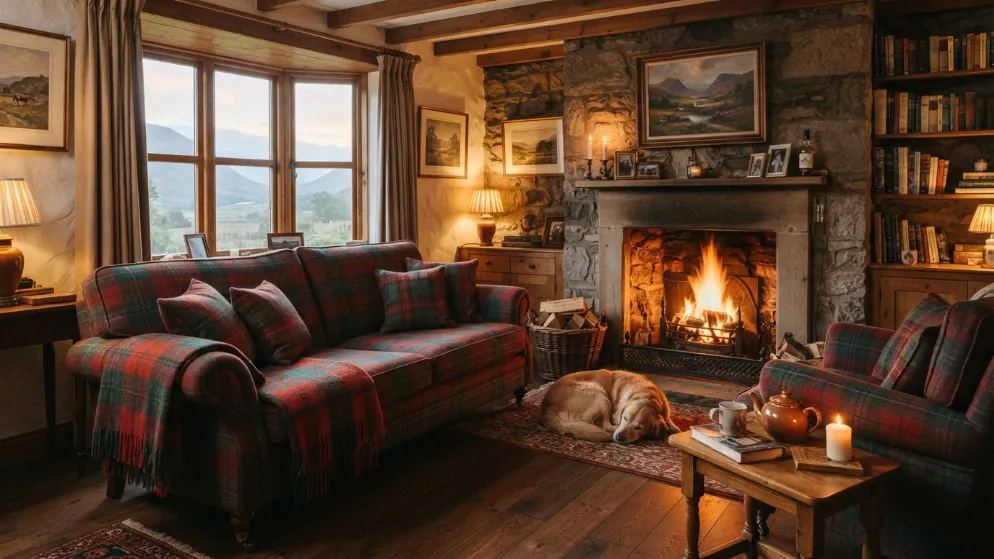
Best for adding classic tartan warmth to sofas and armchairs.
Dark wood without a dark room
Dark wood is the backbone of the Scottish living room: mahogany or walnut side tables, a solid coffee table, dark-stained floorboards, maybe a bookcase that has clearly been there for decades. The risk is that a room full of dark wood with small windows turns gloomy, which is the opposite of cozy. The fix is contrast in the right places, not less wood.
Keep the largest wood surfaces — floors and big furniture — dark, and lighten everything that sits against them. Walls in warm off-white, soft sage, or pale stone make dark furniture read as rich rather than heavy. A light rug under a dark coffee table breaks up a dark floor. Lamps with warm bulbs placed beside dark furniture create pools of light that show the wood grain instead of letting it disappear into shadow. And leave some breathing room: a dark bookcase looks intentional when one shelf in three is left partly empty, and crowded when every inch is filled.
If your room is short on natural light, be selective about which wood stays dark. One dark anchor piece — a coffee table or a sideboard — plus medium-toned wood elsewhere gives the same character without swallowing the light. Paint is your friend here too: a dark wood mantel or door frame against pale walls delivers the contrast that makes both look better.
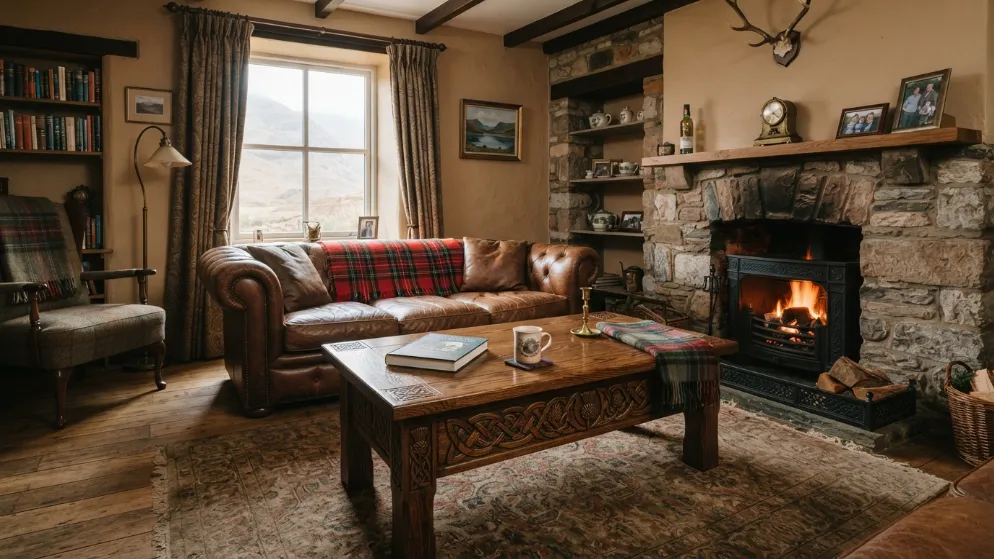
Signature Design by Ashley Sturlayne Transitional Coffee Table with Trestle Base, Dark Brown
Best for anchoring a classic Scottish seating area with dark wood.
Wall colors that hold the room
Scottish rooms lean warm. Walls in warm white, soft stone, muted sage, or pale oat let wood and wool do the work. A single deep accent wall — forest green, navy, or a dark warm brown — can anchor a fireplace wall or the wall behind the sofa, but only one wall, and only if the room gets enough light to carry it. Two dark walls in a small room will close it in fast.
Undertone is the detail people miss. A cool grey-white next to warm wood looks cold and disconnected, while a warm white with a yellow or pink undertone makes the same wood glow. Test paint on the wall that gets the least light, not the brightest one — that is where a wrong undertone shows up first. And keep the ceiling warm white rather than brilliant white, which can feel harsh against dark wood in lamplight.
Seating: deep, soft, and built for long evenings
A Scottish living room is a sitting room in the old sense: people stay in it. Sofas should be deep enough to tuck your feet up on, with cushions that are soft rather than drum-tight. A rolled-arm sofa in leather or a heavy woven fabric suits the style better than a low, hard, modern frame. If your sofa is already modern and low, a thick wool throw and soft cushions can warm it up without replacing it.
Seating arrangement matters more than any single piece. Pull chairs and sofa into a closed group around the focal point — fireplace, coffee table, or a window with a view — with no more than a comfortable conversation distance between them. Chairs pushed against walls around the edges of a room feel like a waiting room. A group pulled inward, even slightly, feels like a room people gather in. Leave a clear path through the room so the closed group does not become a trap; people should be able to reach a seat without climbing over a coffee table.
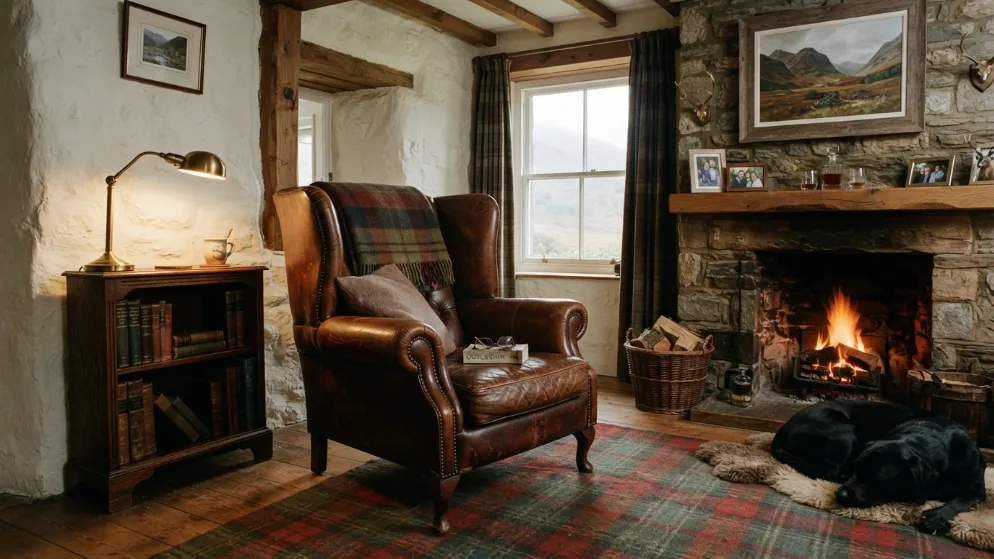
Martha Stewart Decker Plaid Wingback Armchair
Best for a classic wingback reading nook by a window or fireplace.
Textiles: layering wool, linen, and weight
Textiles are where a Scottish room earns its coziness. The formula is layers of different weights and textures rather than one thick blanket: a wool throw over the sofa arm, linen or cotton cushions underneath, a heavier knit or woven throw on the reading chair. Each layer should feel different to the touch — smooth linen, nubby wool, soft knit — because the hand notices variety even when the eye only registers warmth.
Cushion discipline keeps the layering from turning into clutter. Three to five cushions on a standard sofa is plenty: two larger ones at the corners, one or two smaller ones in front, and the tartan among them rather than on every one. More than that and people spend the first five minutes of every evening moving cushions just to sit down. Covers you can remove and wash matter more than precious fabrics — a room that cannot be lived in will not stay cozy for long.
The fireplace as anchor, or a stand-in that works
If you have a fireplace, let it be the anchor and arrange seating around it. Keep the mantel simple: a mirror or one piece of art, a pair of candlesticks or lamps, and nothing that needs dusting every week. A crowded mantel fights the fireplace for attention and loses the room’s focal point.
If you have no fireplace, build a stand-in focal point with the same job: a large mirror or piece of art hung at eye level, flanked by a pair of lamps or bookcases, with seating facing it. The point is not to fake a fire but to give the room a direction — a place the eye lands and the seating gathers around. A television can serve as the focal point, but hang or frame it so it does not dominate when it is off; a room arranged entirely around a black screen feels like a cinema, not a living room.
Lighting in layers, never from the ceiling alone
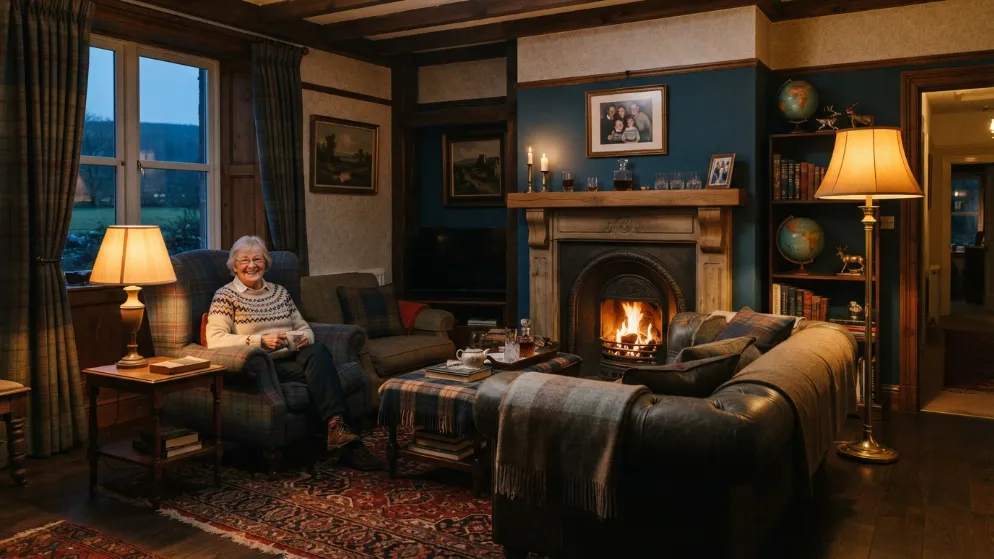
Scottish rooms live in lamplight. Overhead lighting on its own makes dark wood look flat and tartan look harsh. The working formula is three layers: table lamps beside seating for reading and conversation, a floor lamp or two for corners, and one softer source — candles, a small lamp on a bookcase, or a dimmed overhead — for overall glow. Warm bulbs matter more than bright ones; a room lit warmly at moderate brightness feels cozier than a room lit brightly in cool white.
Place lamps where people sit, not where the ceiling dictates. A lamp beside each end of the sofa and one by the reading chair covers most rooms. If you only buy one thing for the room, make it a good table lamp with a linen shade — it softens everything around it, including wood and tartan that looked too strong in daylight.
QiMH Farmhouse Table Lamp Set of 2, Traditional Table Lamps with Linen Shade, Wood Grain
Best for warm, layered traditional lighting that highlights the room’s character.
Windows: curtains that earn their weight
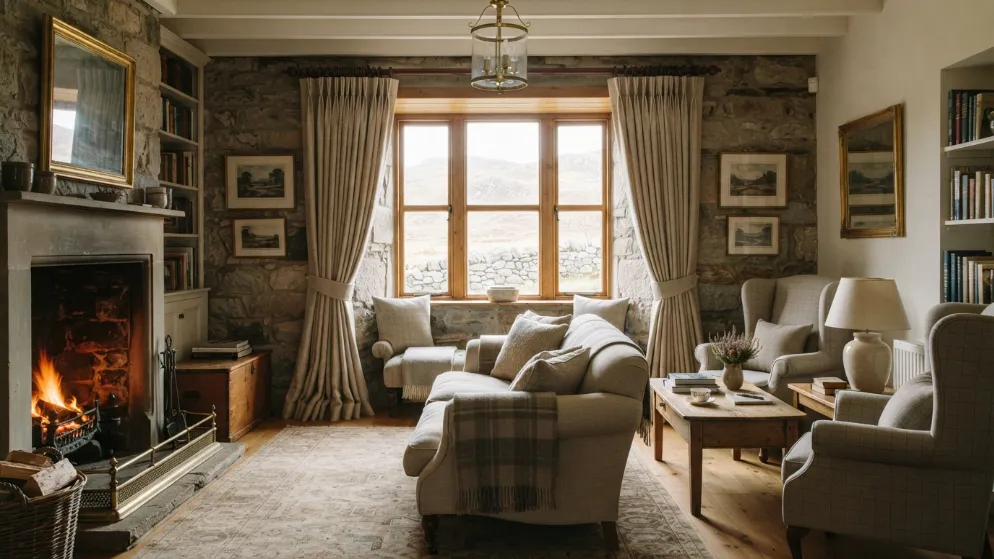
Heavy curtains are part of the Scottish look, but they need to work. Curtains hung high and wide — rod near the ceiling and extending past the window frame on both sides — make windows look larger and let the maximum daylight in when open. Linen or a linen-look fabric in a natural tone softens light without blocking it entirely; a heavier wool or velvet curtain suits a room that needs real insulation or privacy, but only if the room is big enough to carry the weight.
The common mistake is curtains that are too short or too narrow, which make windows look smaller and the room feel unfinished. Curtains should just brush the floor, and when open they should clear the glass almost entirely. If your windows are small, lighter fabric and a wider rod do more for the room than heavier fabric ever will.
NICETOWN Thick Linen Living Room Curtains 2 Panels Set, Natural, W52 x L90
Best for softening the space with natural linen and gentle filtered light.
Rugs: size and layering rules of thumb
A rug that is too small is the quickest way to make a seating group look scattered. As a rule of thumb, the front legs of the sofa and chairs should sit on the rug, and the rug should extend past the coffee table on all sides. In a typical seating group that means a rug substantially larger than people expect — measure the seating footprint, then add room around it, rather than guessing from the coffee table size.
Layering works when the layers have different jobs: a large, flat, neutral rug to define the seating area, with a smaller, softer wool rug on top where feet actually land. Keep the top rug’s pattern quiet if the bottom one is patterned, and vice versa. One patterned rug plus a plain one reads as intentional; two competing patterns under the same coffee table read as a mistake.
RUGORIA Handmade Oushak Wool Area Rug, Traditional, 5′ x 8′, Blue & Green
Best for layering warmth underfoot and defining a cozy seating zone.
🛒 Shop This Look:
Small rooms and rented rooms
Scottish style adapts well to small rooms because its core is warmth, not size. In a small room, keep the dark wood to one or two pieces, keep tartan to cushions and a throw, and let the walls stay light. A single wingback chair in a corner with a lamp and a small table gives you the reading-nook feeling without needing a full suite of furniture. Mirrors opposite a window borrow light and make the room feel larger, and they suit the style — an old gilt or dark-wood framed mirror fits a Scottish room naturally.
Renters can get most of the look without touching walls or floors. The big moves are all removable: a large rug, heavy curtains on a tension rod or existing rail, lamps, throws, and cushions. If the walls are a cold rental white, warm-toned textiles and lamps do more to fix the feeling than any single piece of furniture. Leave the landlord’s paint alone and change the light and the layers instead.
Where money shows, and where it does not
If you are spending carefully, put money where hands and eyes land most: the rug underfoot, the throw people actually wrap up in, and the lamp shades that shape the light. These are the pieces people touch and notice every evening. Save on decorative objects, extra cushions, and anything bought purely to fill a shelf — a room with fewer, better things feels more Scottish than a room crowded with themed ornaments.
Secondhand and old furniture is an advantage here, not a compromise. Dark wood with a bit of wear looks right in a Scottish room in a way that shiny new furniture often does not. A solid old coffee table or bookcase with honest wear has more character than a new imitation, and it usually costs less. Check stability and comfort before finish — a wobbly chair is not charming, however old it is.
Mistakes that flatten the look
The most common mistake is tartan overload: tartan sofa, tartan curtains, tartan cushions, tartan rug. One hero pattern, as above, is the cure. The second is the museum problem — a room so full of dark wood, heavy fabric, and decorative objects that nobody wants to sit in it. If you cannot put a cup down without moving three things, edit. The third is lighting from the ceiling alone, which makes everything look flat and cold; add lamps before you buy anything else. The fourth is a rug that floats in the middle of the room touching no furniture, which makes the seating group look unanchored — size up or reposition until front legs sit on it.
A starter plan
Start with light and layout before you buy anything decorative. Move seating into a closed group around the focal point, add two lamps beside seating, and put a rug under the group that is big enough for front legs. Then add one tartan throw and two or three cushions in wool and linen. Then hang curtains high and wide if the windows need them. Only after those layers are in place should you add art, mirrors, and objects — and when you do, add one piece at a time and live with it for a few days before adding the next. A Scottish room is built by layering, and layering done slowly always looks better than a single shopping trip.
If you want to carry the same language into other rooms, the bedroom version of this style works from the same bones — dark wood, wool, warm light — with bedding doing the job that seating does here. Scottish bedroom design follows the same rules with a softer palette. For more ideas in this room, explore more living room ideas, and see how the same classic language changes in modern Victorian living rooms, Irish living rooms, and Swedish living rooms.
🛒 Shop This Look:



