
As an Amazon Associate, I earn from qualifying purchases. This means I may earn a commission if you purchase through links on this page — at no extra cost to you.
A bathroom stores more per square foot than any room in the house — towels, toiletries, medicines, cleaning supplies, and the half-used bottles everyone means to finish — yet it is usually the smallest room, with the least storage, and the highest standard for looking clean. That combination is why bathroom walls matter more than bathroom floors: the floor is needed for feet, so the walls have to hold everything else. But bathroom walls have a condition no other room’s walls have. They live in steam. Every fixing, material, and placement decision has to survive moisture first, and only then can it be judged on looks or convenience. Plan bathroom walls by moisture zones, then by frequency of use, and the small room starts to work.
Moisture Zones Decide Materials First
Divide the bathroom walls into three zones before choosing anything. The wet zone is the wall inside or directly beside the shower or bath: it gets direct spray and constant steam. Only sealed, waterproof materials belong here — stainless steel, sealed plastic, glass, or tile-mounted systems — and fixings must be rust-proof. The splash zone is the wall around the sink and beside the bath edge: it gets splashes and heavy steam but not direct spray. Sealed wood, metal, and waterproof baskets work here; raw wood, cardboard, and unsealed fiberboard do not — they swell, stain, and grow mold. The dry zone is the wall by the door, the wall above the toilet tank, and any wall away from water: normal materials are fine here, and this is where wood shelves, baskets, and art belong.
Zone discipline prevents the most common bathroom storage failure: a beautiful wood shelf hung in the splash zone that warps within a season, or a fabric basket in the wet zone that never dries. If you are unsure which zone a wall is in, assume it is wetter than you think — steam reaches further than splashes, and the wall beside a shower enclosure is a splash wall even if it never gets directly wet. The choice of bathroom paint that resists moisture and mold follows the same logic: the wall finish and the storage on it both have to be chosen for the zone they live in, not for the look alone.
What Goes Where, by Frequency of Use
Within the zones, place things by how often they are reached for. Daily items — toothbrushes, hand towels, the soap and shampoo in current use — belong between waist and shoulder height, within arm’s reach of where they are used, and in open or single-motion storage: a hook, a rail, a small shelf, a caddy. Every extra motion — opening a cabinet, lifting a lid, moving a bottle — is friction applied to a task done half-asleep, and friction is why things end up on the counter instead of in their place. Weekly items — cleaning supplies, spare toiletries, hair tools — belong in closed storage at any reachable height: a cabinet, a lidded basket, a shelf with bins. Rarely used items — spare towels, bulk refills, first-aid stock — belong high, above head height, where they do not compete with daily reach. And medicines deserve their own rule: keep them in closed storage, away from steam and away from child height, not in open wall storage above the sink where steam degrades them and children can reach them.
Height rules follow from use, not from the wall. Towel bars and hooks should sit where a wet hand can reach them without stepping: beside the shower exit and beside the sink, not across the room. Shelves above a toilet tank should start above the tank lid’s swing — measure the lid lifted, not closed — and should hold only light, rarely used items, because reaching over a toilet for a daily item is awkward and unhygienic. Shelves beside a mirror should not block the mirror’s light or force you to reach across the sink to grab something.
🛒 Shop This Look:
Systems Compared by Job
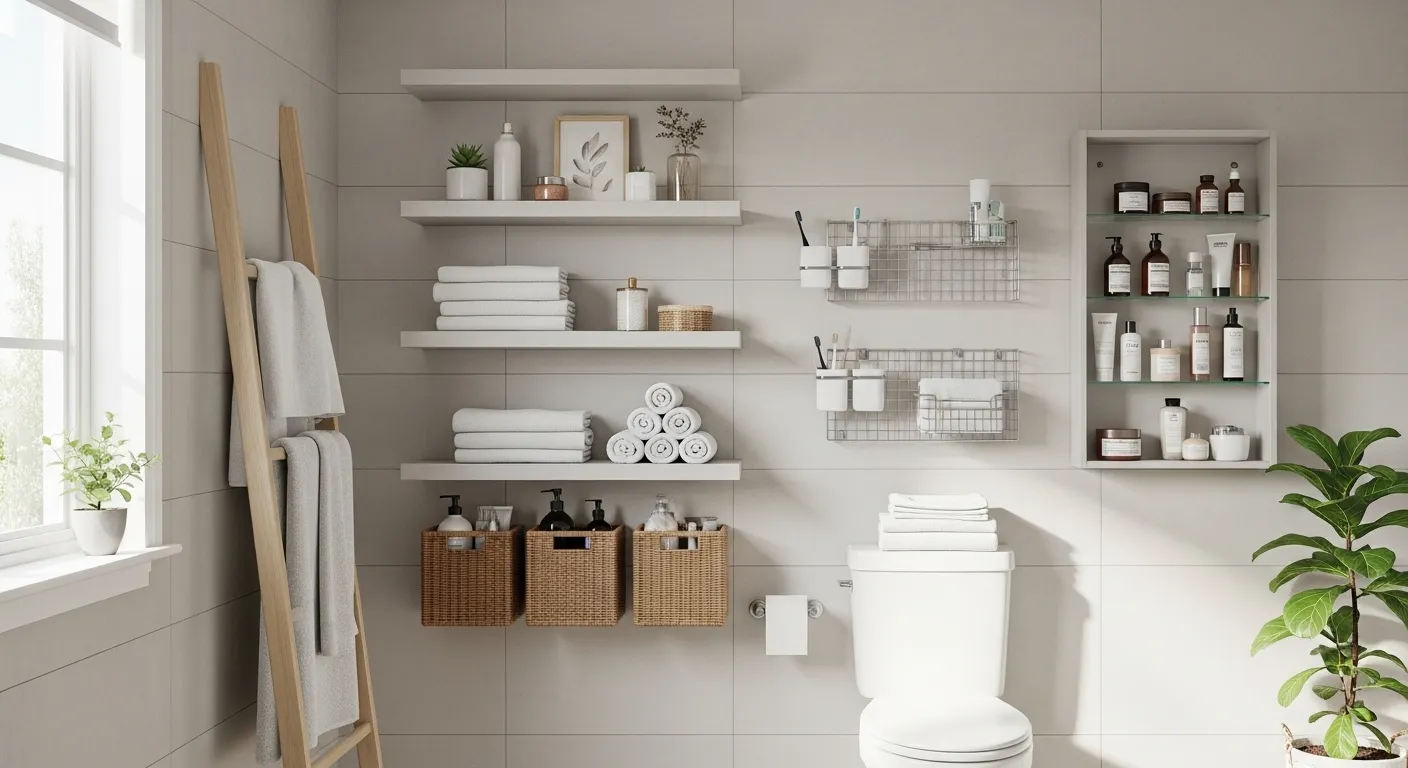
Open shelves suit display and daily reach: towels, rolled washcloths, and attractive bottles. They also collect dust and steam, so they suit the dry zone and the upper splash zone, not the wet zone, and they need wiping as part of the cleaning routine. Towel bars and rings suit towels in use: one bar per person in use beats one long bar shared, because shared bars lead to towels piled on towels that never dry. Hooks suit robes, bags, and the towel in current use — a hook holds one thing well and several things badly, so plan one hook per item, not one hook per person. Baskets suit categories: one basket for hair tools, one for cleaning supplies, one for spares — baskets make open shelves look ordered and let you lift a whole category down at once. Cabinets suit everything that should not be seen or steamed: medicines, cleaning chemicals, spare toiletries. Over-door racks suit rooms with no free wall, but check the door swing and the steam exposure — a rack on a bathroom door lives in the splash zone at least. Ladder shelves suit the dry zone beside a toilet or door: they lean, they hold several levels, and they need no fixings, but they need floor space and a wall they can lean against safely, and they must not block access to anything behind them.
The Above-Toilet Wall, Done Right
The wall above the toilet is the bathroom’s most used and most abused storage wall. Done right, it holds spare rolls, a small plant or decor, and rarely used items, all without interfering with the toilet itself. Three rules. First, depth: keep shelves shallow — six to eight inches deep — so nothing hangs over the tank or falls behind it. Deep shelves above a toilet invite items dropped into the tank gap. Second, height: the lowest shelf should clear the raised tank lid by at least a few inches, and the arrangement should not force anyone to lean over the toilet to reach a daily item — above-toilet storage is for spares and decor, not for the toothbrush. Third, weight: the wall above a toilet is often a partition wall, so heavy items need proper fixings, not basic plugs. The above-toilet wall decor guide covers how to balance storage and decoration on this wall — the storage version of the same lesson is that the wall works best when it is mostly decor and spares, with the working storage elsewhere.
Small Bathrooms: Narrow Walls, Door Backs, Vertical Runs
Small bathrooms need vertical thinking. A narrow wall — the strip beside a door, the wall between a mirror and a corner — can hold a vertical run of small shelves or a tall narrow cabinet that a wide shelf cannot fit. The door back is a full wall most bathrooms ignore: an over-door rack or a row of hooks holds robes, bags, and the towel in use, but check that the rack does not stop the door closing or rattle against the frame. The wall beside the sink, even a strip six inches wide, can hold a small rail for hand towels or a narrow shelf for daily items. And the space above the door — rarely used, always dry — suits a single high shelf for spare towels and bulk refills. The slim storage wall hacks guide is built for exactly these strips and gaps: the principle is that a bathroom’s usable wall is larger than its empty wall, because narrow strips count once you stop looking for wide runs.
Towels: How Many, Where, and How They Dry
Towels are the bathroom’s biggest wall-storage consumer, so they deserve their own plan. Count first: one bath towel per person in current use, plus one hand towel per sink, plus one spare set per person in reserve. The towels in use live on bars or hooks near the shower and sink, where they can dry — a towel that cannot dry grows musty, and a musty towel is worse than no towel. Bar spacing matters: towels on a shared bar need air between them, so one towel per bar section, not two towels folded over one bar. Hooks dry towels faster than bars when the towel hangs fully open, but a towel bunched on a single hook dries slowly — use a double hook or spread the towel over two hooks. Reserve towels live folded on a high shelf or in a cabinet, not on the wall, because a wall full of reserve towels is a wall that cannot hold anything else. And wet towels should never be stored in a closed basket or cabinet — they need air, or they mildew. A ventilated basket or an open hook is the right home for a damp towel; a lidded bin is not.
🛒 Shop This Look:
The Dry Zone Can Hold Art, Too
Not every bathroom wall is a storage wall. The dry zone — the wall by the door, the wall opposite the shower — can hold art, and art is what stops a storage-planned bathroom from feeling like a utility room. The rules are the same as storage, applied to decoration: sealed frames, no unglazed paper in steam, nothing precious where splashes reach. A single framed print in the dry zone, or a small arrangement above a towel rail, changes the room’s character without competing with storage. The question of whether you can hang wall art in a bathroom comes down to zone and sealing: in the dry zone, with a sealed frame, yes; in the wet zone, no, no matter how well sealed the frame claims to be. Keep art and storage on different walls where possible — a wall trying to do both usually does neither well.
Renter Options and Their Honest Limits
Renters face the same moisture zones with fewer fixing options, and steam makes the limits stricter. Suction hooks and caddies work on smooth tile and glass and fail on textured tile, grout lines, and painted walls — and they fail faster in steam, because steam breaks the seal. Test a suction fixing for a week with a light load before trusting it with anything heavy or breakable. Adhesive hooks hold light items on smooth, dry surfaces and fail in the splash zone, where steam softens the adhesive over weeks, not days — a hook that holds in January can drop in March. Tension rods in a shower recess or between two walls need no fixings and hold a caddy or a curtain well, but only where the walls are solid and the rod can grip; they slip on textured tile. Over-door racks need no permission, but check the door material and the steam exposure. Freestanding shelves and ladder shelves need no fixings at all and are the most reliable renter option in a bathroom, provided they have floor space and do not block access. Whatever the method, never trust adhesive or suction with medicines, heavy glass, or anything above a toilet tank — a falling object over a toilet is a breakage and a plumbing problem at once.
Mistakes That Make Bathroom Walls Fail
The first mistake is ignoring zones: raw wood, fabric, or unsealed fiberboard in the splash or wet zone will warp, stain, or mold, and no amount of cleaning fixes a swollen shelf. The second is storing medicines and chemicals in open steam: steam degrades medicines and corrodes containers, so closed, dry, high storage is the rule for both. The third is the over-door trap: a rack on a door that no longer closes fully, or that bangs the frame every time, is worse than the storage it provides. The fourth is blocking ventilation: shelves or cabinets built across an extractor fan or a vent slot trap steam in the room and punish every other storage decision. The fifth is the counter spillover: when wall storage is too high, too closed, or too far from the point of use, daily items migrate to the counter, and the bathroom looks cluttered no matter how good the walls are. Wall storage works only when the daily kit lives within arm’s reach of where it is used, in storage that opens in one motion. The sixth is forgetting the floor: a bathroom with perfect walls but no hamper still ends up with clothes on the floor, and a wall plan that leaves no floor space for a hamper or a step stool has planned for a room nobody actually uses.
🛒 Shop This Look:
Plan bathroom walls by moisture zone first, then by frequency of use, with towels given their own drying plan and the dry zone allowed a little art. Done that way, the smallest room in the house stops being the most cluttered one, and its walls start holding everything the floor never should have had to.



