
As an Amazon Associate, I earn from qualifying purchases. This means I may earn a commission if you purchase through links on this page — at no extra cost to you.
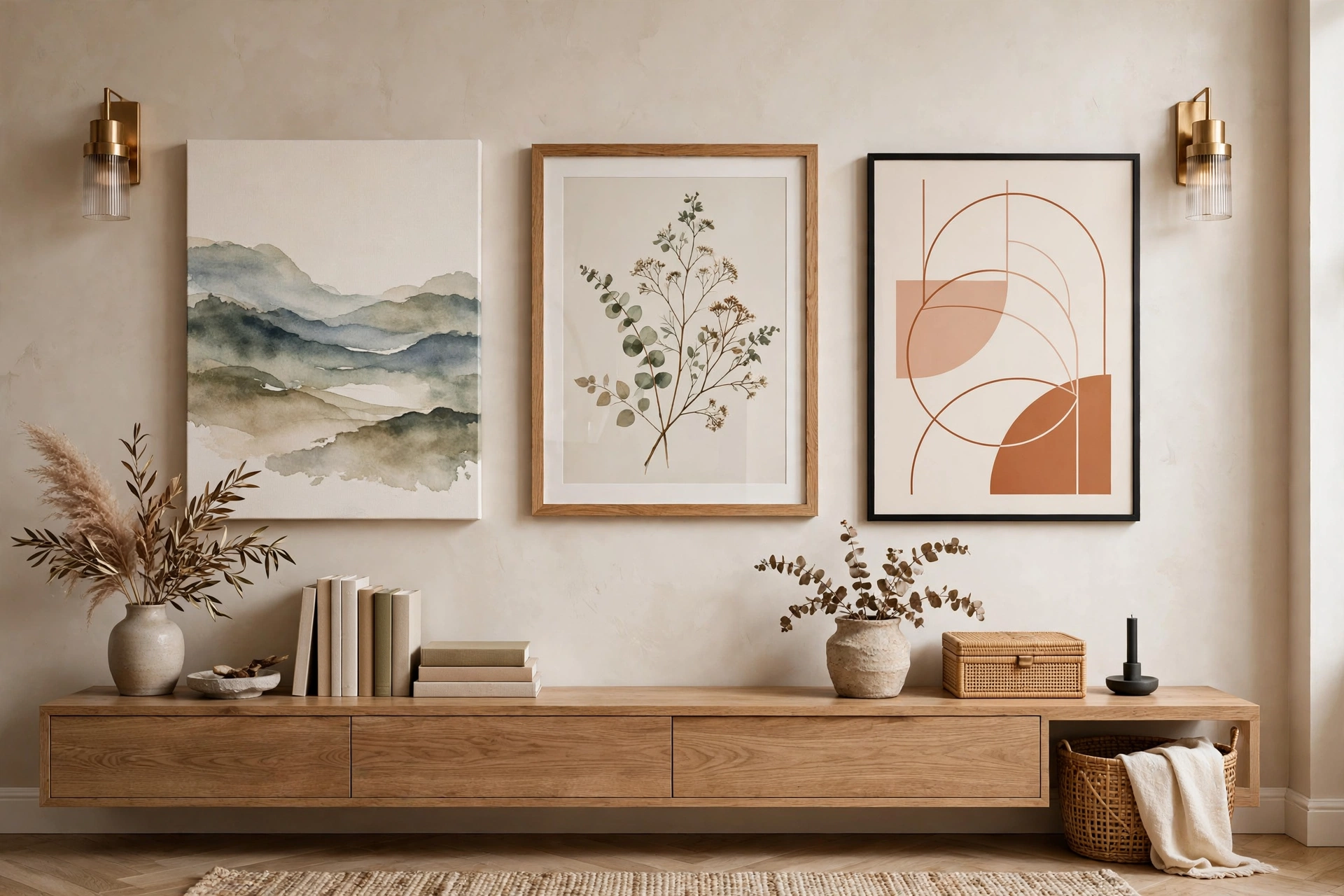
Canvas prints are images on stretched fabric with no glass (casual, modern, $20-200), framed prints are paper prints behind glass in a frame (formal, protective, $15-150+), and posters are unframed paper prints (cheapest, most casual, $5-30). The main differences are material, formality, durability, and price.
Canvas Prints
What: Image printed on cotton or polyester canvas, stretched over wooden bars.
Look: Modern, casual, gallery-style. No frame or glass.
Pros: Ready to hang, lightweight, no glare, affordable for large sizes.
Cons: Can’t be cleaned with water, edges can dent, less formal.
Best for: Living rooms, bedrooms, modern spaces.
Framed Prints
What: Paper print (matte, glossy, or fine art paper) in a frame with glass/acrylic.
Look: Classic, polished, versatile.
Pros: Protected from dust/UV, looks expensive, easy to swap prints.
Cons: Heavier, glass creates glare, framing adds cost.
Best for: Hallways, offices, traditional spaces, valuable prints.
Posters
What: Unframed paper prints, often thinner stock.
Look: Casual, youthful, temporary.
Pros: Cheapest, lightweight, easy to change.
Cons: Wrinkles easily, no protection, looks less finished.
Best for: Dorms, kids’ rooms, temporary spaces, renters.
Side-by-Side Comparison
Durability: Framed > Canvas > Poster
Price (large): Poster < Canvas < Framed
Formality: Framed > Canvas > Poster
Ease of hanging: Poster > Canvas > Framed (weight)
Sizing Guide: Getting Dimensions Right for Each Type
Size mistakes are the number one reason wall art looks off, and the right dimensions differ slightly by format. The universal rule: art above furniture should span roughly two-thirds to three-quarters of the furniture’s width. Above a 7-foot sofa, that means a single piece or grouping around 4.5 to 5 feet wide. A small 16×20 print floating alone over a large sofa looks lost no matter how beautiful the image is. When in doubt, go bigger — most people buy art that is too small, not too large.
For canvas, oversized is where the format truly shines. A 36×48 or 40×60 canvas has real presence, and canvas is the most affordable way to go big because there is no glass or heavy frame adding cost and weight. Gallery-wrap edges, where the image continues around the sides, look finished without any frame, while mirror-wrap edges work well for images that would look odd stretched. A triptych — one image split across three canvases — is a smart way to fill a wide wall with a format that reads modern and intentional, and the gaps between panels add architectural rhythm.
🛒 Shop This Look:
For framed prints, remember the mat and frame add 4 to 8 inches to the overall dimensions. Measure the finished framed size, not the print size, when planning your wall — a 16×20 print in a 2-inch mat and frame becomes roughly 22×26 on the wall. Wide mats make art feel more expensive and gallery-like, but they also shrink the visible image, so balance mat width against image impact. Orientation matters too: wide horizontal pieces suit the space above sofas, beds, and consoles, while vertical pieces work in narrow spots like between windows, in hallways, or flanking a doorway.
Viewing distance is the final check that buyers forget. Large pieces need room to breathe — a 48-inch canvas needs at least 6 to 8 feet of viewing distance to be appreciated as a whole; in a tiny room it overwhelms rather than impresses. Stand where you will actually view the art and hold up a cardboard template cut to the candidate size. This thirty-second test prevents more regret than any amount of measuring. Match the scale of the art to the scale of the room, not just the wall, and leave enough empty wall around the piece that it reads as intentional rather than crammed.
Hanging, Lighting, and Care Tips for Each Format
Each format has its own care needs, and most art damage comes from preventable placement mistakes. Canvas prints should stay out of steamy bathrooms and direct blasts of sunlight. Moisture can loosen stretcher bars and cause sagging, while UV fades inks over time — a canvas in a sunny spot can visibly fade within a few years. Dust canvas with a dry microfiber cloth only; never use water or cleaning sprays, which spot the fabric permanently. If a canvas corner dents, lightly misting water on the back of the canvas and applying gentle heat from a hair dryer can sometimes tighten it, but careful handling beats every repair.
Framed prints are the lowest-maintenance option once hung, because the glazing does the protective work. Placement still matters: avoid hanging framed pieces directly opposite a window, where glare washes out the image for half the day. For sunny rooms, UV-filtering glass or museum-grade acrylic is worth the upgrade — it dramatically slows fading of the print inside and is the single best preservation investment for valuable pieces. Clean glass with a damp microfiber cloth, spraying cleaner onto the cloth rather than the glass so liquid never seeps under the frame edge and stains the mat.
Posters need the most attention of the three. Unframed posters curl — it is simply what paper does in changing humidity. Reverse-rolling a poster gently around a tube for a few hours flattens most curl, and archival corner mounts or a simple magnetic hanger keep it flat on the wall long-term. If you are storing posters, keep them rolled with the image facing out in a rigid tube, never folded — creases never fully disappear. Keep all three formats away from exterior walls prone to condensation; trapped moisture behind a frame causes warping and mold that ruins art silently from behind.
Lighting transforms how art looks after dark. A picture light mounted above a framed piece or canvas creates a gallery effect and is inexpensive to add. If you use track or recessed lighting, aim it at roughly a 30-degree angle to the art — this minimizes glare on glass while evenly illuminating the piece. Warm bulbs (2700-3000K) flatter most art; cool daylight bulbs can make warm-toned prints look washed out. And never hang valuable art in direct sun even with UV glass — UV protection slows fading, it does not stop it.
Common Mistakes to Avoid When Buying Wall Art
Buying art that is too small is the classic error. A postage-stamp print centered on a big empty wall makes the whole room feel unfinished and makes the art itself look like an afterthought. Measure first, then shop — and photograph your empty wall with a tape measure visible so you can reference real dimensions while browsing. The second mistake is ignoring glare: glossy canvas coatings and standard glass frames turn into mirrors under bright lights or opposite windows. Matte canvas finishes and anti-glare acrylic solve this, so assess your room’s lighting before you buy, not after.
Third, do not assume a cheap poster will look fine unframed forever. Thin poster paper wrinkles, fades, and curls within months in real rooms with real humidity swings. If you love a poster image, budget for at least a basic frame — it is the difference between dorm-room temporary and intentional decor. A twenty-dollar frame elevates a ten-dollar poster more than any other single upgrade. Fourth, watch the frame style: an ornate gold frame on a minimalist abstract print creates visual confusion, while a thin black frame on a traditional oil-style reproduction looks underdressed. Let the art’s style guide the frame — simple black or natural wood frames are nearly foolproof for most contemporary prints.
Fifth, resist buying wall art before you know where it will hang. Art purchased in a vacuum — because it was on sale, because it looked good in the store — often ends up the wrong size, wrong orientation, or wrong color temperature for the room it lands in. Note the destination wall’s measurements, light conditions, and existing colors, and shop with that information in hand. Finally, do not hang art too high. The center of the piece should sit around 57 inches from the floor (average eye level), and art above furniture should hover 6 to 8 inches above the furniture’s top edge. Art hung near the ceiling reads as disconnected from the room — this single fix improves more living rooms than any purchase.
🛒 Shop This Look:
Display Ideas: Making Each Format Look Its Best
How you display art matters as much as which format you choose. Canvas prints look strongest hung directly on the wall with no frame — their depth, typically around 1.5 inches, creates a shadow line that gives them presence and dimension. For a more finished look, float frames (thin frames that leave a small gap around the canvas edge) add polish without the bulk of traditional framing. Large canvases can also be leaned against the wall on a console, dresser, or mantel for a relaxed, gallery-casual feel that is easy to rearrange whenever the mood strikes.
Framed prints reward thoughtful grouping. A grid of identically framed prints — same frame, same mat, evenly spaced — reads as sophisticated and intentional, ideal for hallways, staircases, and home offices. For a more collected feel, mix frame styles within a tight color family: black, white, and natural wood frames coexist beautifully as long as the mats are consistent. Picture ledges are the renter-friendly way to display framed prints: lean multiple frames at varying depths, overlap them slightly, and swap pieces seasonally without drilling new holes. Ledges also solve the commitment problem — you can restyle in minutes.
Posters deserve better than bare walls and tape. A simple frame instantly elevates a poster from temporary to permanent-looking. Magnetic wooden hangers are the minimalist alternative — they suit Scandinavian and Japandi interiors and make swapping prints effortless, which is ideal for kids’ rooms or anyone who redecorates often. For creative spaces, clipboards, washi tape borders, or binder clips on a wire create changeable displays that invite rotation. Whatever the format, keep hanging height consistent across the room — that invisible alignment is what makes mixed pieces look curated rather than random.
Consider the wall color as part of the display. White mats pop against colored walls; dark frames anchor light walls. A bold accent wall can carry larger, simpler art, while a neutral wall lets detailed or colorful pieces shine. And do not neglect the space beside the art — a small sconce, a trailing plant, or a sculptural object nearby completes the vignette. Art never hangs in isolation; it always converses with its surroundings.
Budget Planning: What Quality Costs at Each Tier
Setting a realistic budget prevents the two classic mistakes: overspending on pieces for low-impact spots and underspending on focal-point art that anchors a room. At the budget tier, posters and open-edition prints are the smart play — put your money into decent frames rather than expensive prints, because a well-framed inexpensive print consistently looks better than a pricey print in a cheap frame. Standard-size frames from big-box and online retailers keep costs down; custom framing can easily cost five to ten times the print itself, so reserve it for art you truly love and plan to keep for years.
In the mid-range, canvas prints offer the best size-per-dollar ratio for statement pieces. A large canvas that would cost a fortune to custom-frame delivers similar visual impact for a fraction of the price. This is the sweet spot for above-sofa and above-bed art — the pieces with the biggest visual job in the room. Framed prints at this tier benefit from upgraded glazing: anti-reflective or UV-protective glass is a modest upcharge that noticeably improves how art looks in bright rooms and protects the print for decades.
At the premium tier, you are paying for original art, limited editions, and archival materials — pieces that hold value and carry emotional weight. One original piece in a living room elevates everything around it in a way reproductions cannot. A practical budgeting rule: spend the most on art for the rooms where you spend the most time, and go budget-friendly in transitional spaces like hallways, guest rooms, and laundry areas. Remember that lighting is part of the budget — an inexpensive picture light can make a modest print look like a gallery piece, delivering more visual upgrade per dollar than a pricier print in bad light.
Finally, budget for the long game. Cheap art that fades, warps, or falls apart within two years is not a bargain — it is a replacement cost waiting to happen. Spending slightly more on archival inks, acid-free mats, and solid frames pays back in years of good looks. Buy fewer, better pieces rather than filling every wall at once; a home decorated slowly with art you genuinely love always looks better than one filled quickly with filler.
Which Should You Choose?
- Choose canvas for large statement pieces on a budget
- Choose framed for a polished look or to protect valuable prints
- Choose posters for temporary spaces or when you like changing decor often
🛒 Shop This Look:



