
As an Amazon Associate, I earn from qualifying purchases. This means I may earn a commission if you purchase through links on this page — at no extra cost to you.
Three hundred square feet is enough room to live well — if every square foot earns its keep. At this size, there is no spare room to absorb bad decisions: an oversized sofa, a closet full of clothes that never get worn, or a kitchen counter buried under appliances will all show up immediately. The upside is that the same small scale makes good decisions pay off fast. One wall bed, one honest declutter, or one better daily routine can change how the whole place feels.
This guide covers how to plan a 300-square-foot life from the start: what to prioritize in the first month, the pitfalls that trip people up, a room-by-room playbook, how to choose furniture that does more than one job, vertical storage, daily rhythms, and how two people share the space without friction. Small living forces intentionality — and intentionality, practiced daily, is what makes a micro space feel like a home rather than a compromise.
The First Month in a Micro Space: What to Prioritize
The first month in a micro space sets the pattern for everything after it. The order of decisions matters more than the speed: get the big footprint choices right first, and the smaller ones fall into place.
Start with the bed system. The bed is the largest single footprint in 300 square feet, so deciding how it works during the day — wall bed, loft bed, daybed, or a sofa that genuinely converts — determines how much living space exists at all. A standard bed on a frame with nothing underneath and no second function can eat a quarter of the apartment and give nothing back. Decide this before buying anything else.
Next, measure everything and write the numbers down. Measure the room, the doorways, the ceiling height, and every piece of furniture before it comes through the door. At this scale, an inch matters: a sofa that is three inches too deep blocks a walkway, and a shelf that is two inches too wide will not fit the only wall that can hold it. Tape outlines on the floor for the big pieces before committing — it takes ten minutes and prevents the most common micro-space regret, furniture that technically fits but leaves no room to move.
Then edit belongings before arranging them. Moving into 300 square feet with a full apartment’s worth of possessions guarantees clutter from day one. Sort by use, not sentiment: keep what gets used weekly, store or donate the rest, and be honest about duplicates. A smaller wardrobe, a smaller kitchen kit, and fewer decorative objects are not sacrifices — they are the precondition for the space working.
Fix the lighting early. A single overhead bulb makes a small room feel flat and cramped, and poor lighting is one of the fastest ways to dislike a micro space. Layer the light: a floor or wall lamp near the seating area, task lighting where work and cooking happen, and a warm bedside light. Good lighting costs little and changes the mood of the whole apartment from the first evening.
Finally, set up one zone at a time and live with it for a few days before adding the next. Trying to finish the whole apartment in a weekend leads to rushed purchases and furniture placed by guesswork. The sleeping zone first, then the kitchen, then the living and work zones — each one tested by actual daily use before the next one is arranged.
Common Pitfalls and How to Avoid Them
Most micro-space problems are predictable, which means they are avoidable. These are the mistakes that show up again and again — and the fix for each one.
Bringing apartment-scale furniture. Furniture labeled “apartment-size” is often designed for a 600-square-foot one-bedroom, not a 300-square-foot studio. A sofa that looks compact in a showroom can dominate a micro living zone. The fix is dimensional honesty: compare the actual measurements against the taped floor outline, not against the marketing label, and favor pieces scaled for small rooms — loveseats over full sofas, narrow consoles over wide desks, nesting tables over a fixed coffee table.
Keeping everything “just in case.” In a larger home, a box of rarely used items disappears into a closet. In 300 square feet, there is no closet deep enough to hide it, so “just in case” becomes visible clutter within weeks. The fix is a use-based rule: if an item has not been used in a season and has no specific upcoming use, it leaves. Seasonal and rarely used items belong in off-site storage or with someone who has room — not in the apartment.
Treating lighting as an afterthought. One ceiling fixture leaves corners dark, makes the room feel smaller, and turns evenings gloomy. The fix is to plan lighting with the same seriousness as furniture: at least three light sources at different heights, warm-toned bulbs, and a lamp positioned to wash light up a wall, which visually expands the room.
Buying single-function pieces. Every item in a micro space should justify its footprint. A chair that only seats one person, a table that only serves meals, or a bench with no storage inside all cost floor space without returning value. The fix is to run every purchase through a simple test: does this piece do at least two jobs, or store something, or fold away? If the answer is no to all three, it probably does not belong.
Skipping the entry zone. Without a defined landing spot, shoes, bags, keys, and mail pile up exactly where they are dropped — which, in 300 square feet, is three steps from everything. The fix is a compact entry station from day one: wall hooks, a narrow tray or shelf for keys, and a shoe solution that keeps the floor clear. A messy entry in a micro space is a messy apartment.
Ordering before checking returns. Light blocking, mattress comfort, and furniture fit are hard to judge until the item is in the room. The fix is to check the return policy before ordering anything large, and to favor sellers with free or cheap returns on furniture. A piece that cannot be sent back is a permanent decision made on incomplete information.
The Room-by-Room Micro-Living Playbook
Three hundred square feet works when every zone pulls double duty. Here is how to think about each area:
The Sleeping Zone
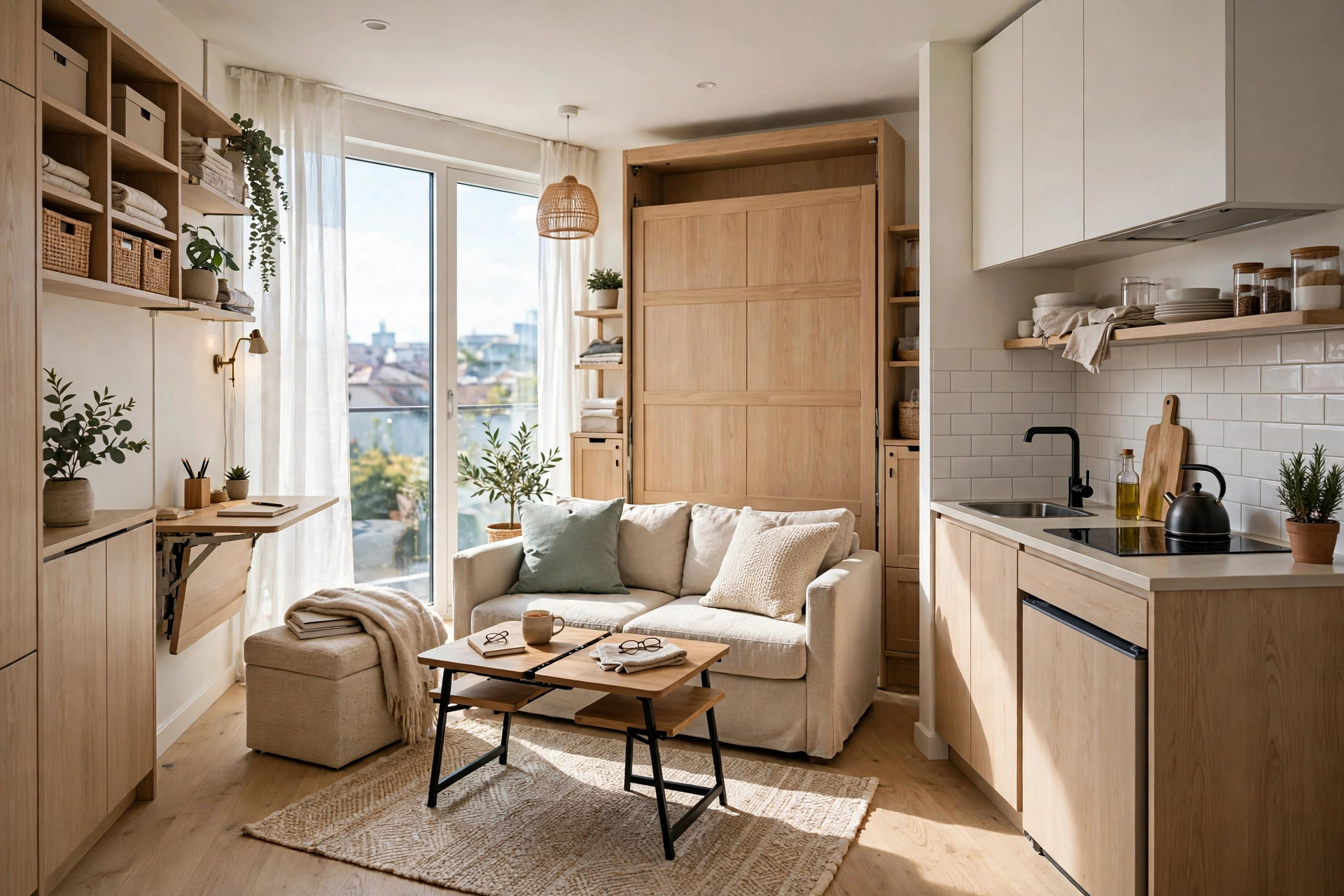
The bed is the biggest footprint decision in a micro space. A Murphy bed or wall bed reclaims 30 or more square feet every morning — the single highest-impact choice. If that is not possible, a loft bed creates a whole second zone underneath (desk, dresser, reading nook). A daybed or futon that functions as a sofa by day is the budget option. What does not work: a standard bed on a frame with nothing underneath and no dual function — it eats a quarter of the apartment and gives nothing back. Keep the sleeping zone visually calm: bedding in one palette, nothing stored on the floor around the bed, and a single bedside surface for the essentials.
The Kitchen Zone
Micro kitchens work on the “one in, one out” principle. Keep only the cookware used weekly: one good pan, one pot, one sheet tray, a chef’s knife, a cutting board. A dish rack that fits over the sink (rather than beside it) preserves counter space. Magnetic knife strips and wall-mounted spice racks move essentials off counters. The counter is for active cooking only — everything else lives vertically. Small kitchen decorating on a budget follows the same rule: fewer, better-chosen items and clear surfaces beat a crowded room every time. Simplify the cooking itself, too: simpler meals cooked more often suit a micro kitchen better than elaborate meals cooked occasionally, and prepping ingredients before turning on the heat (mise en place) matters far more when there is no counter space to spread out on.
The Living Zone
One comfortable seat beats three cramped ones. A loveseat or a good armchair with an ottoman serves better than a full sofa that crowds the room. Nesting tables replace the coffee table — pull them out when needed, tuck them away when not. Wall-mounted or arc floor lamps free up table surfaces. Keep one surface genuinely clear at all times: a completely clear table or shelf gives the eye somewhere to rest and makes the whole room feel larger. For more arrangement ideas, see how to decorate a small living room with space-saving tricks. Choose a rug that fits the seating group rather than the room — a rug that is too small chops the space up, while one that anchors the seating area pulls it together.
The Work Zone
A wall-mounted drop-down desk or a narrow console (12–14 inches deep) along an unused wall creates a workspace with near-zero footprint. Pair it with a comfortable chair that can tuck fully under. If the dining table doubles as the desk, the “5-minute reset” ritual — sweeping work into a tray at meal times — keeps the space from feeling like a permanent office. Keep work gear contained: one tray, one drawer, or one shelf for everything work-related, so the end of the workday is a visible transition rather than a slow sprawl across the apartment. Good task lighting matters here more than anywhere else — a small adjustable lamp prevents eye strain and marks the zone’s boundary after dark.
Choosing Multifunctional Furniture: What Actually Matters
Not all “multifunctional” furniture earns its keep. Evaluate each piece on:
Transition effort: if converting the sofa to a bed takes several minutes and rearranging the room, the conversion will stop happening within a month. The best multifunctional pieces transform quickly, ideally in under a minute, with no heavy lifting and no parts to store separately.
Daily comfort in both modes: a sofa bed with a thin, unsupportive mattress fails as a bed; a dining table at the wrong height fails as a desk. Each function needs to be genuinely good, not merely present. Test both modes before buying — sit, lie down, eat at it, work at it — and reject any piece where one mode is clearly an afterthought.
Storage integration: ottomans with storage, beds with drawers, benches with compartments — in 300 square feet, every piece should store something. Storage built into furniture is storage that costs no extra floor space.
Scale honesty: “apartment-size” and “micro-apartment-size” are different things. Measure the space and compare against actual dimensions, not marketing labels. A piece that is the right style but the wrong size is the wrong piece.
Quality over quantity: one excellent convertible piece outlasts and outperforms three cheap single-function pieces. In a micro space, every piece gets used constantly — cheap mechanisms break and cheap comfort wears thin fast. Spend the budget on the pieces touched every day (bed system, seating, desk chair) and save on the rest. For a fuller explanation of the category, see what multifunctional furniture is and which pieces are worth it.
🛒 Shop This Look:
Storage: The Vertical Imperative
In 300 square feet, the walls are the square footage. Floor-to-ceiling thinking changes everything:
Go up, not out: tall narrow shelving (12–14 inches deep) holds as much as a wide bookcase in half the floor space. The top shelves hold the rarely used; daily items live between knee and eye level.
Door backs: every door is a storage surface — over-door organizers for shoes, cleaning supplies, pantry items, accessories. The back of the bathroom door alone can hold a week’s worth of toiletries and cleaning gear.
Under everything: under-bed bins, under-sofa boxes, under-sink organizers. The 6–8 inches under furniture is free real estate — low, flat bins turn it into out-of-sight storage for off-season clothes, spare linens, and rarely used gear.
Ceiling: hanging pot racks, suspended shelving, and hooks from ceiling-mounted tracks work in kitchens and entryways. In a kitchen with no counter space, a ceiling pot rack moves the bulkiest items off every surface at once.
The “one home” rule: everything owns a specific spot. In a normal apartment, a misplaced item is clutter; in 300 square feet, three misplaced items make the whole place feel chaotic. The discipline of “everything has a home” is not optional at this scale — it is the system that makes the space livable. When something new arrives, it needs a designated home before it crosses the threshold, or it becomes clutter by default.
🛒 Shop This Look:
Daily Rhythms That Make It Work
Small-space living succeeds or fails on habits more than furniture:
The 15-minute reset: one daily tidying session — morning or evening — keeps 300 square feet under control. At this scale, cleaning the whole place takes less time than cleaning one room of a house, which means the reset actually gets done instead of being postponed.
Clean as you go: in a micro kitchen, washing the pan while the food rests is not virtuous — it is necessary, because there is nowhere to stack dirty dishes. The same logic applies everywhere: put the item back the moment its use ends, because the surface it sits on is needed for the next task.
Laundry cadence: small closets mean doing laundry more often (weekly at minimum). A lidded hamper that looks like furniture keeps the process invisible, and a smaller wardrobe makes the cadence self-enforcing — when the hamper is full, it is laundry day.
The entry ritual: shoes off, bag on its hook, keys in the tray — every time. In a micro space, the entry is three steps from everything; a messy entry is a messy apartment. The ritual takes thirty seconds and prevents the daily pile-up that otherwise starts at the door and spreads.
Seasonal editing: every few months, remove what has not been used. At 300 square feet, there is no “store it just in case” — the space cost of every item is visible. A short seasonal pass — one bag out, surfaces re-checked, one home re-confirmed for everything left — keeps the equilibrium without a major overhaul.
Micro-Living for Couples: Making It Work for Two
Two people in 300 square feet is entirely workable — but it runs on systems, not square footage. The practices that matter most: staggered rhythms (if one person cooks while the other works at the table, choreograph who needs which zone when); designated personal territory (even just “this chair is mine” gives each person a retreat); noise agreements (headphones for calls, quiet hours that both people actually honor); and the exit valve (a regular solo outing — gym, walk, cafe — so togetherness stays a choice, not a trap).
At this scale, unspoken annoyances surface fast, which makes direct communication more important than in a larger home — the space does not cause conflict, but the lack of agreed systems does. The couples who do well in micro spaces are the ones who treat the apartment as a shared project: a weekly ten-minute check-in about what is working, what is crowding whom, and what needs to move. Small frictions (a chair left in a walkway, dishes in the one sink, a call taken on speaker) are easy to fix when they are named early and hard to live with when they are not. Agree on the rhythms before moving in — cooking times, work hours, sleep schedules, guest rules — and revisit them whenever the routine changes.
🛒 Shop This Look:
The “Would I Carry It Upstairs?” Filter
A useful acquisition rule for micro living: before buying anything, ask whether it would be happily carried up three flights of stairs. If the answer is no, it is not wanted enough to give it precious square footage. This single filter prevents most impulse purchases — and it is oddly accurate, because the physical effort of carrying something mirrors the spatial cost of owning it. Pair it with the one-in-one-out rule (something new arrives only when something old leaves), and the apartment maintains its equilibrium without constant vigilance.
The filter works best when applied at the moment of temptation, not after the purchase. Online shopping makes it easy to forget the physical reality of an object — its weight, its box, the space it will occupy for years. Imagining the carry restores that reality in seconds. It also sharpens gift-giving and hand-me-down decisions: a free item that fails the filter still costs square footage, and square footage is the one thing a micro space cannot spare.
What Surprises People About Micro Living
Cleaning takes minutes: one clear upside. A full clean of 300 square feet often takes under 20 minutes, which means it actually gets done — daily resets replace weekend cleaning marathons, and the apartment stays at a steady baseline instead of cycling between tidy and chaotic.
Time spent outside grows: a small space pushes life outward — to parks, cafes, friends’ places, libraries, and gyms. For people who enjoy an outward-facing routine, this reads as a benefit rather than a drawback: the apartment becomes a base for sleeping, cooking, and recharging, while much of daily life happens in the neighborhood.
Guests change the equation: one overnight guest in 300 square feet is an event requiring planning (air mattress, space for their belongings, bathroom scheduling). It is manageable, but it is never casual — and setting expectations early (“day visits are easy, overnights need a plan”) prevents awkwardness on both sides.
Couples need systems: two people in 300 square feet works fine with agreed rhythms (who cooks when, quiet hours, alone-time strategies). Without them, it is friction. The space does not cause conflict; the lack of systems does.
It is the editing, not the deprivation: the lasting lesson of micro living is not “live with less” as suffering — it is that most of what fills larger homes was never adding anything. The editing habit — keeping only what earns its place — tends to stick even after moving somewhere bigger, because it makes any home easier to live in.
Frequently Asked Questions
Can two people live in 300 square feet?
Yes, with systems: agreed daily rhythms, designated personal zones (even just a chair that is “yours”), and honest communication about alone time. The space works; it is the lack of coordination that does not. A weekly check-in about what is working keeps small frictions from building up.
What is the most important furniture piece for 300 sq ft?
The bed system — because it is the largest footprint. A Murphy bed, loft bed, or quality daybed determines whether the space works. Get this decision right and everything else is detail; get it wrong and no amount of clever storage compensates.
How do you cook in a tiny kitchen?
Simplify the toolkit (one pan, one pot, one knife used well), prep efficiently (mise en place matters more with no counter space), and cook simpler meals more often rather than elaborate ones occasionally. An over-sink dish rack and wall-mounted storage are the two highest-impact additions.
Where do guests sleep in 300 sq ft?
Options in order of practicality: a quality air mattress stored compactly, a convertible sofa if yours converts well, or the honest conversation that overnight guests are tough and day visits are better. Most people in micro spaces land on a combination — it depends on how often guests actually come.



